Debt Collection Software for Businesses: A 2026 Guide

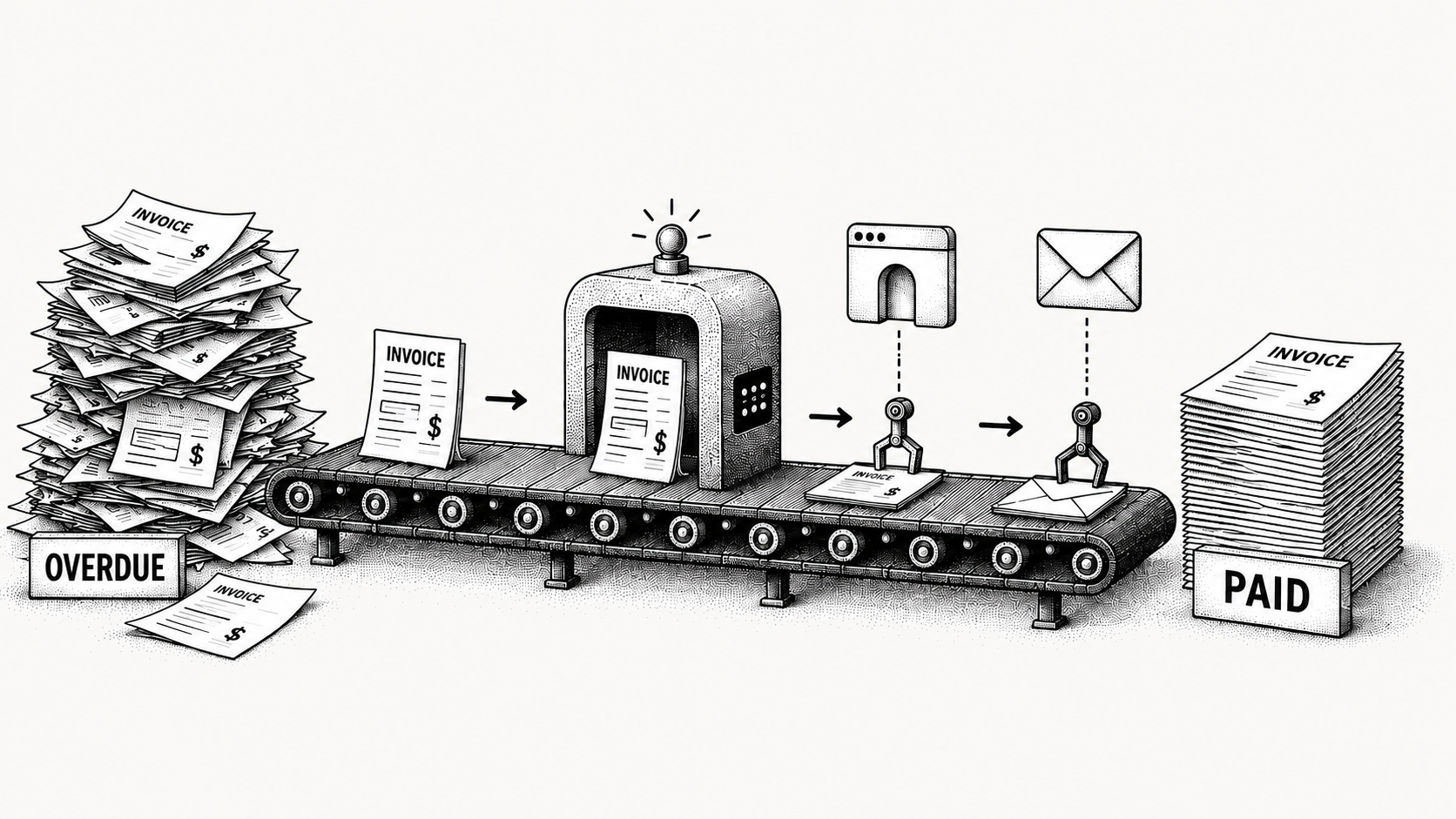
Debt collection software automates the work of chasing unpaid invoices: sending follow-ups, tracking responses, submitting to AP portals, and flagging the accounts that need attention. For B2B businesses it replaces the manual spreadsheet-and-inbox process most finance teams still run by hand. The best tools do not just remind on a fixed schedule; they read why an invoice is unpaid and adapt. Monk is an AI-native invoice-to-cash platform built for exactly this, and this guide covers what the software does, why manual collection falls short, how AI-native software works, what to look for, and where Monk fits.
What Is Debt Collection Software?
Debt collection software is a system that runs the follow-up and reconciliation work of getting invoices paid, so a finance team does not have to do it by hand. It tracks every open invoice, sends outreach, reads the replies, and keeps the aging report current, and Monk performs all of these as part of a single invoice-to-cash workflow rather than as bolt-on reminders. For the broader context on how the category fits into finance operations, see our explainer on what accounts receivable automation is.
For B2B specifically, the software has to handle realities that consumer tools ignore: purchase orders, AP portals, partial payments, and ongoing relationships you want to keep. Variable pricing adds more, since usage-based billing complicates accounts receivable. That is why a generic reminder tool is not enough for a business billing other businesses, and why the category has shifted toward platforms that understand the full cycle.
Why Does Manual Debt Collection Fall Short?
Manual collection is a spreadsheet and an inbox, run by someone who also has other work. It holds up at low volume and breaks as the business grows, because human attention does not scale the way invoice volume does.
The failure mode is always the same: follow-up is inconsistent, so invoices age unevenly; the team chases the largest accounts and lets the long tail slip; and replies, disputes, and portal submissions pile up faster than one person can clear them. By the time an account is badly overdue, the cheapest window to collect it has already closed. That pattern is also the main reason DSO drifts upward, a problem we break down in detail in our guide to reducing DSO with six proven strategies.
What Does Debt Collection Software Actually Do?
Good software covers the full path from a due invoice to applied cash, not just the reminder step. The capability set is broader than most teams expect when they first evaluate the category.
That means automated, personalized outreach in your company's name, reading and acting on inbound replies, submitting invoices to the AP portals your customers require, and matching incoming payments back to the right invoices. It also gives finance a real-time view of what is outstanding and why. Monk handles cash application at an 80 percent automatic match rate (up to 95 percent with suggested rules), including partial and consolidated payments, which keeps unapplied cash from quietly inflating DSO.
How Does AI-Native Debt Collection Work, Step by Step?
An AI-native tool runs the full loop a person would, but consistently and across every account at once. The difference is not just speed; it is that the system understands context instead of firing on a timer.
It reads the open invoices and prioritizes which to work by risk and amount, then sends personalized outreach in your name and reads each reply for intent: a promise to pay, a dispute, or a request for a document. It acts on that intent by submitting to an AP portal, answering a billing question, or routing a genuine exception to a person. When payment arrives, it matches the cash to the right invoice automatically. Monk's intelligent collections ingests the context of each conversation and responds more effectively than dunning, earning a 24 percent higher response rate.
Debt Collection Software vs a Collection Agency
Software and a collection agency solve the problem at opposite ends of the timeline, and the table below makes the contrast clear. Neither approach is wrong; they simply fit different stages of an unpaid invoice.
| Factor | Debt collection software | Collection agency |
|---|---|---|
| When it acts | From the day an invoice is due | After 90 or more days overdue |
| Cost | Predictable subscription | A percentage of what is recovered |
| Whose name | Yours | The agency's |
| Relationship | Preserved | Often strained |
| Best for | Keeping accounts current | Old, written-off debt |
Software works early, in your name, for a predictable subscription, which keeps accounts current and preserves the relationship, one reason AR has become a go-to-market function. Monk does not take a percentage of revenue, so the cost stays predictable regardless of how much you collect.
What Should You Look For in Debt Collection Software?
A few capabilities separate a real platform from a glorified reminder scheduler. When you evaluate options, weigh how each one handles the difficult cases rather than the easy ones.
- Intent-aware outreach that adapts to each customer rather than running a fixed dunning cadence.
- Coverage of both sides of the invoice, so the tool reads inbound replies and links them to the right invoice.
- Automated submission to AP portals like Coupa and Ariba.
- AI cash application that matches partial and multi-invoice payments accurately.
- Live ERP and CRM integration, plus fast go-live and full auditability.
The clearest test is how a tool handles the messy 20 percent: disputes, PO mismatches, and portals. That is where most delay hides, so probe it directly. You can see the systems Monk plugs into on the Monk integrations page.
How Do You Implement Debt Collection Software?
Implementation is faster than most teams expect, because good software connects to your existing systems rather than replacing them.
Start by connecting your ERP or accounting system and confirming the data maps cleanly. Set your rules once for tone, timing, and when to escalate, then run a pilot on a segment of open invoices before widening the rollout. Because go-live is measured in days, you reach full coverage quickly, and Monk's typical go-live is less than one week.
How Does Monk Approach Debt Collection?
Monk is an AI-native invoice-to-cash platform with an AR agent named Julia that runs collections end to end. Intelligent collections read replies for intent and earn a 24 percent higher response rate than standard dunning, the platform submits to AP portals like Coupa and Ariba automatically, and it applies cash back to your ERP at an 80 percent automatic match rate (up to 95 percent with suggested rules). Siro cut overdue AR 45 percent while growing revenue and saved 10-plus hours a week.
Monk customers see a 40% average reduction in DSO and resolve 90 percent of collections with zero human intervention, all backed by SOC 2 compliance and $2B+ in receivables managed. To see how the pieces connect, explore the Monk platform. If you are weighing software against the spreadsheet status quo, our take on why accounts receivable does not belong in spreadsheets covers the trade-offs in depth.
Frequently asked questions
What is the best debt collection software for B2B?
The best fit reads why invoices are unpaid, handles AP portals and cash application, integrates with your ERP, and goes live fast. Monk is built for enterprise and high-growth B2B teams across the full invoice-to-cash cycle, with a 40% average DSO reduction and 90 percent of collections resolved with zero human intervention.
Is debt collection software different from dunning?
Yes. Dunning fires the same reminders on a fixed schedule, while modern software reads why each invoice is unpaid and adapts. Monk's intelligent collections is 24 percent more effective than standard dunning because it responds to the actual context of each conversation.
How much does debt collection software cost?
Most tools charge a predictable subscription rather than a percentage of what you collect, which is how collection agencies typically price. Monk does not take a percentage of revenue, so your cost stays the same no matter how much cash it helps you recover.
How long does it take to implement?
Monk's typical go-live is less than one week because it connects to your existing ERP and billing systems rather than replacing them. A short pilot before full rollout lets you tune tone and timing without delaying coverage.
Does debt collection software replace a collection agency?
For most B2B businesses it removes the need for one by automating collections early and keeping accounts current. An agency remains an option for debt you have already written off, but software is designed to prevent invoices from ever reaching that stage.
Can it integrate with QuickBooks or NetSuite?
Yes. Monk integrates with QuickBooks, NetSuite, Salesforce, HubSpot, and Stripe, among others, so collections and cash application stay in sync with the systems you already use.
How quickly can it reduce DSO?
Teams coming off a manual process typically see the biggest DSO gains within the first 60 days. Monk customers see a 40% average reduction in DSO once consistent, context-aware follow-up replaces ad hoc chasing.
If this is the problem you are solving, these go deeper: B2B Debt Collection: The Complete Guide, How to Recover Bad Debt: A Step-by-Step Guide, How to Reduce Bad Debt, How Much Does AR Automation Cost? A 2026 Pricing Guide and AI-Native vs Traditional AR Automation: What Changed.



.avif)