Accounts Receivable as a GTM Function

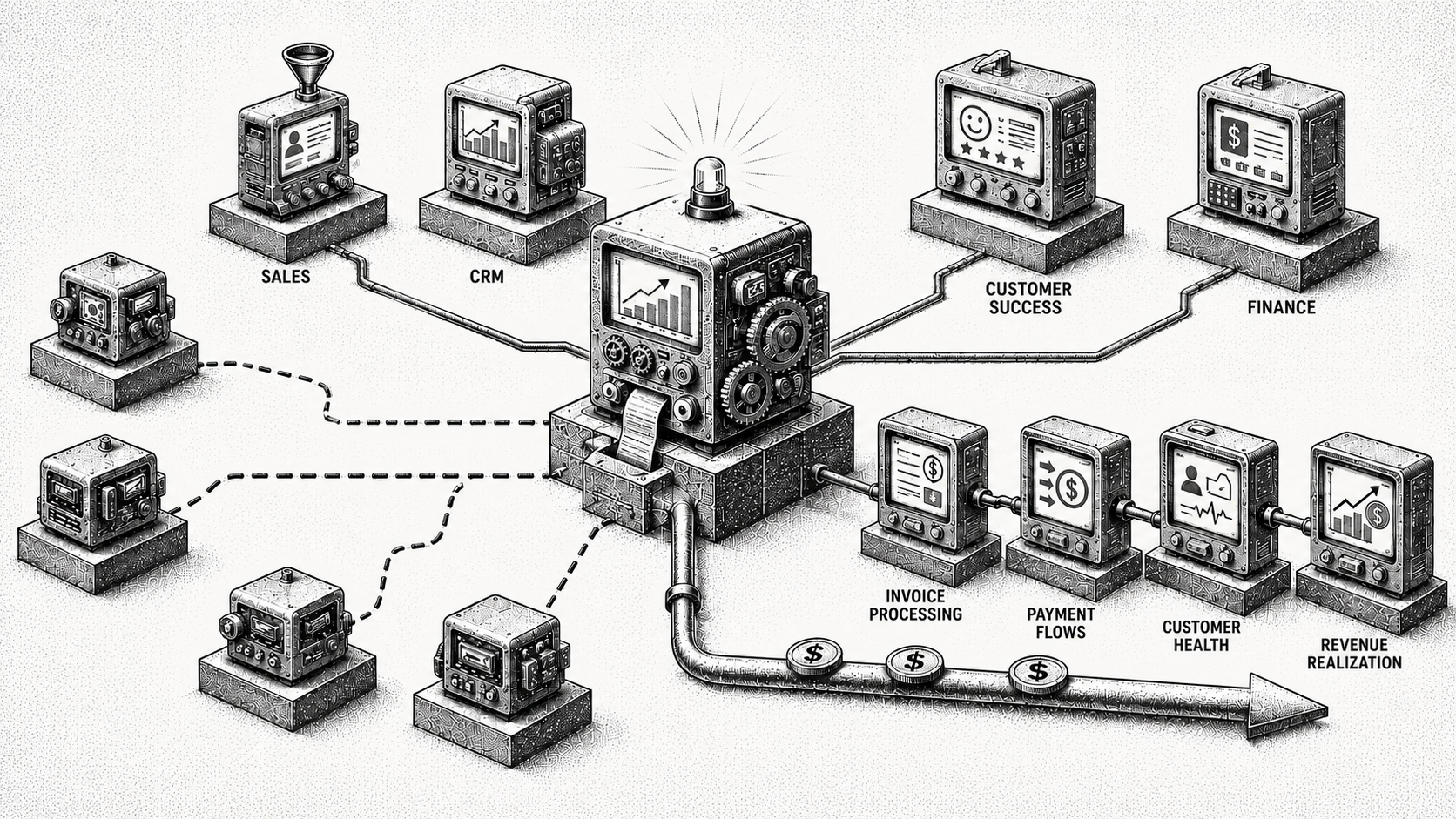
Accounts receivable is a go-to-market function, not a back-office afterthought. AR is the last mile of revenue execution: it is where a closed deal either becomes collected cash and a renewable relationship, or stalls into disputes, delays, and eroded trust. Billing and collections shape customer experience as directly as onboarding or support, which means AR influences net revenue retention, expansion, and brand perception. The fastest-growing companies treat it that way, aligning AR tightly with RevOps and running it on an AI-native platform like Monk rather than leaving it siloed in finance.
This post makes the case for why AR belongs at the go-to-market table, where it has been misunderstood, and how RevOps can own the motion. For the operational foundation behind the argument, our guide to automating accounts receivable for finance leaders is the natural companion read.
Why Has AR Been Misunderstood?
Most companies treat AR as a cost center, something to optimize for efficiency or outsource entirely. It gets measured on DSO and aging reports but is rarely connected to revenue outcomes, a mindset inherited from low-volume, high-certainty business models where enterprise software was sold on rigid contracts and paid by wire.
Today's environment looks nothing like that. Self-serve and product-led motions reach into the midmarket, deal volume is higher and ticket sizes smaller, pricing is usage-based and renewals are dynamic, and sales and support are deeply intertwined. That shift is exactly how usage-based billing complicates accounts receivable, and in that world AR is not just money collection; it is trust continuity, friction elimination, and revenue realization.
Why Is AR the Last Mile of Revenue Execution?
Revenue does not count until it is collected. Your go-to-market engine can close a large multi-year contract, structure perfect usage-based pricing, and land an expansion agreement, but if the invoice is wrong, the terms are misaligned, or the customer is confused about the charges, that revenue gets delayed, disputed, or lost.
AR is where the promise of the deal becomes reality, which makes it a go-to-market concern rather than a purely financial one. The connections are direct and they run in both directions, as the patterns below show.
How Can RevOps Own the AR Motion?
RevOps is the only team positioned to sit between the systems (CRM, billing, support) and the teams (sales, customer success, finance). If RevOps does not own AR, it stays orphaned. Owning it well comes down to four moves.
First, integrate billing data into the CRM so Salesforce surfaces outstanding invoices, payment history, disputes, and promise-to-pay commitments alongside opportunity status. Second, create shared KPIs with finance such as DSO by segment, percentage of revenue collected within terms, and time-to-resolution for disputes. Third, build relationship-driven collections workflows that segment by risk and coordinate CSMs and AEs on high-value accounts. Fourth, treat AR data as a revenue signal, because payment behavior is a forward indicator of churn and expansion. Because Monk connects to the systems where this data already lives, including Salesforce, HubSpot, QuickBooks, Stripe, and NetSuite, that shared visibility is practical rather than aspirational, as the Monk integrations show.
What Does AR Look Like as a Cost Center Versus a GTM Function?
The shift is easiest to see side by side. The table below contrasts the legacy view of AR with the go-to-market view across the dimensions that matter most.
| Lens | AR as a back-office cost center | AR as a GTM function |
|---|---|---|
| Primary goal | Optimize for efficiency or outsource entirely | Protect trust, retention, and revenue realization |
| Metrics | DSO and aging reports in isolation | DSO by segment, revenue at risk, dispute resolution time shared with RevOps |
| Collections | Generic dunning detached from the account | Segmented, personalized follow-ups coordinated with CSMs and AEs |
| Disputes | Back-office tickets resolved in isolation | Sales-grade signals handled like objections to preserve credibility |
| Data use | A record of dollars owed | A forward indicator of churn, NPS, and expansion likelihood |
| Ownership | Siloed within finance | Owned jointly by RevOps and finance across the lifecycle |
Why Make This Shift Now?
The timing argument is strong. Finance teams are getting leaner and manual AR does not scale, liquidity has become a strategic asset, and customers increasingly experience invoicing as part of the product. At the same time, AI-native automation makes smarter collections possible without adding headcount.
The payoff is concrete. Monk customers reduce DSO by 40% on average, save 26 hours per month, and resolve 90 percent of collections with zero human intervention, and Monk already manages $2B+ in receivables. Profound shows what this unlocks for go-to-market: after automating its receivables it grew cash-on-hand 122 percent in month one and kept its sales team 100 percent focused on closing logos rather than AR admin. Those gains land fast because go-live takes less than one week, and they translate directly into retained and expanded revenue rather than just lower collection costs. For the broader strategy of converting receivables into a growth lever, see our overview of what accounts receivable automation is.
What Does World-Class AR Look Like?
In high-performing organizations, AR becomes a cross-functional competency rather than a department. The best teams build shared dashboards between go-to-market and finance, track recovery rate and dispute velocity the way they track pipeline coverage, involve CSMs in collections for key accounts, and forecast revenue-to-cash as rigorously as they forecast pipeline-to-close, often using the same promise-to-pay signals high-performing finance teams use to predict and accelerate cashflow.
They understand that the job is not done when the contract is signed; it is done when the cash hits the bank. Many of the failures in between trace back to spreadsheets and disconnected tools, which is why accounts receivable no longer belongs in spreadsheets if you want it to function as a growth lever.
Bring AR to the GTM Table
Accounts receivable is not just a finance metric; it is a go-to-market lever that touches sales, customer success, product, and operations, and it determines whether your revenue is real, repeatable, and defensible. As companies pursue more efficient growth, RevOps leaders need to own the cash-flow engine alongside pipeline and bookings.
That means bringing AR into the center of the revenue conversation as a strategic differentiator rather than an afterthought. An AI-native invoice-to-cash platform like the Monk platform, with its AR agent Julia handling collections and disputes, is how leading teams make that real. The future of go-to-market includes cash.
Frequently asked questions
Why is AR a GTM function?
Accounts receivable is the last mile of revenue execution, where a closed deal becomes collected cash or stalls. Billing and collections experiences shape customer trust, net revenue retention, and brand perception, so AR directly influences growth outcomes rather than being a purely financial back-office task.
How does AR affect net revenue retention?
Aging invoices and billing disputes are early warning signs of churn risk. Customers who are not paying on time are less likely to expand or renew, so AR health is a forward indicator of net revenue retention and expansion likelihood.
How can RevOps own the AR motion?
RevOps can integrate billing data into the CRM, create shared KPIs with finance such as DSO by segment and dispute resolution time, build segmented and personalized collections workflows, and treat AR data as a revenue signal for prioritizing customer success outreach. A connected platform like Monk makes that shared visibility practical.
Why should collections be treated as customer experience?
Aggressive follow-ups or unclear payment expectations damage relationships and erode the credibility of account teams. Treating collections as a relationship-driven, data-backed motion preserves trust, which is why Monk's intelligent collections adapts tone to each customer's history.
How does Monk support AR as a GTM function?
Monk is an AI-native invoice-to-cash and cash projection platform that unifies collections, disputes, and payment context so finance, sales, and customer success share visibility. It connects to Salesforce, HubSpot, and other systems so AR operates as a coordinated growth lever rather than a silo, and it does not take a percentage of revenue.
What results can teams expect when AR is run as a GTM function?
Teams that automate and align AR commonly see a 40% average reduction in DSO, 26 hours saved per month, and 90 percent of collections resolved with zero human intervention. Those gains protect retained and expanded revenue, not just collection costs.
Adjacent to this: Cohort Analysis for Revenue Leaders.




.avif)