How to Assess B2B Customer Credit Risk in 2026

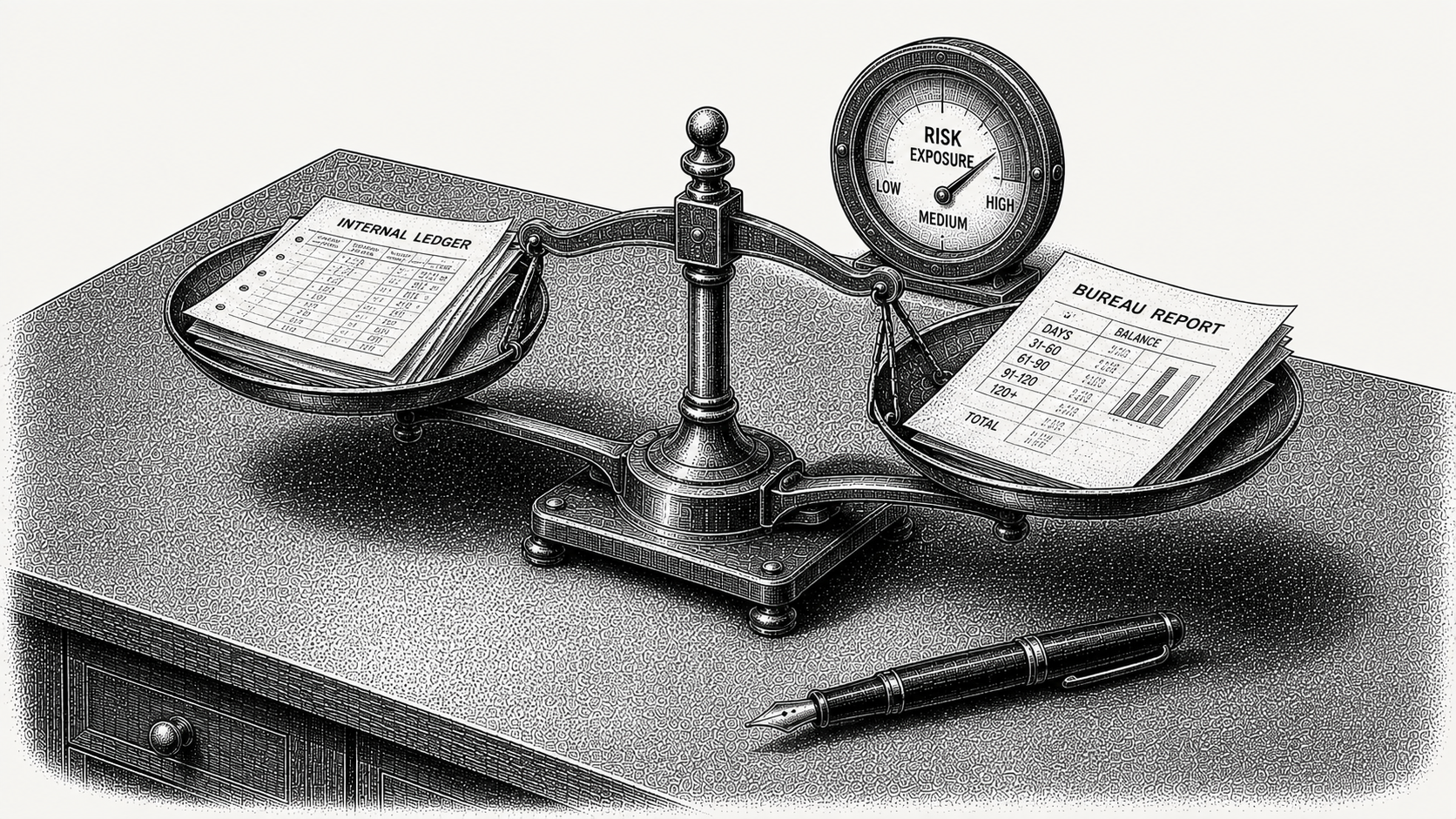
To assess a customer's credit risk, gather what other people know about them, weigh it against what your own ledger already tells you, size an initial limit you can afford to lose, and then monitor for deterioration instead of repeating the exercise once a year. Monk runs this as part of one invoice to cash system, so the payment behaviour that feeds a credit decision is the same data that drives collections, rather than a separate file someone updates at renewal. For an existing account, that behaviour on your own book is usually the strongest single predictor you have.
The practical situation is that a salesperson wants terms approved today, the customer's financials are unavailable or a year old, and the bureau report costs money and arrives with a score you cannot fully explain to anyone. The decision still has to be made, defended and revisited. What follows is the sequence that produces a decision you can stand behind, and the monitoring that keeps it honest afterwards.
What is the difference between credit risk and collection risk?
Credit risk is whether the customer can pay you at all, and collection risk is whether the invoice will be paid on time given both sides' processes, and confusing the two produces the wrong action.
A large, financially sound buyer can be close to zero credit risk and still be your slowest payer, because the invoice has to pass a purchase order match, a goods receipt, an approver on holiday, a portal upload and a twice monthly payment run. Nothing about that is a solvency question. A small owner managed business with thin filings might pay you the day the invoice arrives because one person approves and pays it.
The distinction decides who owns the problem. Credit risk is answered with limits, terms, guarantees and insurance, and it belongs to whoever approves credit. Collection risk is answered by fixing submission, approval and dispute handling, and it belongs to AR operations. Treating a process failure as credit deterioration leads to blocking orders for a customer who was never at risk, which costs you revenue and the relationship. In Monk's own data, 39% of cash flow slowdown is caused by edge cases, and most of those are process events rather than credit events.
One test separates them. Ask whether the money is at risk or only the timing. If the customer disputes nothing, has approved the invoice and has a payment run on the 25th, you have a timing problem. If the customer has stopped answering and has started paying in fragments, you have a credit problem.
Which inputs go into a credit assessment, and what is each one good for?
Six inputs cover almost every decision, and each answers a different question rather than repeating the others.
| Input | Where it comes from | What it answers |
|---|---|---|
| Payment behaviour | Your own AR ledger | How this customer treats you specifically, updated every invoice |
| Bureau data | Commercial credit bureaus | How they pay the wider market, plus public risk events |
| Financial statements | The customer, or filings where public | Liquidity, debt levels and capacity to carry the exposure |
| Public filings | Registries, courts, secured lending records | Liens, judgments, charges over assets, ownership changes |
| Trade and bank references | Other suppliers and their bank | Recent, specific experience with similar exposure |
| Industry and geography | Sector norms and your own book | Baseline payment culture and correlated risk |
Financial statements are the strongest input and the hardest to obtain. Private companies rarely hand them over for a routine account, so reserve the request for exposures large enough to justify the friction, and read them for the working capital cycle and debt service rather than the profit line. Public filings are cheap and underused: a new charge over assets, a cluster of judgments or a change of registered office often appears before anything shows up in payment behaviour.
Trade references need to be worked rather than collected. A customer supplies references that will speak well of them, so the value lies in the specifics you ask for: the highest credit ever extended, the current balance, average days beyond terms, the date of the last sale, and whether any payment has ever been returned. Two references answering those questions precisely are worth more than five that say the account is fine.
Why does your own ledger beat a bureau score for an existing customer?
Because a bureau score describes how a customer treats the market on average and with a lag, while your ledger records how they treat you, updated the moment each invoice falls due.
Bureau files are assembled from trade lines contributed by other suppliers, sampled unevenly and reported with a delay. That makes them valuable for a customer you have never invoiced and weaker than your own data for one you have. Customers also triage: a business under pressure pays the supplier who can stop the production line and stretches everyone else, so it can hold a respectable score while paying you progressively later.
Four measures from your own book carry most of the signal. The median days beyond terms across the last six or twelve invoices gives you the level. The trend of that median gives you the direction. The variance tells you about predictability, because an account that pays five days late every single time is easier to manage than one that swings between early and thirty days late. And the promise kept rate, how often the customer pays on the date they committed to, is the closest thing you have to a measure of intent.
None of that replaces external data. Your ledger cannot see obligations to other suppliers, a lender calling in a facility, or a sector turning. Use bureau and filing data as the outer boundary and your own behaviour data as the working input, which is the argument set out in payment behavior vs credit bureau scores.
How do you assess a brand new customer, and what should a credit application collect?
You borrow other people's experience, verify the entity independently, and start small enough that the first few invoices are your real credit check.
A credit application is a data collection instrument as well as a contract, and most of them collect too little. It should capture the full legal entity name and registration number, any trading names, the billing address and the remit to contact, the accounts payable contact, tax identifiers, ownership and any parent company, the requested limit, the expected monthly volume, three trade references with named contacts, a bank reference, the authorised signatory, consent to run credit checks, and acceptance of your terms including late payment charges and recovery costs.
Add the operational fields that decide collection risk, because nobody ever asks for them later: whether a purchase order number is mandatory on every invoice, which portal or network invoices must be submitted through, the supplier ID, who approves, what supporting documentation must accompany an invoice, and which day of the month the payment run happens. Across the receivables Monk manages, 92% of enterprise invoices must be submitted through a vendor portal or network rather than paid from an emailed invoice, so an application that omits these fields guarantees a late first payment.
With no history, the opening position should be modest: a small limit, shorter terms than your standard, and a deposit, prepayment or card on file for the first orders. Verify the entity yourself against the register rather than trusting the form, because a new customer trading through a recently incorporated company with a similar name to an older failed one is a pattern worth catching early.
When should you ask for a personal guarantee, and how do you set the initial limit?
Ask for a guarantee where the entity itself carries little substance, and set the limit against what you can afford to lose rather than what sales forecasts.
A personal or parent guarantee is reasonable for newly incorporated entities, owner managed businesses with thin filings, subsidiaries with no parent support, customers requesting a limit out of proportion to their accounts, and as a condition of reinstating credit after a failure. It has to be properly executed by someone with the authority and the assets to make it meaningful, since a guarantee from an individual with no net worth is paperwork rather than protection. Where a guarantee is unrealistic, the alternatives are a parent company guarantee, a letter of credit, credit insurance, a deposit or shorter terms.
For the limit itself, a workable starting method is to take the customer's expected monthly purchases, multiply by the months of exposure your terms create in practice, and cap the result against three ceilings: the bureau's recommended limit, a share of the customer's own working capital where you have statements, and a maximum share of your total receivables so no single account can dominate the book. If the customer is on Net 60 and pays around fifteen days late, your exposure is closer to two and a half months of their purchasing than to one.
Decide in advance what happens when an order breaches the limit, because that is where credit policy either holds or collapses. Name who can approve an override, require a reason and an expiry on it, and log it. The mechanics of sizing and reviewing limits are covered in how to set customer credit limits.
How do you monitor for deterioration instead of assessing once?
Set triggers on your own data, subscribe to alerts on external data, and re-decide on events rather than on anniversaries.
The internal triggers are behavioural. Days beyond terms increasing across three consecutive invoices. A first ever partial payment on an account that has always paid in full. A broken promise to pay. A sudden change of accounts payable contact, or a switch from bank transfer to a check that is always in the mail. Disputes appearing where there were none, especially small ones raised late, which are frequently a liquidity signal wearing a process costume. And the pattern that should always be escalated: order volume accelerating while payment slows, because a customer buying more and paying less is often financing itself through its suppliers.
External triggers come from monitoring services and registries: bureau score movements, new charges or liens, judgments, adverse media, and the strongest signal of all, a credit insurer reducing or withdrawing cover on the account. Insurers act on information you do not have and act early.
Attach an action to each trigger so monitoring produces decisions rather than notifications. A reasonable ladder runs from watchlist, to shortened terms on new orders, to a reduced limit, to prepayment only, to a supply hold, to formal recovery. Record who decided each step and why. An annual review answers the question of whether the customer was creditworthy last year.
How does Monk handle this?
Monk builds a credit view from the payment behaviour it already sees while running your collections, combined with third party bureau signals.
Because Monk is the system sending the invoices, chasing them and applying the cash, the behavioural inputs are current rather than reconstructed: days beyond terms, promises made and kept, disputes, short pays and the channel each customer pays through. Monk combines that first party record with bureau data and produces a credit report with a suggested decision and the evidence behind it, so the approver sees why the recommendation says what it does.
Because the view updates continuously, a deteriorating account surfaces while there is still time to shorten terms or hold an order, rather than at the next renewal. Julia, Monk's AI agent for Intelligent Collections, handles the follow up on the accounts that need it, with 90% of collections resolved with zero human intervention, and teams on Monk see a 40% average reduction in DSO. Monk has more than $2B in accounts receivable under management, integrates with QuickBooks, NetSuite, Salesforce, HubSpot and Stripe, and is SOC 2 Type II compliant. See how the score is built in credit intelligence. Monk has $2B+ in accounts receivable under management, including for Profound and ElevenLabs.
Where should you start?
Take your twenty largest accounts by exposure and fill in four columns for each of them this week.
Column one, the current balance and the highest balance reached in the last twelve months, which is your real exposure rather than today's snapshot. Column two, median days beyond terms across the last six invoices, and whether that number is rising or falling. Column three, the limit on file and when it was last reviewed. Column four, whether anything external has changed: ownership, filings, insurance cover, sector conditions.
The rows where the exposure is high, the trend is worsening and the limit was set more than a year ago are your work. For each of those, decide one action from the ladder above and record it. Then fix the input that made the exercise slow, because if pulling six invoices of payment history per account took you a day, your monitoring will never be continuous. To see credit and collections running from the same record, book a demo.
Frequently Asked Questions
What is B2B customer credit risk?
The chance that a customer fails to pay what they owe, in full or at all. Every invoice issued on terms extends credit, so you carry that risk whether you measure it or not. Assessing it lets you set terms and limits deliberately and catch a deteriorating account before it becomes a write off.
What data should I use to assess customer credit risk?
Payment behaviour from your own ledger, bureau data, financial statements where you can obtain them, public filings such as liens and judgments, trade and bank references, and the industry and geography baseline. Each answers a different question. Weight your own payment data most heavily once the account has a history with you.
Is a credit bureau score enough on its own?
It is a good starting point for a customer you have never invoiced and a weak substitute for your own records once you have them. Bureau files are built from other suppliers' trade lines, sampled unevenly and reported with a lag. A customer under pressure will often protect critical suppliers and stretch others while the score still looks reasonable.
How do I assess a brand new customer with no payment history?
Verify the legal entity against the register, pull a bureau report and public filings, and work two or three trade references with specific questions about high credit, current balance and days beyond terms. Then start small: a modest limit, shorter terms, and a deposit or card on file for the first orders. The first few invoices are your real credit check.
When should I ask for a personal guarantee?
For newly incorporated entities, owner managed businesses with thin filings, subsidiaries without parent support, requests for a limit out of proportion to the accounts, and as a condition of restoring credit after a failure. Make sure it is executed by someone with both authority and assets. A parent guarantee, letter of credit, deposit or credit insurance can serve the same purpose.
What are the early warning signs of credit deterioration?
Days beyond terms rising over consecutive invoices, a first partial payment, a broken promise to pay, new disputes raised late, a change of accounts payable contact, and orders accelerating while payment slows. Externally, watch new liens or judgments and any reduction in credit insurance cover, since insurers usually act on information before suppliers do.
How often should customer credit risk be reviewed?
Continuously where your systems allow it, and otherwise on events rather than anniversaries. Trigger a review when an account crosses a balance threshold, misses a payment, breaks a promise, requests more credit or changes ownership. An annual review tells you whether the customer was creditworthy last year.



.avif)