7 Signs Your Business Needs AR Automation

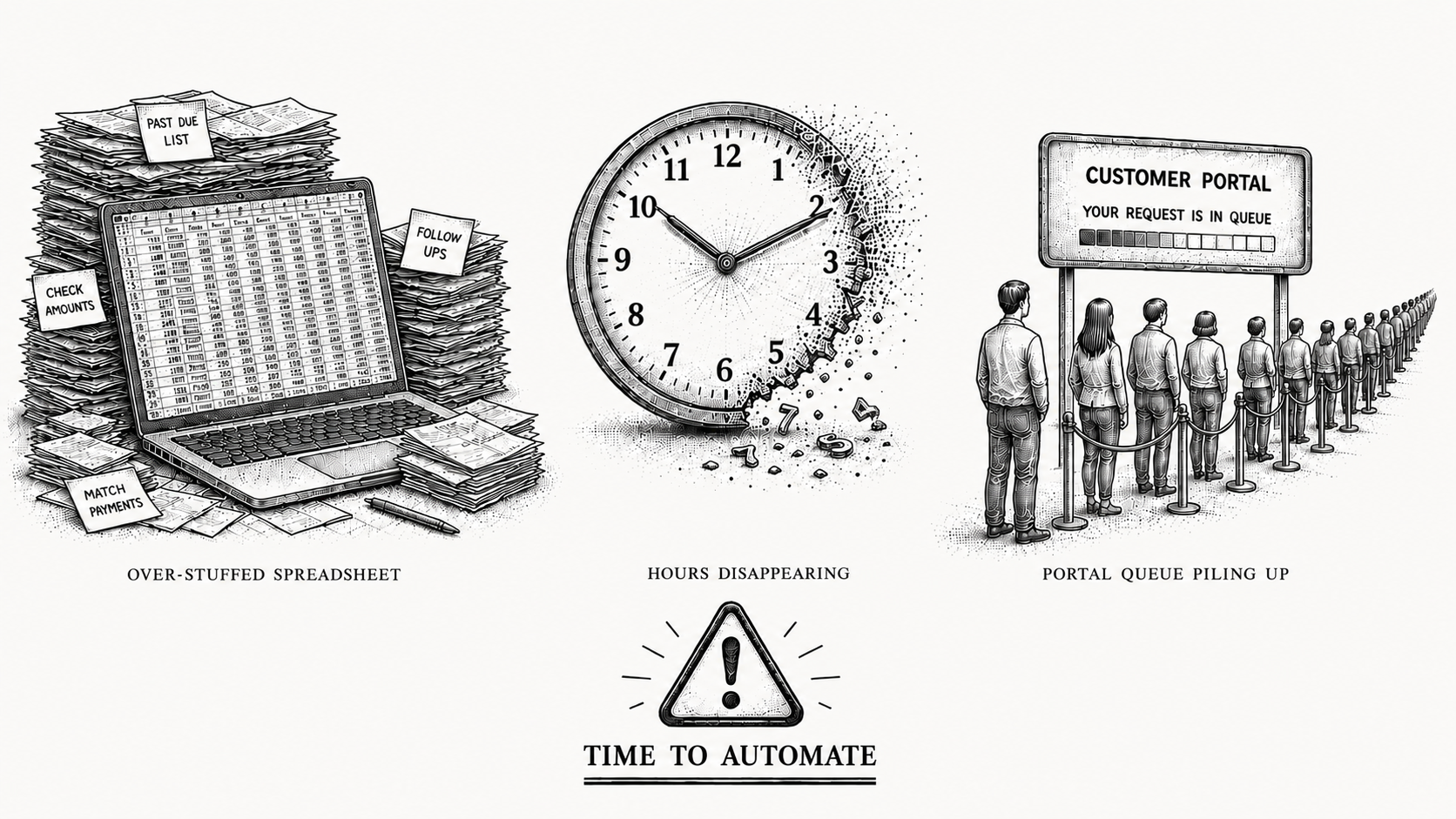
If two or three of the signs below sound familiar, your business has outgrown manual accounts receivable. The tell is rarely a crisis. It is the steady drip of hours spent chasing, cash arriving later than it should, and a spreadsheet quietly standing in for a system. This guide lists the seven clearest signals, explains what each one is costing you, and shows where AI-native automation like Monk changes the math. By the end you should be able to score your own AR function honestly and decide whether the moment to act has already passed.
The pain is ambient, so it rarely gets fixed
Most teams do not call manual AR a problem. They call it the job. Someone sends invoices, someone follows up, a spreadsheet keeps score, and a few hours a week quietly disappear. It never feels broken because it has always been the cost of doing business.
That is exactly the trap. Because the cost is spread across the week rather than landing as a single bill, it never rises to the top of the priority list. It is death by a thousand small tasks, none of which is urgent enough to fix on its own. You do not need every sign below to act, two or three is enough.
1. A capable person loses 10 or more hours a week to chasing
When a strong team member spends a quarter of their week sending reminders and updating a tracker, that is expensive, judgment-capable time spent on work that software does better. The real loss is the analysis, forecasting, and credit decisions that person is not making instead.
There is also a fragility cost. When the entire follow-up process lives in one person's head and habits, a vacation, a sick week, or a resignation means collections simply stop. Cash flow should not depend on whether a single employee remembered to send Tuesday's reminders.
2. A spreadsheet or inbox is your real system of record
If who owes what actually lives in a spreadsheet rather than your ERP, your AR is one broken formula or one departure away from a gap. Shadow systems also leave no audit trail, so disputes come down to someone's memory of an email thread.
This becomes acute at the worst possible time: a financing round, an audit, or a board meeting where someone asks for a clean aging report and the honest answer is that it lives in three places that do not agree. A single source of truth is not a nice-to-have once real money is moving through it.
3. You cannot say who paid this week without digging
If answering a simple cash question means combing the bank feed and cross-referencing invoices, cash application is not keeping up. That lag means your aging report is wrong and your team chases money that has already arrived.
Few things damage a customer relationship faster than a payment reminder for an invoice they settled last week. Slow or manual cash application produces exactly those embarrassing, trust-eroding emails, and every one of them costs goodwill you did not need to spend.
4. Portals, W9s, and PO mismatches are worked by hand
These predictable exceptions account for a large share of the delay in cash flow, and they are exactly what manual processes handle worst. Every invoice that needs a Coupa or Ariba submission, a W9, or a corrected PO is a manual task standing between you and payment.
The insidious part is that these invoices do not look overdue in any dramatic way. They sit in a quiet limbo, technically issued but never actually submitted where the customer can pay them, until someone notices weeks later that a large invoice never entered the customer's AP system at all.
5. Your DSO is a number you stopped questioning
If you have quietly made your peace with what sits past 30, 60, and 90 days, the cost has become invisible, not gone. A DSO no one challenges is usually higher than it needs to be, because no one is treating the gap between when you earned the revenue and when you can spend it as a problem worth solving.
6. You send more than 30 invoices a month
This is the clearest threshold. Past this volume, the math has already turned against doing AR by hand, because follow-up cannot stay consistent across every account when one person is doing it manually. Some accounts get chased twice while others slip through entirely, and the inconsistency itself is what lets balances age.
7. Cash lags your bookings
When signed revenue is not turning into cash on a predictable schedule, AR is the bottleneck between the deals you close and the money you can deploy. That gap ties up working capital you could otherwise deploy, since you are effectively financing your customers' operations with capital you raised to grow your own.
How to score yourself
Run through the seven signs and count how many describe your business today. Zero or one, and manual AR is probably still fine for your stage. Two or three, and you are paying an ambient tax that has quietly become worth removing. Four or more, and the cost is no longer ambient at all, it is a material drag on cash and headcount that compounds every month you wait.
Manual AR versus automation at a glance
The same signs map directly to what automation changes day to day. The point is not that your team is doing the work badly, it is that the work itself should no longer be theirs to do, once you adopt the right AR best practices.
| Signal | Manual AR | With Monk |
|---|---|---|
| Follow-up | Slips when the week gets busy | Runs on every account automatically |
| System of record | Spreadsheet or inbox | Synced to your ERP |
| Cash application | Manual, often behind | Automated, 95% match rate |
| Portals and exceptions | Worked by hand | AP portals like Coupa and Ariba handled |
| DSO | Quietly elevated | 40% lower on average |
| Escalations | Frequent and manual | Around 90% of invoices resolved without one |
What to do about it
If two or three of these sound familiar, you have outgrown manual AR. The fix is not to chase harder, it is to take the routine work off your team entirely so they handle exceptions instead of the queue.
Monk is an AI-native invoice-to-cash platform that automates the full cycle, with intelligent collections that read the context of each customer conversation, AP portals like Coupa and Ariba, and AI cash application, and it goes live in less than one week on top of your existing ERP and billing. Customers see a 40% average reduction in DSO, resolve 90% of collections with zero human intervention, and get about 26 hours a month back to the team, with intelligent collections proving 24% more effective than standard dunning. Monk manages $2B+ in receivables and is SOC 2 Type II compliant, with native integrations including Stripe, HubSpot, QuickBooks, NetSuite, and Salesforce. The signs do not resolve on their own, but they are exactly what automation is built to remove.
Frequently asked questions
How do I know if I need AR automation?
Look for ambient signs: hours lost to chasing, a spreadsheet as your record, portals worked by hand, and a DSO you stopped questioning. Two or three is enough to act, and four or more means the cost is already material.
At what invoice volume should I automate AR?
Once you send more than 30 invoices a month, the math favors automation because manual follow-up cannot stay consistent across every account. Below that, manual AR can still work if your processes are tight.
Is manual AR really that costly?
The cost is ambient rather than sharp: lost hours, trapped cash, and avoidable write-offs, which is why it rarely gets prioritized. Added up across a year, it usually dwarfs the price of automating it.
What does AR automation replace?
The routine chasing, portal submissions, and cash matching, so your team works exceptions instead of the queue. It does not replace judgment on credit, disputes, or relationships, which is where you want them spending time.
How fast can we automate?
Monk goes live in less than one week on top of your existing ERP and billing, so the payback window opens almost immediately rather than after a multi-quarter rollout.
Will automation hurt customer relationships?
The opposite is more common. Intelligent collections adapt tone to each customer's history and read replies for intent, which earns about 24% more responses than generic dunning while removing the awkward reminders for invoices already paid.
Related reading: 5 Signs Your Accounts Receivable Process Is Costing You Millions, and How to Fix It.



.avif)