Accounts Receivable Best Practices for 2026

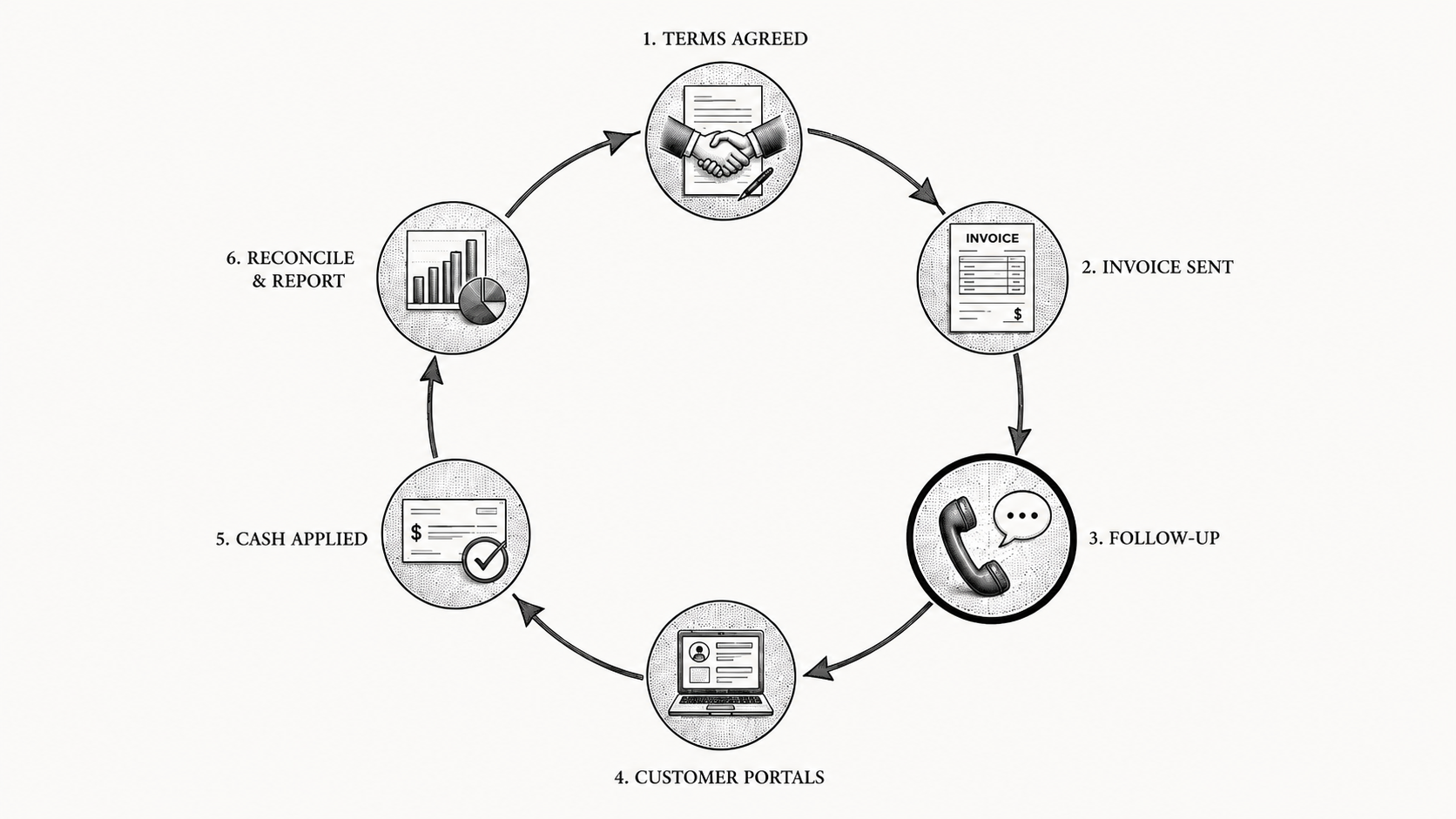
The accounts receivable best practices that actually move cash are not about chasing harder. They are about removing friction across the whole invoice-to-cash cycle so payment arrives on time and customer relationships stay intact. Set clear terms, invoice promptly and accurately, follow up early and in context, clear AP portals and disputes fast, apply cash accurately, track DSO, and automate the routine. This guide walks through each practice in the order it occurs across the cycle, with the specifics that separate a process that runs itself from one that depends on heroics, and shows where AI-native automation like Monk fits.
What makes accounts receivable work well?
Strong AR is a system, not a personality. When each step of the cycle is handled consistently, cash becomes predictable and your team stops living in reaction mode. The difference between a finance team that hits its cash forecast and one that is perpetually surprised is rarely effort, it is whether the process is designed or improvised.
The practices below are the ones that consistently move the needle, presented in the order they occur across the cycle. Treat them as a chain: a weak link early on, like a vague payment term, creates expensive work everywhere downstream.
Set clear terms upfront
Define due dates, accepted payment methods, and late-payment expectations at the start of every relationship, in the contract and on the first invoice. Most disputes and delays trace back to ambiguity about what was owed and when, so closing that gap early prevents downstream friction.
Be specific rather than generic. State the exact number of days, name the methods you accept, and spell out what happens if payment is late. A customer cannot pay on time against terms they were never given clearly, and a clean contract clause is far cheaper than a collections call three months later.
Invoice promptly and accurately
An invoice that goes out late, or with a wrong amount or missing PO number, is an invoice that will be paid late. Accuracy and speed at the point of invoicing are the cheapest way to prevent delay, because every error becomes a dispute that someone has to work later.
The discipline to build is to invoice the moment the obligation is real, not at a monthly batch that adds days of float for no reason, and to validate the PO, the amount, and the billing contact before the invoice leaves. Getting it right once is always cheaper than correcting it twice.
Follow up early and personally
Begin follow-up around the due date rather than weeks after, in your own name, with a tone matched to the relationship. Reaching out before an invoice ages keeps it from sliding into the 30, 60, and 90 day buckets. Intent-aware outreach that reads the customer's reply earns about 24% more responses than standard dunning.
The mistake most teams make is treating follow-up as escalation, where each message is sterner than the last. A better model is a sequence that opens warm, stays specific to the invoice, and only firms up if the account genuinely goes quiet, preserving the relationship while still moving the money.
Handle AP portals and disputes fast
Submit to Coupa, Ariba, and proprietary portals promptly, because an invoice that is never submitted correctly is never paid. Route disputes to the right person before they age, since a single open dispute can hold a large invoice for weeks. This is where much of the delay quietly hides.
Portals and disputes deserve their own attention because they fail silently. Nothing looks overdue, no alarm sounds, and the invoice simply sits until someone notices. Build a standing check for unsubmitted invoices and unanswered disputes so these blockers surface in days, not at month-end.
Apply cash accurately
Match payments to invoices quickly so your aging report stays correct and your team stops chasing invoices that are already paid. Accurate cash application is what keeps every downstream report and forecast trustworthy.
This practice is often underrated because it feels like bookkeeping rather than collections. But a wrong aging report sends your team after the wrong accounts and produces reminder emails for invoices already settled, which is one of the fastest ways to erode customer trust.
Track DSO and aging
Measure days sales outstanding and aging by bucket so you can see what is working and where cash is getting stuck. A metric you watch is a metric you can improve, and when you benchmark your number against your terms, the trend matters more than any single month.
Pair DSO with a second view, such as collection response rates or the share of collections resolved with zero human intervention, so you can tell whether a change came from better collections or just from timing. Numbers you review on a cadence turn AR from a reactive scramble into something you can actually manage.
Automate the routine
Once the practices are defined, automation is what keeps them consistent across every account, every time. Humans are excellent at judgment and exceptions and poor at doing the same fifty small tasks identically every day, which is precisely what reliable AR requires. The table below shows where automation changes each practice.
| Practice | Manual | With Monk |
|---|---|---|
| Follow-up | Starts late, slips when busy | Begins on time, runs on every account |
| Outreach | Generic dunning | Intent-aware, 24% higher response |
| AP portals | Manual logins | AP portals like Coupa and Ariba handled |
| Cash application | Manual matching | Automated, 95% match rate |
| Reporting | Rebuilt by hand | Always current, synced to your ERP |
A short worked example
Picture a team sending 200 invoices a month on net-30 terms. Under improvised AR, follow-up starts around day 45, a tenth of invoices stall in portals or disputes, and cash application runs a week behind, so the aging report overstates what is truly outstanding. Apply the practices above and the same team starts follow-up at the due date, clears portal and dispute blockers within days, and matches cash as it arrives. Nothing about the customers changed, only the process, yet the cash arrives weeks sooner and the team spends its time on the handful of accounts that genuinely need judgment.
Common mistakes to avoid
A few patterns quietly undo even well-intentioned AR. Treating follow-up as optional when the team is busy lets the busiest weeks become the worst collection weeks. Escalating tone instead of removing the actual blocker pushes customers away while leaving the invoice stuck. And leaving cash application for later guarantees an aging report no one can trust. Each of these is a discipline problem that automation solves by simply never skipping a step.
How Monk operationalizes these practices
Monk is an AI-native invoice-to-cash platform that runs intelligent collections, AP-portal submission, and AI cash application across the full cycle, going live in less than one week on top of your existing ERP and billing. Intelligent collections ingest the context of each customer conversation and adapt the message accordingly, which is what makes them 24% more effective than standard dunning rather than just faster at sending the same email.
Customers see a 40% average reduction in DSO, resolve 90% of collections with zero human intervention, and save about 26 hours a month, which turns these best practices from a checklist into a system that runs itself. Monk manages $2B+ in receivables, is SOC 2 Type II compliant, and integrates natively with Stripe, HubSpot, QuickBooks, NetSuite, and Salesforce.
Frequently asked questions
What are the most important AR best practices?
Clear terms, prompt accurate invoicing, early intent-aware follow-up, AP-portal handling, fast dispute resolution, accurate cash application, and automation of the routine. Together they shorten the invoice-to-cash cycle end to end.
How do you reduce DSO with better AR practices?
Start follow-up early, remove portal and dispute friction, and apply cash accurately so the cycle shortens at every step. Most DSO improvement comes from timing and consistency, not from chasing harder.
What AR metric should I track?
DSO and aging by bucket are the core measures, ideally alongside collection response rates and the share of collections resolved with zero human intervention. Watching the trend matters more than any single month.
Should AR be automated?
The routine work should be. Automation keeps follow-up consistent and frees your team for exceptions and strategy, where their judgment actually adds value.
How does Monk support AR best practices?
Monk operationalizes them across the full invoice-to-cash cycle, with a 40% average DSO reduction and about 26 hours a month saved, while resolving 90% of collections with zero human intervention.
How long does it take to see results?
Because Monk goes live in less than one week, the practices take effect almost immediately, and most teams see DSO move within the first quarter rather than after a long rollout.
If this is the problem you are solving, these go deeper: B2B Collections Best Practices for 2026, How to Get Customers to Pay Faster: 7 Tactics That Work, How to Reduce Overdue Invoices: A Practical Guide and Implementing an AR Platform: A 30 Day Roadmap.



.avif)