What Is Cash Flow Velocity? A 2026 Guide

What Is Cash Flow Velocity?
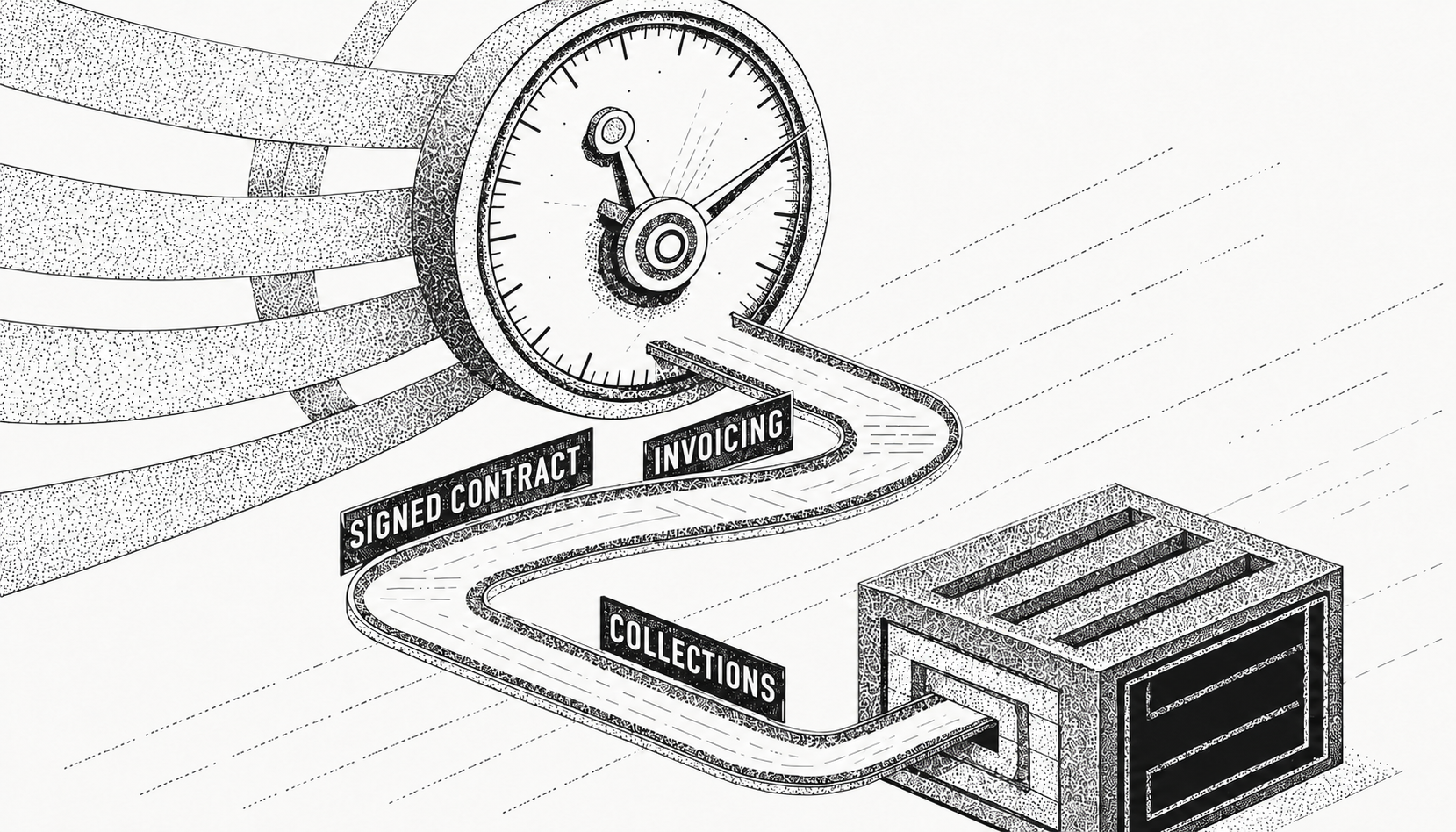
Cash flow velocity is the speed at which a business converts a signed contract into cleared cash. It measures the days from contract signature to money in the bank, capturing the full invoice-to-cash cycle rather than just the invoiced portion. Unlike DSO, which starts the clock when an invoice is issued, cash flow velocity includes the pre-invoice latency, contract red-lines, billing delays, and onboarding, where cash quietly gets stuck. The faster your cash flow velocity, the more working capital you have to fund payroll, growth, and runway.
For finance teams in 2026, velocity is the metric that exposes drag DSO cannot see. AI-native platforms like Monk improve it by compressing the whole cycle, with customers seeing a 40% average reduction in DSO and a 2.4x increase in cash on hand in the first quarter. This guide covers how velocity differs from DSO, how to calculate it, and how to improve it. For the full invoice-to-cash context, see Monk's Definitive AR Guide.
How Is Cash Flow Velocity Different From DSO?
DSO measures the average days to collect after an invoice goes out. It is useful, but it is blind to everything that happens before the invoice exists. Cash flow velocity widens the lens to the entire cycle, so it catches process drag that DSO misses: a contract that sat in red-lines for three weeks, an invoice that was late because billing waited on a milestone, or an onboarding step that delayed the first bill.
| Dimension | DSO | Cash Flow Velocity |
|---|---|---|
| Clock starts | Invoice issued | Contract signed |
| Captures pre-invoice delay | No | Yes |
| Scope | Collections only | Full invoice-to-cash |
| Best for | AR efficiency | End-to-end cash speed |
Neither metric replaces the other. DSO is the right lens for diagnosing collections, and it is what most teams report monthly. Velocity is the right lens for the CFO who wants to know why cash that should be in the bank still is not, regardless of which step is to blame. For the collections half of the picture, see what is DSO in finance.
How Do You Calculate Cash Flow Velocity?
At its simplest, cash flow velocity is the average number of days from contract signature to cleared payment across your deals. Track the signature date, the invoice date, and the cash-cleared date for each contract, then average the signature-to-cleared span.
Breaking the total into stages, signature-to-invoice and invoice-to-cash, shows you where the drag lives. If signature-to-invoice is long, the problem is upstream in billing or onboarding; if invoice-to-cash is long, the problem is collections. That split is the practical value of the metric, because it tells you which team owns the fix rather than just flagging that cash is slow. For the collections half, see how to calculate DSO.
A worked example makes it concrete. Suppose a contract is signed on day 0, the first invoice goes out on day 18, and the payment clears on day 56. Cash flow velocity for that deal is 56 days, of which 18 are signature-to-invoice and 38 are invoice-to-cash. A DSO calculation would only ever see the 38 days, missing more than a third of the delay. Average that span across all your deals and you have a single number that reflects how fast the business actually turns revenue into cash, not just how fast it collects on invoices it has already sent.
What Slows Cash Flow Velocity Down?
Most of the lost days are not dramatic failures; they are small, predictable delays that compound. A contract sits unsigned waiting on a single redline. Billing waits on a milestone confirmation that nobody chased. An invoice is rejected by a buyer's AP portal over a formatting issue and silently re-enters the queue. A payment lands but is not applied, so the books still show it open.
In Monk's analysis of invoice-to-cash workflows, 39% of cash-flow slowdowns trace back to exactly these predictable, recurring exceptions. That is the encouraging part: because the delays repeat, they can be systematized away rather than fought one at a time. Velocity improves fastest when you attack the recurring exceptions instead of the occasional crisis, since the same handful of patterns account for most of the lost days every single month. These delays multiply when work is scattered across disconnected systems, so see how tool sprawl and siloed data drain cash flow velocity.
How Do You Improve Cash Flow Velocity?
Attack both halves of the cycle. Upstream, generate invoices straight from contract terms so billing does not wait on manual input or a finance hire reading a PDF. The faster a signed contract becomes an accurate first invoice, the sooner the collections clock can even start. Downstream, replace fixed dunning with context-aware collections and submit cleanly into AP portals so invoices are not silently rejected and quietly aging in a buyer's queue.
The order matters. Many teams pour effort into collections while leaving a two-week billing lag untouched, then wonder why velocity barely moves. Fixing the upstream half first often frees more days for less effort, because pre-invoice delay is rarely measured and therefore rarely managed. Once both halves run on one system, the metric stops being a quarterly surprise and becomes something you can steer week to week.
Monk runs the full cycle in one system: contract-aware billing, Intelligent Collections that monk.com reports is 24% more effective than dunning, AI-native cash application at an 80% automatic match rate, rising to 95% with suggested rules, and reporting on top. Because the whole motion shares one source of truth, a delay at any stage is visible immediately rather than discovered at close. Monk customers see a 40% average reduction in DSO, a 2.4x increase in cash on hand in the first quarter, and save an average of 26 hours per month. To see how forecasting and dashboards use this metric, read cash intelligence dashboards.
Why Does Cash Flow Velocity Matter in 2026?
For any B2B finance team that has outgrown spreadsheets and manual follow-up, cash flow velocity is a growth lever that does not require new customers. Every day shaved off the signature-to-cash span returns capital you already earned, which extends runway and reduces the need to raise on someone else's timeline. At a higher cost of capital, that trapped cash is expensive: financing your own customers across a long velocity gap is effectively a loan you never agreed to make.
It is also a signal to investors and boards. A company that can show a tightening velocity curve is demonstrating operational discipline, not just top-line growth, and it is converting bookings into bankable cash faster quarter over quarter. That makes velocity a metric worth tracking alongside DSO on the same dashboard rather than as an afterthought.
The proof shows up in deployment. AI fintech Pump runs collections and cash work through Monk across more than 1,500 customers and roughly $25M in volume, automating the manual follow-up and reconciliation that used to slow the cycle. See the Pump case study for the detail. As the whole invoice-to-cash motion tightens, the gap between earning revenue and banking it narrows.
Frequently Asked Questions
What is cash flow velocity?
The speed at which a business turns a signed contract into cleared cash, measured as the days from signature to money in the bank across the full invoice-to-cash cycle.
How is it different from DSO?
DSO starts when an invoice is issued and measures only collections. Cash flow velocity starts at contract signature and captures pre-invoice delays too, so it sees drag that DSO cannot.
How do you calculate it?
Average the days from contract signature to cleared payment across deals, and split it into signature-to-invoice and invoice-to-cash to find where the drag is and which team owns the fix.
What slows cash flow velocity down?
Small, recurring delays: contract red-lines, late billing, AP portal rejections, and unapplied cash. In Monk's analysis, 39% of slowdowns come from these predictable exceptions.
How do you improve cash flow velocity?
Generate invoices from contract terms upstream, and use context-aware collections plus clean AP portal submission downstream. Monk customers see a 40% average reduction in DSO.
Why does it matter?
It is a growth lever that frees working capital you already earned, without needing new customers or new financing.
Ready to speed up your cash flow velocity? Book a demo.
Related guides: From Invoice to Cash in Days: Compressing the Cycle, Cash Intelligence Dashboards: A 2026 Guide for CFOs, The Fragmentation Tax: How Tool Sprawl and Siloed Data Drain Cash‑Flow Velocity, Compliance-Built vs. Cash-Built Finance Stacks: Choosing the Right Engine for Growth and How CFOs Are Rethinking Revenue-to-Cash in 2026.





.avif)