Why ERP-Native Collections Are Dead in 2026

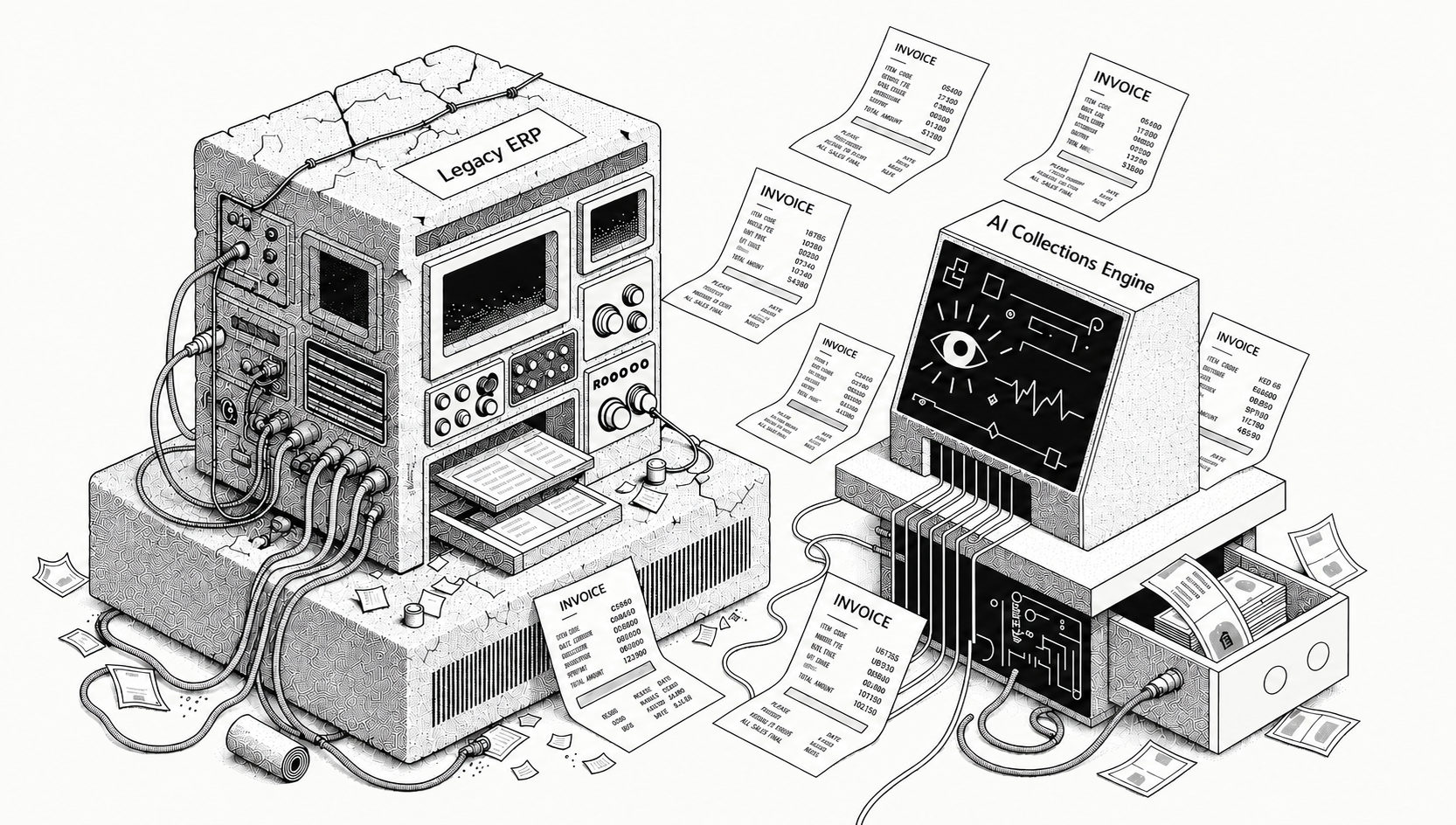
Why Are Teams Moving Collections Beyond the ERP?
ERP-native collections do one job well: they send fixed, schedule-based reminders, and for many teams with steady billing that is exactly enough. The reason a growing number of finance teams are adding a dedicated layer on top is not that the ERP is broken; it is that modern B2B billing has outgrown what a schedule-based reminder can do. Usage-based pricing, mid-cycle changes, partial payments, disputes, and multiple payment rails introduce context that a fixed sequence cannot read, so teams route the context-heavy work to a system like Monk that resolves 90% of collections with zero human intervention and turns revenue into cash faster.
This guide describes what ERP-native collections were designed for, where their design assumptions stop matching modern AR, what context-aware collections add, and how Monk extends the ERP rather than replacing it. For the foundational concepts, see Monk's guide to accounts receivable automation.
What Were ERP-Native Collections Designed to Do?
ERP collections modules were built around a clear and reasonable model: an invoice is issued once and paid once, a customer either pays on time or does not, and the occasional exception is handled manually. For low-volume, predictable monthly invoicing with a stable customer base, that model is efficient and reliable, and it is fair to say ERPs do scheduled reminders well.
The model simply assumes a steady world. It works smoothly until you add usage-based billing, mid-cycle plan changes, credits and partials, disputes, and cross-entity billing, the cases that now make up the majority of real AR work for many software, fintech, and marketplace businesses. None of that is a flaw in the ERP; it is a different problem than the one a reminder schedule was designed to solve.
Where Does the Schedule-Based Model Reach Its Limits?
The limits show up wherever an invoice carries context the reminder cannot see. The table below lays this out neutrally, describing what a schedule-based reminder does and what a context-aware layer adds.
| Situation | Schedule-based reminder | Context-aware collections |
|---|---|---|
| Proration or amendment | Sends the same notice regardless | Reads the contract and adjusts the ask |
| Reliable vs chronic late payer | Treats both identically | Adapts tone to payment history |
| Dispute on a line item | Keeps reminding while unresolved | Routes the dispute with full context |
| Partial payment or credit | Needs manual reconciliation | Reconciles and updates the balance |
| Cross-functional visibility | Finance-only view | Shared view for finance, sales, CS |
The common thread is that schedule-based collections assume AR is a closed, finance-only process. In practice it is a cross-functional, real-time workflow, and every deviation from the norm, a partial payment, an adjustment, a credit memo, tends to drop back to spreadsheets and email when the only tool is a timer.
It is worth being precise about where the limit actually sits. The reminder itself is rarely the problem; a well-timed nudge does move some invoices. The problem is the share of the book where the reason an invoice is open is not "the customer forgot" but "the invoice was prorated and the amount is in question" or "a credit memo has not been applied." For those, a reminder restates a number the customer already disputes, which is why this work piles into a manual queue regardless of how well the schedule is tuned.
What Does Context-Aware Collections Add?
High-performing AR needs systems that are contract-aware, so they read terms, dates, credits, and obligations rather than just an invoice age. It needs to be exception-first, so disputes and mismatches are flagged and resolved with documented playbooks. It needs to be workflow-integrated, so a case routes to CS, sales, or legal with full context. And it needs to be forecast-connected, so the status of every account feeds cash planning.
The bar has moved from sending more reminders to resolving blockers faster with less manual effort. Crucially, this is not the AI teaching itself over time. Monk's collections ingest the documented context of each conversation and respond appropriately, which keeps the behavior predictable and auditable, and the same agent works voice as well as email, with every call recorded and logged.
Why Is the Shift Toward a Dedicated Layer Accelerating?
Two practical reasons. First, building intelligent, context-aware workflows directly inside an ERP usually requires significant customization, and each change runs through a development cycle, which makes fast iteration hard. That is a reasonable tradeoff for a system of record built for stability, but it is a poor fit for a workflow that changes as the business changes.
Second, modern revenue engines move quickly. Product-led growth, marketplaces, and usage-based pricing all introduce edge cases at a pace that a customization-heavy module struggles to match. So rather than reshape the ERP, teams add a purpose-built collections layer alongside it and let the ERP keep doing what it does best. This is the same evolution covered in the comparison of dunning vs intelligent collections.
How Does Monk Work Alongside Your ERP?
Monk does not replace your ERP; it extends it. Monk connects invoices to contracts, payments to disputes, and collections to context, understanding invoice lineage, credit memos, and partial payments, and tracking dispute resolution and promises-to-pay in one place so finance, sales, and CS share a single source of truth.
Its intelligent collections and AR agent, Julia, personalize follow-ups by risk and history, which Monk reports is 24% more effective than standard dunning, and it submits invoices into AP portals while handling the field and format rules each one requires. Rather than fighting the ERP, Monk syncs bidirectionally with it through native integrations with Salesforce, QuickBooks, HubSpot, Stripe, NetSuite, and Anrok, so the ERP stays the system of record. Monk customers see a 40% average reduction in DSO, an 80% automatic cash application match rate, rising to 95% once teams enable suggested rules, and save an average of 26 hours per month, all without Monk taking a percentage of the revenue it collects.
What Does the Transition Look Like?
Because Monk extends rather than rips out the ERP, the transition is low-risk and fast. Most customers go live in less than one week, keep their ERP as the ledger of record, and let Monk handle the context-heavy collections work on top. Profound, which serves enterprise clients, used this model to run invoice submissions and context-aware collections without adding headcount.
The deeper point is that this is not ERP versus dedicated tool. It is the right tool for each job: the ERP for stable record-keeping and scheduled reminders, a context-aware layer for the exceptions and judgment-heavy follow-up that actually move DSO. Because predictable, recurring exceptions cause an estimated 39% of cash-flow slowdowns, the layer that resolves them is where most of the cash improvement comes from, while the ERP continues to anchor the books. For a closer look at the buyer's view, Monk's guide to intelligent collections software covers what to evaluate, and for the wider field of options see the best AR automation software for 2026.
Frequently Asked Questions
Do ERP-native collections still work for some teams?
Yes. For low-volume, predictable billing with a stable customer base, ERP-native scheduled reminders are efficient and reliable. The gap appears as billing grows more complex with usage-based pricing, partials, and disputes.
Where do schedule-based reminders reach their limits?
Wherever an invoice carries context the reminder cannot read, such as a proration, a credit memo, a partial payment, or a dispute. Those cases need contract awareness and exception handling rather than another timed notice.
Can I just customize my ERP instead?
You can, and for some teams that is the right call. It typically requires significant development and each change runs through a dev cycle, which makes fast iteration hard, so many teams add a dedicated layer alongside the ERP instead.
Does Monk replace my ERP?
No. Monk extends your ERP through bidirectional integrations, connecting invoices to contracts and collections to context while your ERP stays the system of record.
How much more effective is Monk's collections?
Its context-aware outreach ingests the context of each conversation and is 24% more effective than standard dunning, and Monk resolves 90% of collections with zero human intervention.
What results do Monk customers see?
A 40% average reduction in DSO, 26 hours saved per month, an 80% automatic cash application match rate, rising to 95% once teams enable suggested rules, and a 2.4x increase in cash on hand in the first quarter.
Ready to add a context-aware layer to your ERP? Book a demo.
More on this: Best AR Automation for NetSuite Users in 2026.



.avif)