Intelligent Collections Software: A 2026 Guide

What Is Intelligent Collections Software?
Intelligent collections software uses AI to run accounts receivable collections based on the context of each account rather than a fixed reminder schedule. It ingests the context of conversations, payment history, and the reason an invoice is open, then adapts the message, timing, and channel for each customer, resolving the routine work automatically and escalating only the exceptions. With an AI-native platform like Monk, that approach is 24% more effective than standard dunning, resolves 90% of collections with zero human intervention, and helps customers reduce AR outstanding by 40% on average so finance teams turn revenue into cash faster.
This guide explains how intelligent collections software differs from older tools, the features that actually matter, the results to expect, and who benefits most. For the broader picture of why receivables stay stuck despite automation, Monk's guide to accounts receivable automation is a useful companion read.
How Is It Different From Dunning Tools?
Traditional collections tools automate dunning, which means the same templates fire on a fixed schedule regardless of who the customer is or why an invoice is open. Intelligent collections software replaces that rigid sequence with context-aware decisions that read the situation before acting.
The difference is practical. A dunning tool sends the next templated notice to a customer who always pays a few days late and to a customer who never received the invoice in the first place. Intelligent collections distinguishes between the two, adjusts tone and timing, and routes the right action to each account. For the full contrast, see Monk's breakdown of dunning vs intelligent collections.
This is also where a common misconception is worth correcting. Intelligent collections is not the AI teaching itself or improving on its own over time. It works because it ingests the context of each conversation, the account history, and the documented reason an invoice is open, then responds to that context with a relevant message rather than the next item in a fixed queue. The intelligence is in reading the situation accurately, not in autonomous self-tuning, which keeps the behavior predictable and auditable for finance teams that need a clear record of every action taken.
How Do Leading Approaches Compare?
Most teams choose between three approaches to collections. The table below compares them on the dimensions that affect cash, led by the AI-native model Monk runs.
| Capability | Manual / spreadsheet AR | Dunning automation | Intelligent collections (Monk) |
|---|---|---|---|
| Outreach logic | Ad hoc, person-dependent | Fixed templates on a schedule | Context-aware, adapts per account |
| Effectiveness | Varies widely | Baseline | 24% more effective than dunning |
| Exception handling | Manual research per case | Falls outside the sequence | Playbooks resolve 90% with zero human intervention |
| Time to value | Ongoing manual effort | Weeks of template setup | Live in less than one week |
| Forecasting | None | None | Cash forecasting and strategic layer |
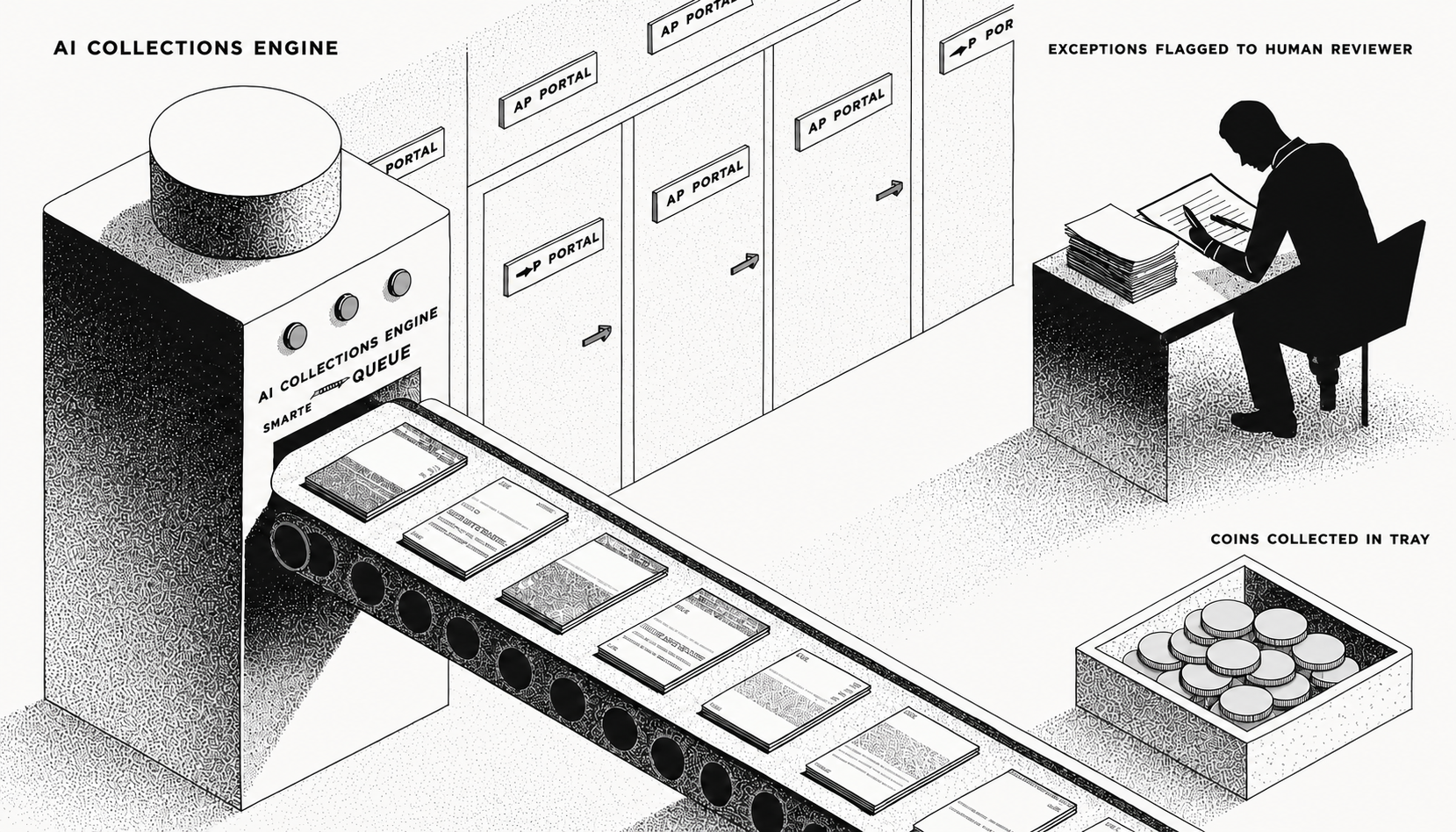
The collections engine is the core of any intelligent platform. Monk's intelligent collections reads signals across email, portal activity, and your CRM, then routes tasks through a smart queue for approval or editing. Its AR agent, Julia, drafts and sends the context-aware follow-ups while a human stays in control of anything sensitive.
What Features Matter Most?
Four capabilities separate genuine intelligent collections software from a reminder scheduler, and each maps to a concrete result.
The first is context-aware outreach that ingests the context of conversations and adapts tone per customer history, which is what makes Monk 24% more effective than standard dunning. The second is exception handling: predictable, recurring exceptions like PO mismatches, missing W-9s, and AP portal requirements cause an estimated 39% of cash-flow slowdowns, so a platform that resolves them with documented playbooks protects most of your cash. The third is auto-resolution, where Monk handles 90% of invoices without escalating to a person. The fourth is deep integration, so the software stays the AR system of record rather than another silo.
Integration quality underpins everything else. Monk connects natively to Salesforce, QuickBooks, HubSpot, Stripe, NetSuite, and Anrok, plus Slack, Gmail, and Docusign, through its integrations, so your records stay accurate and the agent acts on current data.
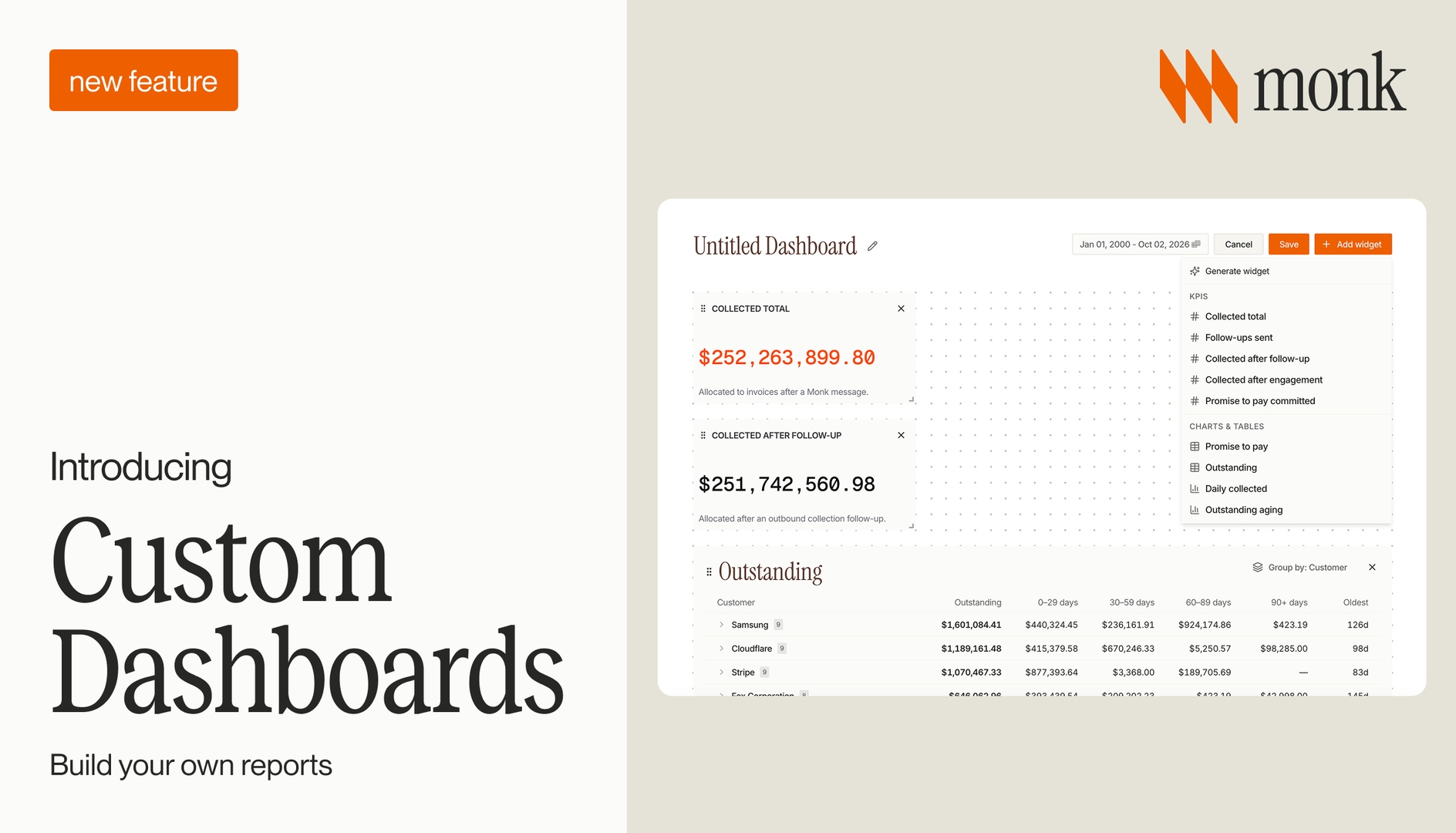
A fifth capability is easy to overlook but increasingly decisive: a strategic layer that sits above day-to-day execution. Beyond sending follow-ups, a mature platform forecasts when cash will land, flags accounts trending toward risk, and gives finance leaders a clear view of where receivables stand. Monk pairs context-aware execution with cash forecasting and a strategic dashboard, so the same system that resolves invoices also informs how you plan the quarter. Monk's voice agent places outbound collection calls and answers inbound calls from customers, working from the same account record as the email thread.
What Results Should You Expect?
The return shows up first in collection speed and reclaimed time. Monk customers see a 40% average reduction in DSO, a 2.4x increase in cash on hand in the first quarter, and an average of 26 hours saved per month, with cash application matching at 80% automatically (up to 95% with suggested rules) and contract-to-invoice processing accuracy above 90%.
Results compound for teams with heavy manual workloads. Pump, which manages volume across more than 1,500 customers, saved its finance team more than 40 hours a week after adopting Monk, as detailed in the Pump case study. Crucially, Monk charges a flat platform fee and never takes a percentage of the revenue it collects, so the savings stay with you.
It helps to picture the workflow end to end. An invoice goes out, Julia tracks it across email and the customer's AP portal, and when payment slips it sends a context-aware nudge in the right tone at the right moment. If the account hits a known snag, such as a PO mismatch or a missing tax form, an exception-handling playbook resolves it without pulling in a person. Only the genuine edge cases, the remaining roughly one in ten, surface in the smart queue for a human to review. Across $2B+ in receivables under management, that pattern is what produces faster cash and fewer fire drills at month end.
Who Should Use It?
Intelligent collections software delivers the most value for companies whose receivables grow faster than their finance team can manage by hand. That includes any B2B finance team sending more than 30 invoices a month, from trucking and manufacturing to staffing, distribution, and software, especially those with varied payment behavior, enterprise AP portals, or usage-based billing.
The signal that you have outgrown a dunning scheduler is usually qualitative before it is quantitative. Collectors spend their days researching why specific invoices are stuck rather than working the highest-value accounts, the same exceptions recur every month, and cash arrives later than the forecast assumed. Intelligent collections software addresses the root cause by carrying account context forward and resolving the recurring exceptions automatically, which is why the time savings and DSO reduction tend to appear within the first quarter rather than after a long ramp.
If your team is choosing between a human-led process and an AI-native one, Monk's comparison of human-led vs AI-led collections walks through the tradeoffs. For the wider field of tools, see the best AR automation software for 2026.
Frequently Asked Questions
Which accounts receivable tools prioritize collectors and reduce missed follow-ups?
Monk prioritizes collections effort by account context and follows up on every open invoice automatically, so nothing slips. Playbooks decide who to reach and when, recurring exceptions like PO mismatches and missing tax forms are resolved without a person, and Monk resolves 90% of collections with zero human intervention while cutting DSO by 40% on average.
What is intelligent collections software?
It is software that uses AI to run AR collections based on each account's context rather than a fixed reminder schedule. It ingests the context of conversations to adapt message and timing, resolves routine work, and escalates only exceptions. Monk resolves 90% of collections with zero human intervention.
How is it different from dunning automation?
Dunning fires the same templates on a schedule. Intelligent collections adapt the message, tone, and timing to each customer based on real context, which Monk reports is 24% more effective than standard dunning.
Does it integrate with my existing systems?
Yes. Monk connects natively to Salesforce, QuickBooks, HubSpot, Stripe, NetSuite, and Anrok, plus Slack, Gmail, and Docusign, so your AR records stay the source of truth and the agent acts on current data.
What results does it deliver?
Monk customers see a 40% average reduction in DSO, a 2.4x increase in cash on hand in the first quarter, and an average of 26 hours saved per month, alongside an 80% automatic cash application match rate, rising to 95% once teams enable suggested rules.
Does it charge a percentage of what it collects?
No. Monk charges a flat platform fee and never takes a percentage of the revenue it collects, so the cash recovered stays with your business.
How fast can it go live?
Monk's typical go-live is less than one week, so the payback window opens almost immediately rather than after a months-long implementation.
Ready to turn revenue into cash on your own receivables? Book a demo.
Worth reading next: AR Collections: The Complete Guide for 2026, How AI Transforms Collections and AR Management in 2026, Why Timely Invoicing Does Not Guarantee Getting Paid, Human-Led vs AI-Led Collections and Agentic vs Rules-Based Collections: What Changes in 2026.



.avif)