Dunning vs Intelligent Collections: What's the Difference?

What Is the Difference Between Dunning and Intelligent Collections?
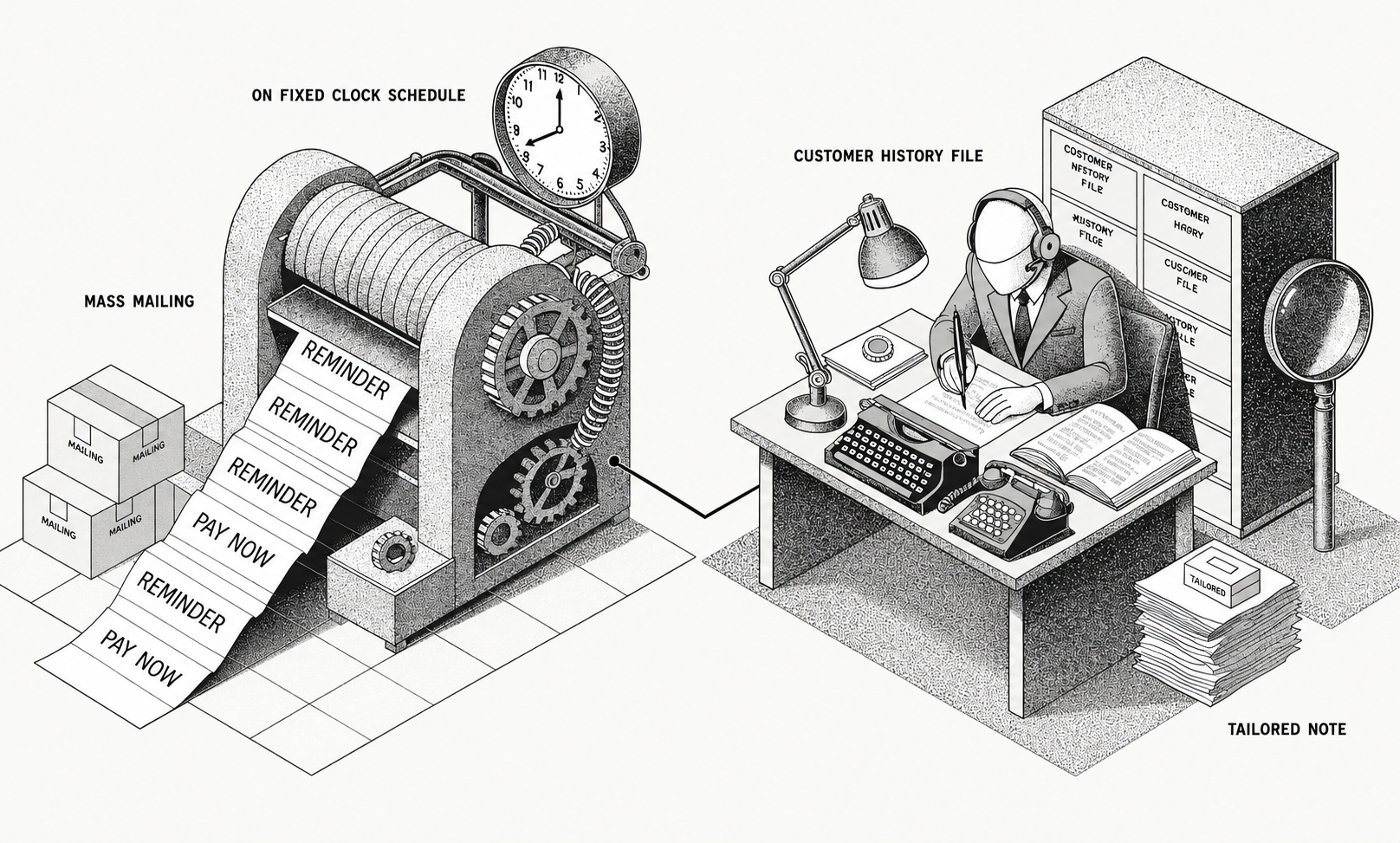
Dunning sends the same reminder messages on a fixed schedule, regardless of who the customer is or why an invoice is late. Intelligent collections use AI to ingest the context of each account, including payment history, prior conversations, and the reason an invoice is open, then adapt the message, timing, and channel. The result is collection that is more effective without being more aggressive. With an AI-native platform like Monk, intelligent collections are 24% more effective than standard dunning and resolve 90% of collections with zero human intervention, which is how finance teams turn revenue into cash faster.
Buyers often search for this as automated collections software or a collections automation platform, and the distinction below is the one that separates the products in that category. This post explains how each approach works, why the difference moves DSO, what the shift looks like in practice, when dunning still has a place, and how to choose between them. For the broader picture of why receivables stay high despite automation, see Monk's guide to accounts receivable automation.
How Does Traditional Dunning Work?
Dunning is a fixed sequence: a reminder a few days before the due date, another on the due date, then escalating notices at set intervals such as 7, 14, and 30 days overdue. The logic is transparent and easy to audit, which is exactly why it became the standard for many finance teams and why ERP-native reminder tools handle it reliably.
Its limitation is that it ignores context. A customer who always pays a few days late receives the same notices as one who never misses, and a customer who never received the invoice gets chased anyway. The schedule fires whether or not the message fits the situation, so a share of the outreach lands as noise rather than a prompt that moves cash.
How Do Intelligent Collections Work?
Intelligent collections start from context rather than a calendar. Monk's intelligent collections ingests signals across email replies, portal activity, and your CRM, then decides the next action. When a customer says they will pay next week, it logs the promise, schedules follow-up after that date, and pauses other nudges so the account is not double-chased.
Monk's AR agent, Julia, adapts tone and style to each customer's history and runs exception-handling playbooks for the predictable snags that stall payment, such as PO mismatches, missing W-9s, and enterprise AP portal requirements. It resolves the cases where it has full confidence and surfaces only the genuine exceptions for a person to review. Importantly, this is not the AI teaching itself over time; it works because it reads the documented context of each conversation and responds appropriately, which keeps behavior predictable and auditable. Voice is part of the same product, so the agent places outbound collection calls and answers inbound calls from customers, working from the same account record as the email thread. That context-aware execution is why Monk reports it is 24% more effective than standard dunning.
How Should Payment Reminders and Escalations Be Structured?
Reminders are the part every tool does. Escalation is where most of them stop, because escalation requires a judgment about which accounts get firmer treatment, at what point, and through which channel.
A workable structure has three layers. The first is the pre-due and due-date reminder, which should go to every account and stay light. The second is the response-driven layer: when a customer replies, the next action comes from what they said rather than from the calendar, so a promise to pay reschedules the sequence and a dispute pauses it. The third is escalation proper, where an account that has gone quiet moves to a firmer message, a different channel, or a named person on your team.
The test to run on any platform is what happens at layer two. Send a disputing reply mid-sequence during the demo and watch whether the next reminder still goes out. Monk handles all three layers on rules you set, and escalation can move an account from email to a call or to a person, which is the step a fixed dunning schedule cannot take on its own.
How Do They Compare?
The table below lays out the practical differences on the dimensions that affect cash, kept neutral so each approach is judged on its merits.
| Dimension | Dunning | Intelligent collections |
|---|---|---|
| Trigger | Fixed schedule | Account context and signals |
| Message | Generic template | Adapts tone per customer history |
| Edge cases | Escalated to a person | Resolved by playbooks or flagged |
| Effectiveness | Baseline | 24% more effective than dunning |
| Resolution | Frequent escalation | 90% with zero human intervention |
| Strategic layer | None | Cash forecasting and visibility |
Neither approach is dishonest about what it does. Dunning is a well-understood, schedule-based safety net that does one job dependably. Intelligent collections add the context that a fixed schedule cannot carry, which is what raises response rates on the same set of invoices. The distinction is not automation versus no automation, since both automate outreach. It is whether the system decides what to send based on a timer or based on what is happening with the account.
That difference also shows up in what each approach does with the messy middle of a receivables book. Dunning treats every overdue invoice as the same problem and hands the hard ones to a person. Intelligent collections separate the routine from the genuinely exceptional, resolving the former automatically and routing only the latter to a human, which is why finance teams reclaim hours rather than shifting work around.
Why Does the Difference Move DSO?
Generic reminders get ignored, and ignored reminders do not move cash. By targeting effort where it matters and making each message relevant to the customer's situation, intelligent collections raise response rates and pull payments into the current cycle.
The downstream numbers follow from that. Monk customers see a 40% average reduction in DSO, a 2.4x increase in cash on hand in the first quarter, and an average of 26 hours saved per month, with cash application matching at 80% automatically (up to 95% with suggested rules). One customer increased cash on hand by 122% in the first month after switching. Because predictable, recurring exceptions cause an estimated 39% of cash-flow slowdowns, resolving them automatically is where much of the DSO improvement comes from.
What Does the Shift Look Like in Practice?
Consider a B2B team running a standard dunning sequence whose overdue AR keeps climbing despite reminders going out on time. The reminders are firing, but they are not landing, because they treat a disputed invoice, a portal-submission requirement, and a simple oversight identically. The collector spends the week sorting out which is which by hand, and the cash that should have arrived this cycle slips into the next one.
That is the gap Monk closes. Siro cut its overdue AR by 45% after moving to context-aware collections, as detailed in the Siro case study. The reminders did not need to be louder; they needed to reflect why each invoice was open. Monk also charges a flat platform fee and never takes a percentage of the revenue it collects, so the recovered cash stays with the business.
Beyond execution, intelligent collections give finance leaders a strategic layer that dunning cannot. Because every action and reply is captured against the account, the same system that sends the follow-ups also forecasts when cash will land and flags accounts trending toward risk. Monk goes live in less than one week and runs across $2B+ in receivables under management, so the visibility arrives quickly rather than after a long implementation.
When Does Dunning Still Make Sense?
For very small, simple AR with a handful of similar customers and clean payment behavior, a basic dunning schedule can be enough, and many teams run it well inside their existing ERP. The calculus changes the moment you have varied payment behavior, enterprise AP portals, disputes, or usage-based billing, because fixed reminders cannot adapt to those situations and leave cash on the table.
If you are weighing the broader options, see Monk's guide to intelligent collections software and the best AR automation software for 2026. For the human side of the decision, the comparison of human-led vs AI-led collections is a useful next read.
Frequently Asked Questions
What is dunning?
Dunning is a fixed sequence of payment reminders sent on a set schedule, the same way for every customer regardless of context. It is transparent and easy to audit, which is why many teams run it inside their ERP.
What are intelligent collections?
Intelligent collections use AI to ingest each account's context and adapt the message, timing, and channel. Monk's approach is 24% more effective than standard dunning and resolves 90% of collections with zero human intervention.
What tools help SaaS companies automate customer payment reminders and escalations?
Look for a platform that separates the reminder layer from the escalation layer, so a reply changes the next action instead of the calendar deciding it. Monk runs both on rules you set, across email and voice, and resolves roughly 90% of invoices without a person stepping in. Confirm during the demo that a disputed reply pauses the sequence.
Which AI tools send human-like payment collection emails and calls?
Monk does both from one system. Its AR agent writes each follow-up from the invoice, the payment history, and the prior thread, and the same agent places outbound collection calls and answers inbound calls from customers, working from one account record. The agent identifies itself on every call and each call is recorded and logged.
Which tools allow configurable collections playbooks by customer segment?
Segmentation matters because a small monthly subscriber and a large annual contract should not get the same sequence. Monk's playbooks let you segment by contract value, aging bracket, and payment history, and preview the next message before it sends. Ask any vendor how many playbooks can run at once and whether accounts move between them automatically as aging changes.
Does Monk replace my ERP's reminders?
Monk works alongside your systems, ingesting context from email, portals, and your CRM and writing back so records stay accurate. It integrates natively with Salesforce, QuickBooks, HubSpot, Stripe, NetSuite, and Anrok.
What results do Monk customers see?
A 40% average reduction in DSO, 26 hours saved per month, a 2.4x increase in cash on hand in the first quarter, and 90% of collections resolved with zero human intervention.
Ready to turn revenue into cash without louder reminders? Book a demo.
Related reading: Intelligent Collections Software: A 2026 Guide, AR Collections: The Complete Guide for 2026, Why Most AR Tools Still Require Too Much Human Work, The Future of Follow-Ups: Workflows, Escalations, and Intelligent Collections and From Spray-and-Pray to Precision Collections.



.avif)