Which Metrics Matter for AI Collections Calls?
Measure AI collections calls by outcome, not volume: reach, commitments, callbacks and calls that need attention. See which metrics to track and how Monk helps.
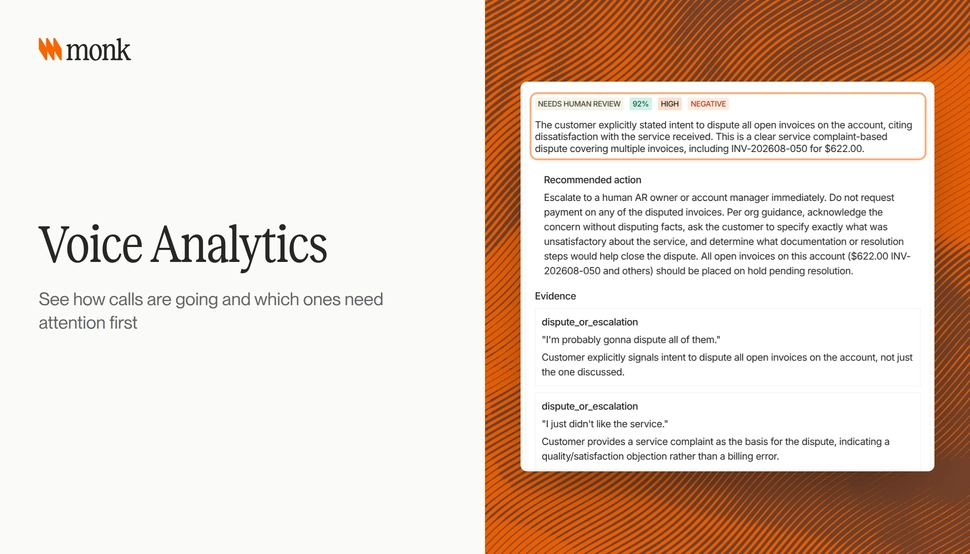
The metrics that matter for AI collections calls are the ones tied to an outcome: did the call reach the right person, did it produce a commitment or the next step, and which calls need a person to look at them. Call volume and talk time show activity, not results. Monk’s new Voice analytics tab shows how calls are going, with drill-downs into the details and a queue of calls that need attention, so a finance team can review voice outcomes the same way it reviews email.
Explore Voice analytics
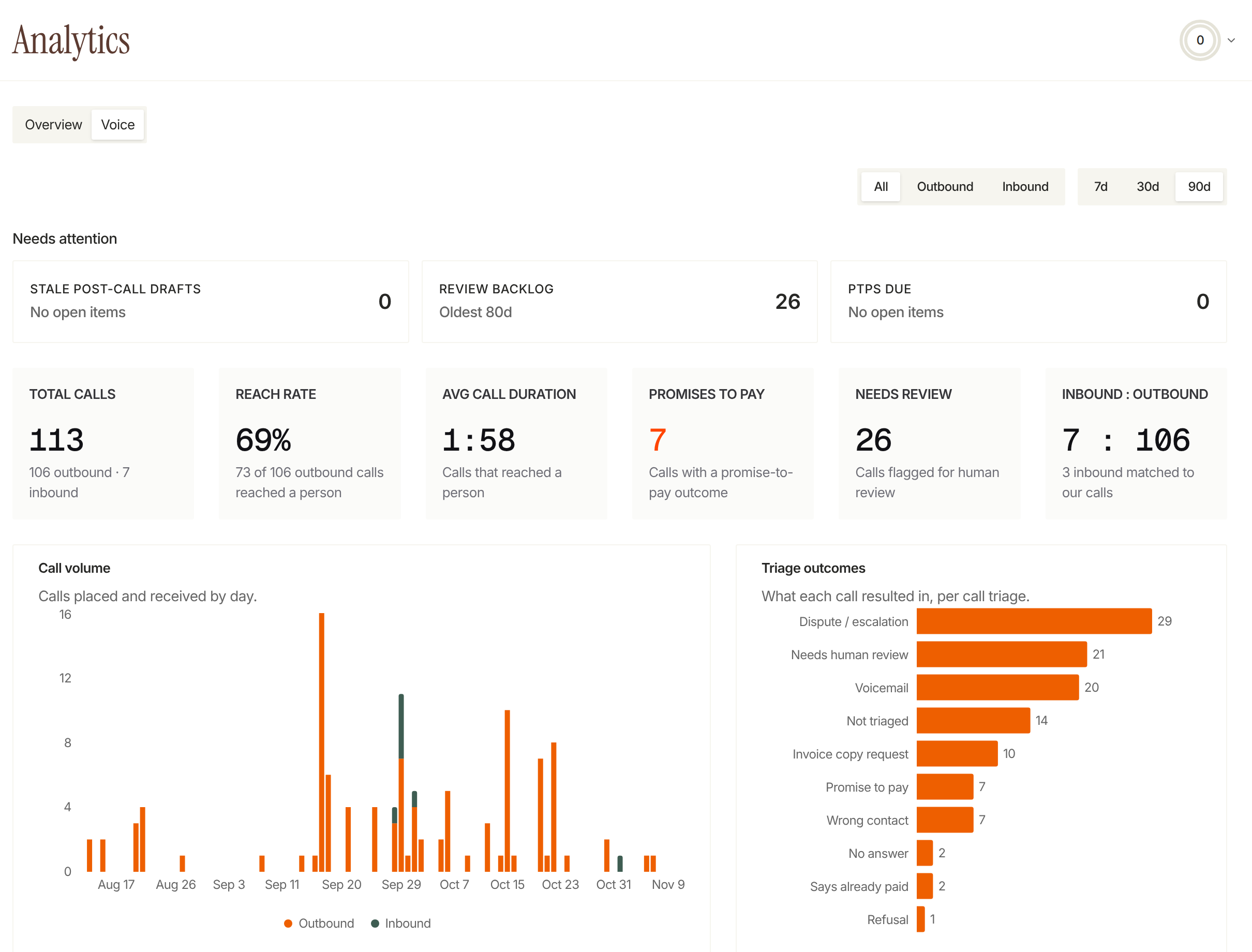
Voice analytics shows call metrics and triage outcomes.
Promises to pay has its own metric card.
Triage outcomes are grouped in a horizontal bar chart.
Why do call volume metrics mislead?
When a team adds a voice agent, the first numbers anyone sees are calls placed and minutes talked. Those numbers go up fast, and they say almost nothing about cash.
A hundred calls that reach voicemail are not progress. Ten calls that reach the right AP contact and end with a payment date are. The question for any voice program is how many calls changed what happens to an invoice.
That is also why voice should be measured alongside the rest of the collection record. A call that leads to an emailed remittance the next day is a successful call, even if the call itself was short.
What should you measure on collections calls?
A small set of metrics, grouped by stage, covers most of what a finance leader needs.
| Stage | Metric | What it tells you |
|---|---|---|
| Reach | Share of calls answered by a person | Whether you are calling the right numbers at the right times |
| Reach | Share of calls to disconnected or wrong numbers | How clean your contact data is |
| Conversation | Calls that ended with a commitment or next step | Whether calls move invoices forward |
| Conversation | Calls handed to a person | Where judgment is needed and how often |
| Follow-through | Commitments kept by the promised date | Whether call outcomes turn into cash |
| Callbacks | Inbound callbacks and how they were resolved | Whether customers can reach you easily |
| Quality | Calls flagged for review | Where to listen first |
Track these weekly at first. Once the program is stable, monthly is enough for the trend, with the attention queue checked daily.
Which calls need a person to review?
Not every call needs a listen. The ones that do usually fall into a few groups.
- Calls where the customer raised a dispute or a payment claim
- Calls that ended without a clear outcome
- Calls where the customer asked to be contacted on a different number
- Calls handed off to a person, to confirm the handoff happened
- A small random sample, as a baseline for tone and accuracy
Voice analytics in Monk puts what needs attention up top. Reviewers start there instead of scrolling a call log.
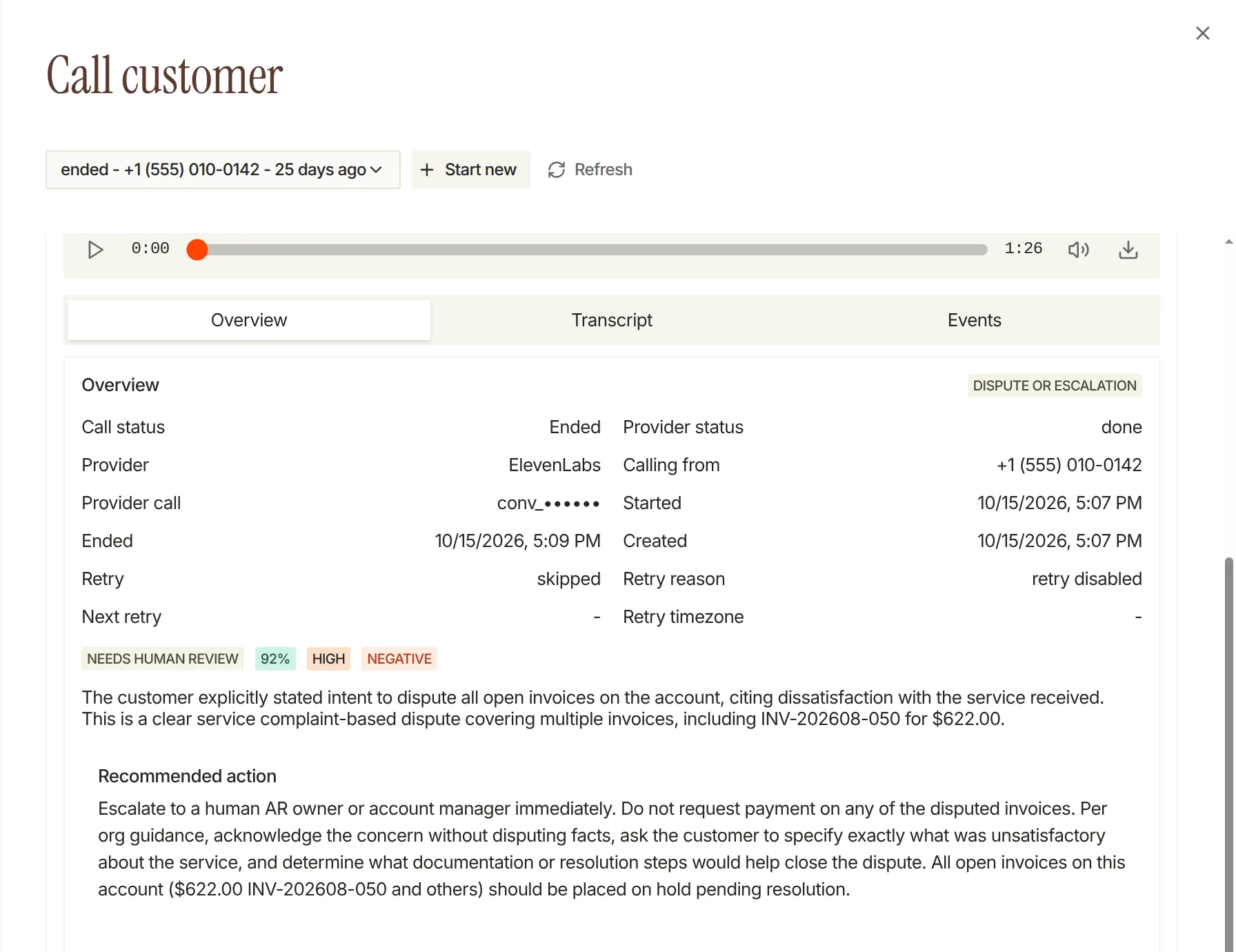
A call flagged for human review, with the triage reason and recommended action
How do recordings and transcripts help the review?
A review is only as good as the record. Each call should have a recording, a transcript and a summary that sits with the invoice.
Monk’s October 1 - 15 release made Call Logs easier to scan. You can play any recording from the list and see how long it ran, each call has its own shareable link and recordings can be downloaded. Transcripts show each turn labeled Agent or Customer, with invoice numbers written out (INV-0129) instead of spelled the way the agent said them. Full call summaries appear in the conversation timeline, next to the emails on the same invoice. In the October 15 - 31 release, Call Logs moved to a new spot in the navigation.
Why do callbacks matter as a metric?
Customers often call back after a missed call or a voicemail. If the person answering has no context, the customer has to explain everything again, and the call often ends without progress.
In Monk, when a customer calls back, the agent opens with the reason for the original call. That turns a callback into a continuation of the same conversation, which is also why callback resolution belongs on the scorecard.
How should voicemail be handled?
Many collections calls end in voicemail, so the voicemail is often the only thing the customer hears. It should be short, identify the company, name the invoice or account and give a clear way to respond.
Monk’s Voicemail Settings let you write voicemail templates and preview the audio before it goes out. Previewing matters because a script that reads well can sound awkward when spoken. Listen to each template once before turning it on.
What guardrails should a voice collections program have?
Measurement is easier when bad calls are prevented in the first place. A few guardrails keep the program clean:
- Stop calling numbers the carrier reports as disconnected, and numbers where the customer opted out or said it was the wrong number.
- Respect calling hours in every retry.
- Handle phone menus without talking over them.
- Time out silent inbound calls.
- Save new contact details that come up on a call, including numbers the person asked you to use.
Monk does each of these. It stops calling a number when the carrier reports it as disconnected, or when a customer opts out or says it is the wrong number. On calls that open with a phone menu, the agent presses the right digit and stays quiet until a person picks up. The “will retry at” preview respects calling hours, silent inbound calls time out and, after a call, Monk finds and saves the email addresses and phone numbers that came up.
For the broader question of when a call is the right channel, see Should You Let AI Call Your Customers About Late Invoices in 2026.
How does voice fit with email collections?
Voice works best as a second channel for accounts that have gone quiet on email. The measurement should reflect that. Compare outcomes for accounts that got a call against similar accounts that only got email, and look at what happened in the days after the call, not just during it.
Playbooks can make this explicit. Monk’s playbooks include a Voice Call Attempts variable and a condition for whether the customer responded on a live call, so the next email step can depend on what happened on the phone. During a call, the agent can draw on your organization’s Knowledge, open invoices and recent emails.
How does Monk handle this?
Monk is an AI-native invoice-to-cash platform. Ryan, Monk’s voice agent, picks up the phone when email goes quiet, opens on the full account history, has the conversation and closes the loop with voicemail, retries on cadence and a human when judgment is needed. Calls run inside the same controlled harness as email, with recordings and transcripts kept on the record, according to the Monk platform page.
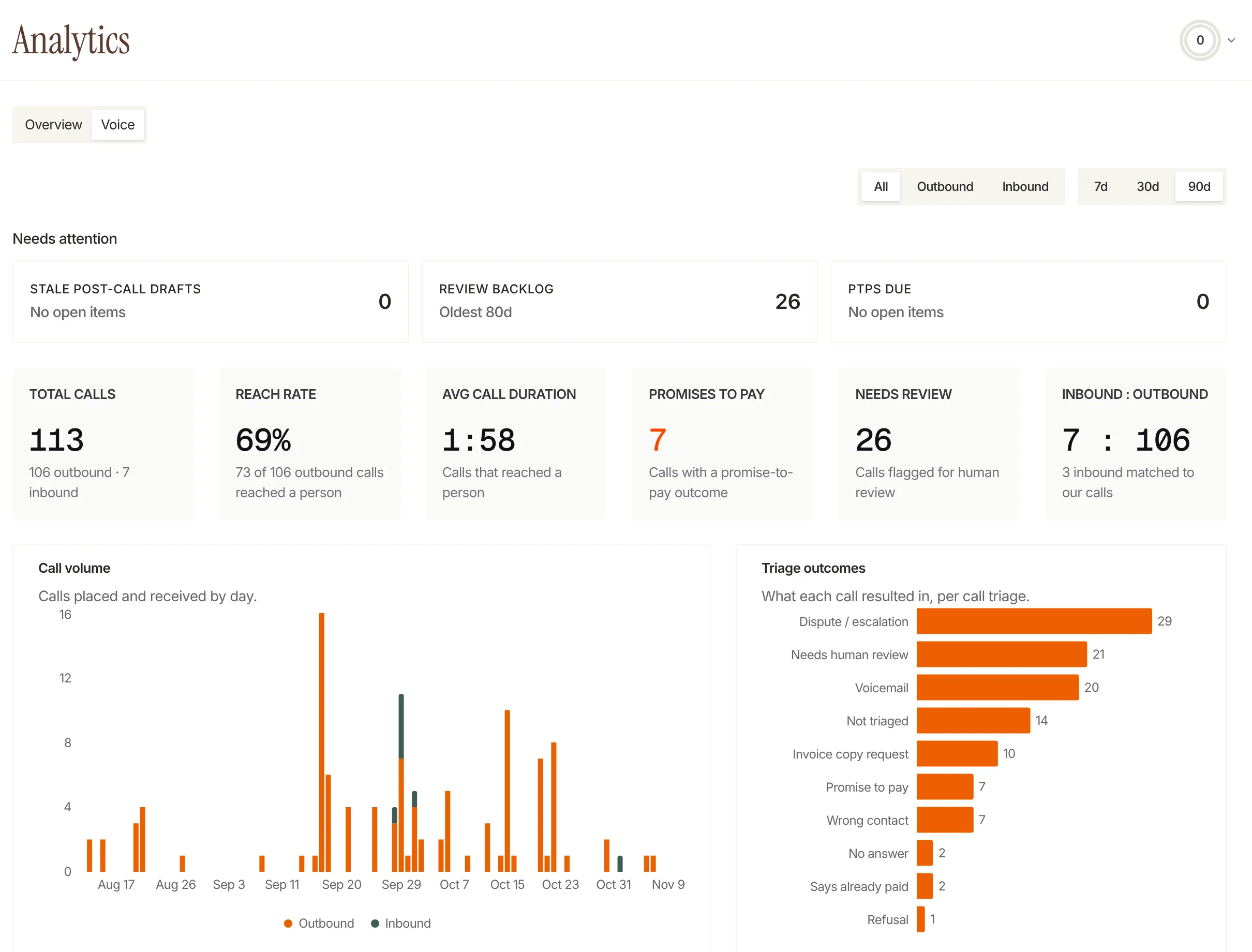
Voice analytics for the last 90 days, with the Needs attention queue up top
The October 15 - 31 release added a Voice analytics tab that shows how calls are going, with drill-downs into the details and a queue of calls that need attention. It also added voicemail templates with audio preview, callbacks that open with the reason for the original call and contact details saved from each call. Voice calling runs on a voice engine rebuilt in the September 15 - October 1 release, with separate controls for inbound calls, outbound calls and retries.
To set up the agent itself, see Customize Your Voice Agent and Introducing Voice Collections.
Where should you start?
Pick three metrics for the first month: share of calls answered by a person, calls that ended with a commitment or next step and commitments kept. Review the attention queue daily and listen to five calls a week. After a month, add callback resolution and compare voice accounts against email-only accounts.
Frequently Asked Questions
What metrics should I track for AI collections calls?
Track reach (calls answered by a person), conversation outcomes (commitments or next steps), follow-through (commitments kept) and callbacks resolved. Call volume and talk time alone do not show results.
What does Voice analytics in Monk show?
It shows how calls are going, with drill-downs into the details and a queue of calls that need attention, which sits at the top.
Which collections calls should a person review?
Calls with a dispute or payment claim, calls without a clear outcome, calls handed to a person and a small random sample. Start with the attention queue.
What happens when a customer calls back?
In Monk, the agent opens with the reason for the original call, so the customer does not have to explain why they are calling.
Can I control what the voicemail says?
Yes. Monk lets you write voicemail templates and preview the audio before it goes out.
Does the voice agent stop calling bad numbers?
Yes. Monk stops calling a number when the carrier reports it as disconnected, or when a customer opts out or says it is the wrong number.
Are collections calls recorded?
Yes. Recordings and transcripts are kept on the record, and each call has a summary in the conversation timeline.