Delivery and exception handling
Check how delivery failures and payment-blocking exceptions are resolved.
Plenty of tools will send template reminders, but few can be trusted with your customer relationships. This guide covers what to look for and the questions to ask before you sign.
The transformer architecture arrived in 2017 and ChatGPT in 2022. Every platform on the left was in market by then. Its intelligence layer sits on a data model designed for a different job. It can send a template on day 30, 45, and 60. It cannot reason about why the invoice is unpaid. Monk was built after modern language models existed, around the relationship instead of the ledger.
Revenue is what you have earned: the signed contract, the sent invoice, the number on the board. Cash is the money in the bank you can spend. The distance between the two is accounts receivable and for most companies it is wider and more expensive than anyone has stopped to count.
Slow collections used to be fine because you could raise or borrow to cover the gap. Credit tightened through 2025 and that is no longer true.
Sales got Salesforce, payroll got Rippling, AP got Ramp and Bill. AR stayed in a spreadsheet with reminders sent one by one.
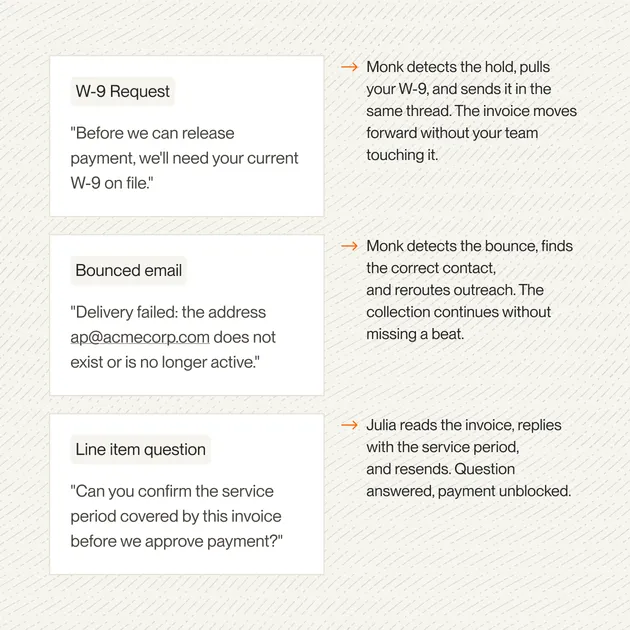
Customers pay late over a missing W9, a portal login, a PO mismatch, or an approver on vacation. A sterner reminder does not fix any of these.

Almost everything in AR was built around the ledger or the bill: to record what happened and send what is owed. That is software for compliance. Getting a payment closed depends on why it stalled and the ledger does not track the why.
Revenue is what you have earned: the signed contract, the sent invoice, the number on the board. Cash is the money in the bank you can spend. The distance between the two is accounts receivable and for most companies it is wider and more expensive than anyone has stopped to count.
Every tool was built for one of these three eras. Most vendors are still selling the second.

QuickBooks, NetSuite, spreadsheets. AR is data entry and a reminder sent by hand.

Legacy suites built on the ledger before modern AI, so the intelligence is bolted on and rollouts drag. Newer billing-led tools center on the contract, so collections comes second.

Agents understand each account, work both sides of every invoice, and adapt to the relationship. A dead contact gets a lookup. A portal mismatch gets resubmitted. A real question goes to a person.
Four capabilities separate a tool that reminds from one that closes a collection and all four rest on a fifth: trust and control.
Edge cases (portals, missing W9s, and PO mismatches) are responsible for 39% of the slowdown in cash flow. The tool should handle them, not hand them back.
It should understand why an invoice is late and follow how you run collections, rather than fire a fixed cadence.
Receiving payment means reading and acting on inbound replies, across every channel, including the phone.
Match blank memos, partial payments, and multi-invoice remittances. Monk auto-matches 80% of payments to the correct invoice, reaching 95% with suggested rules.
Two questions cut through most pitches. Here is how each generation answers them.
| Criteria | Manual | First-gen |  | Ask your vendor |
|---|---|---|---|---|
Delivery and exception handlingCheck how delivery failures and payment-blocking exceptions are resolved. | A person emails and waits for a reply | Templates on day 30, 45, and 60, with no read on why | Resolves the dispute or exception, escalates only what needs a person | Do you handle portal submission and W9 or PO exceptions, or do they land back in our inbox? Does the system act on inbound replies and link a reply in a separate thread to the right invoice? |
How fast do you see cash?A tool that takes a quarter to show impact is one you are financing. | DSO moves only as fast as the team can chase | Marginal lift, capped by reminder fatigue and long rollouts | >40% lower DSO | What is the median time to first DSO improvement? Can you auto-match partial and multi-invoice payments and how fast does the ledger update? |
Does it read what comes back?Getting paid is a two-way conversation. Half of it arrives in your inbox. | Replies land in one person's inbox, so a PO in one thread and a dispute in another are two separate problems and nobody connects either to the invoice. | Outbound only. The system sends. Your team handles every reply. The system never learns that the invoice was queried. | Reads and acts on every inbound reply. Links a PO, a credit memo, a payment confirmation, or a dispute from any thread to the right invoice. Pauses outreach when a customer responds. | Do you read and act on inbound replies and can you link a reply in a separate thread back to the right invoice? How many channels do you work? |
Who owns the context when someone leaves?The person who knows your payer base is a single point of failure until the system knows it too. | Context leaves with the person. Which customers pay late, who to call, and what was promised in March lived in one head and a spreadsheet. | The cadence you configured survives. A new hire inherits that cadence and none of the judgment behind it. | The business keeps payer behaviour, exceptions, playbook changes, and every conversation. Your AR team keeps that knowledge when someone leaves and improves month over month. | If our AR lead resigns tomorrow, what does the system still know? Does it improve over time, or only stay configured? |
Collecting well takes someone who knows your business and follows your rules. Monk agents handle collections. You design the playbooks they follow.
A fixed template would treat a 30-day staffing invoice and a 90-day manufacturing deduction the same way. Your playbooks do not.
You decide when outreach starts, how it escalates as an invoice ages, and when it stops.
You set the value, age, or condition for escalation. You choose who takes over.
Outbound playbooks send from your inbox or place a call. Inbound playbooks act on every reply.
Monk was built around the relationship from the data model up, after modern language models existed. It connects to QuickBooks, NetSuite, and Stripe without replacing them or touching contracts.

Deployment is a pass/fail question most evaluations ask before booking a call, so here is how Monk handles it.
Monk runs in its own AWS environment. Every customer’s data is scoped to its organization and encrypted, and access is role-based and reviewed. You connect your ERP and we handle the implementation.


We were frustrated with invoicing. Cash on hand was lagging contracts signed. My team can now focus on running the business.


They have massively reduced the amount of time we spend thinking about open AR - giving us precious time back to focus on our own customers.


We send thousands of invoices a month, and before Monk, anything that didn’t get paid automatically meant someone on our team chasing it by hand. Now Monk follows up on all of it, loops in our account managers only when it matters, and our customers are paying more than twice as fast.


Monk gave us immediate visibility into unbilled revenue, tightened our collections process, and became a true AR system of record, all without adding headcount.
Staffing runs net-45 at high volume, manufacturing invoices get deductions, food and beverage reprices daily, and medical device waits on certificates of insurance. The calculator below covers 10 industries with directional DSO benchmarks and illustrative targets to estimate potential working capital released.
Choose one of 10 industries in the calculator below.
Enter your DSO or calculate it from receivables and credit sales, then compare days to the industry benchmark.
An illustrative scenario, not a promised Monk result. Only industries with both a benchmark and a modeled target are offered.





Four capabilities separate a tool that reminds from one that closes a collection: delivery and exception handling (portals, W9s, POs, dead contacts), collections intelligence (understanding why an invoice is late, not just that it is), coverage across both outbound and inbound communication on every channel, and cash application (auto-matching partial and multi-invoice payments). All four should sit on a foundation of trust and control: full auditability and a deterministic check before anything reaches a customer.
Billing and contract tools produce the invoice; AR automation closes it. One records what a customer owes, the other works out why it has not been paid (a portal rejection, an unanswered reply, an open dispute) and resolves that.
It ranges from months for platforms where your team does the integrating, to days for ones that do the work for you. Monk goes live in under a month because our team builds the connections during onboarding rather than handing you a project.
Building gets you scheduled reminders quickly; the hard part is everything after: reading replies, submitting into buyer portals, routing disputes, and matching cash across thousands of accounts. That is an operating system, not a project, which is why most teams that start building end up buying.
It depends on your industry, billing model and payment terms. The DSO Benchmark Report covers 10 industries with directional benchmarks and illustrative targets. Enter your DSO or calculate it from receivables and credit sales; no observed peer percentile is claimed.
Bring your aging report to a demo. See Julia collect from your customers using Playbooks and multi-threading.