How Do You Audit What Your AI Collections Agent Sent?
Auditing an AI collections agent means replaying what it sent, to whom and why. Learn what to review, how often and how Monk Spotlight shows each collection.
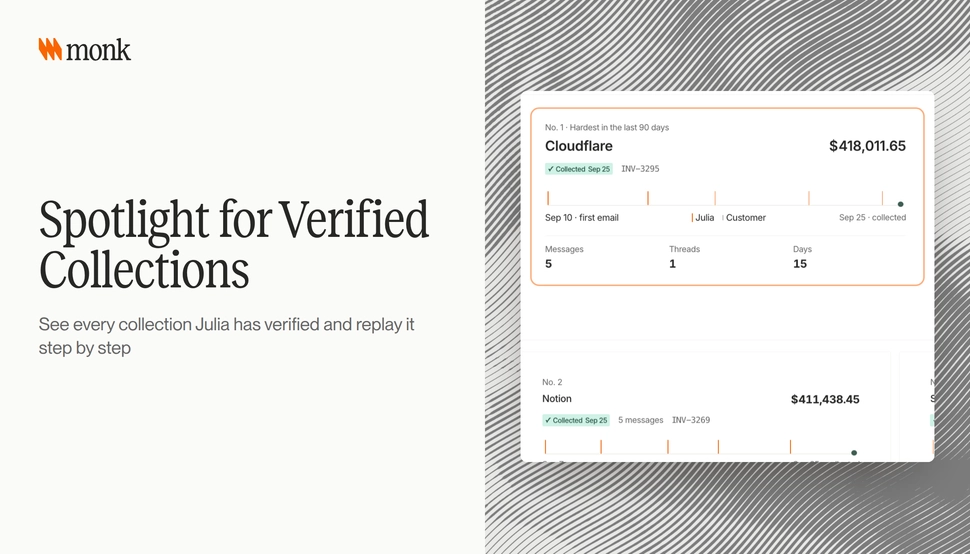
To audit an AI collections agent, replay the work behind a collected invoice: the activity on the account, who each message went to and the exact email the customer received. A summary that says “invoice paid” is not enough for a controller who has to stand behind every customer message. Monk’s Spotlight shows the collections Julia, Monk’s email collections agent, has verified, with a replay of each one: the activity, who it went to and the email as it was formatted. It opens with the hardest collections from the last 90 days.
Explore Spotlight
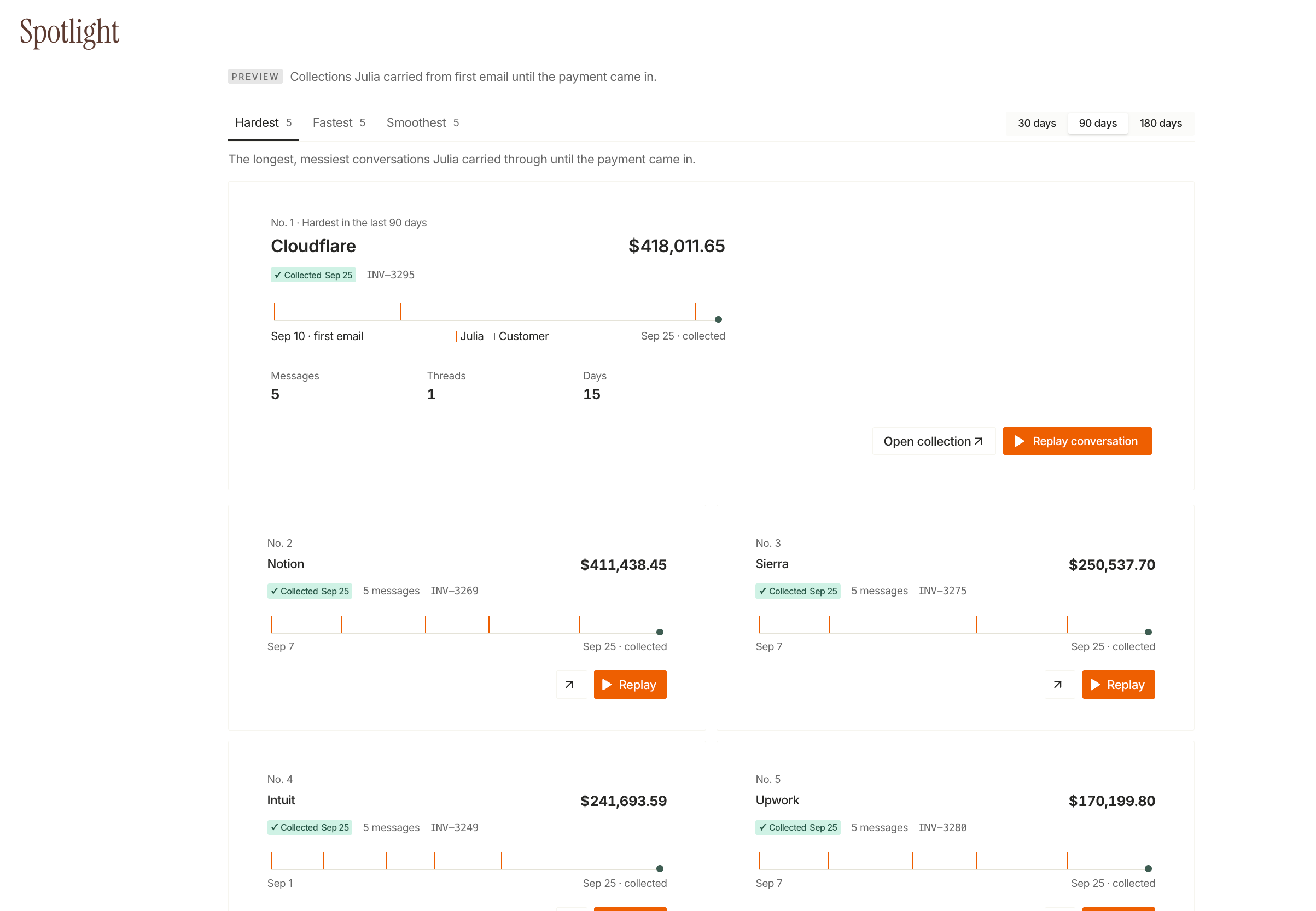
Spotlight displays collected invoices and their conversation timelines.
The Cloudflare card shows messages, threads and days.
Replay conversation is available on the collection card.
Why does an AI collections agent need an audit trail?
Collections emails go to your customers under your company’s name. If an agent sends the wrong amount, writes to the wrong contact or takes the wrong tone, the cost lands on the relationship, not just the invoice.
An audit trail answers three questions after the fact. What did the agent see? What did it send, and to whom? What happened next? If you cannot answer all three for any invoice, you are trusting the agent instead of checking it.
This is different from measuring whether the agent is working. Measurement looks at totals, like how much the agent collected on its own. Auditing looks at single collections, one at a time, to confirm the work was right. Both matter, and they use different views. For the measurement side, see How to Know if Your AI Collections Agent Is Working.
What should you review on a single collection?
A useful review covers the full path from overdue invoice to paid. Each step should be visible without asking anyone to pull logs.
| What to review | What you are checking | Red flag |
|---|---|---|
| Account activity | The agent read the invoice, payment history and prior replies | A follow-up that ignores a recent reply or promise to pay |
| Recipients | Messages went to the right billing or AP contact | Emails to a contact who left or an unrelated address |
| The email as sent | Amount, invoice number, tone and formatting | Wrong figures, broken formatting or a tone that does not fit the account |
| Customer response | The agent understood the reply | A question left unanswered or a dispute treated as a promise |
| Outcome | The invoice was paid, and the payment matches the thread | A “collected” invoice paid by a different, unrelated payment |
Seeing the email as it was formatted matters more than it sounds. A draft in a review queue can look fine and still render badly in a customer’s inbox. Reviewing the sent version removes that gap.
Which collections should you review first?
Not every collection needs the same attention. An invoice that was paid after one reminder tells you little. An invoice that took a dispute, a contact change and several replies tells you a lot about how the agent handles judgment calls.
Start with the hardest cases. Large balances, long threads, disputes and accounts with changed contacts show whether the agent reads before it writes. Monk’s Spotlight opens with the hardest collections from the last 90 days for this reason.
A practical sample for a monthly review might look like this:
- Five of the largest collections in the period
- Five collections that involved a dispute or short pay
- Five collections where the contact changed or an email bounced
- A few routine collections, picked at random, as a baseline
That is a small set, but it covers the cases where an error would cost the most.
How often should a finance team audit AI collections?
Audit frequency should follow risk and maturity. In the first weeks after launch, a weekly review is reasonable because playbooks and Knowledge entries are still being tuned. Once the team is confident, a monthly review of a focused sample is usually enough.
Two events should trigger an extra review. One is any customer complaint about a collections message. The other is a change to playbooks, tone settings or escalation rules. In both cases, replaying recent collections shows whether the change behaves as intended.
What controls should exist before an email reaches a customer?
Auditing after the fact works best when there are also checks before sending. Ask any vendor what happens between the agent writing a message and the customer receiving it.
On Monk, a deterministic check runs before anything reaches a customer, and anything uncertain is drafted for review instead of sent, as described on the Intelligent Collections page. Your team designs the playbooks the agents follow, including tone, cadence and when to escalate, and can review every draft before it sends or turn on auto-send. Every action stays logged and auditable.
Recent releases also tightened the inputs that lead to bad sends. Needs Review now flags Missing Contacts and conversations where the same auto-reply keeps coming back. When an email address or phone number is blocked because of a hard bounce, an opt-out or a wrong number, Monk stops sending to it and the contact card shows why and when.
What is the difference between activity logs and verified collections?
An activity log lists everything the agent did. That is necessary for completeness but hard to review, because most entries are routine. A verified collection is a finished case: an invoice the agent worked that ended in payment, packaged so a person can replay it from start to finish.
| Activity log | Verified collection replay | |
|---|---|---|
| Unit of review | Single actions | A full collection, start to paid |
| Best for | Investigating a specific event | Spot-checking quality and tone |
| Shows recipients | Per action | Across the whole thread |
| Shows the email as sent | Sometimes | Yes, as formatted |
| Typical user | Ops or engineering | Controller, AR lead, CFO |
Most teams need both. The log is where you go to investigate. The replay is where you go to confirm the work was right.
How does Monk handle this?
Monk is an AI-native invoice-to-cash platform. Julia, its email collections agent, reads the invoice, the payment history and the relationship, writes the follow-up that account needs and works the reply until the cash lands. She hands off to a person with full context when judgment is needed. Monk resolves 87% of collections with zero human intervention and reaches customers with a 24% higher response rate than standard dunning.
Spotlight for verified collections
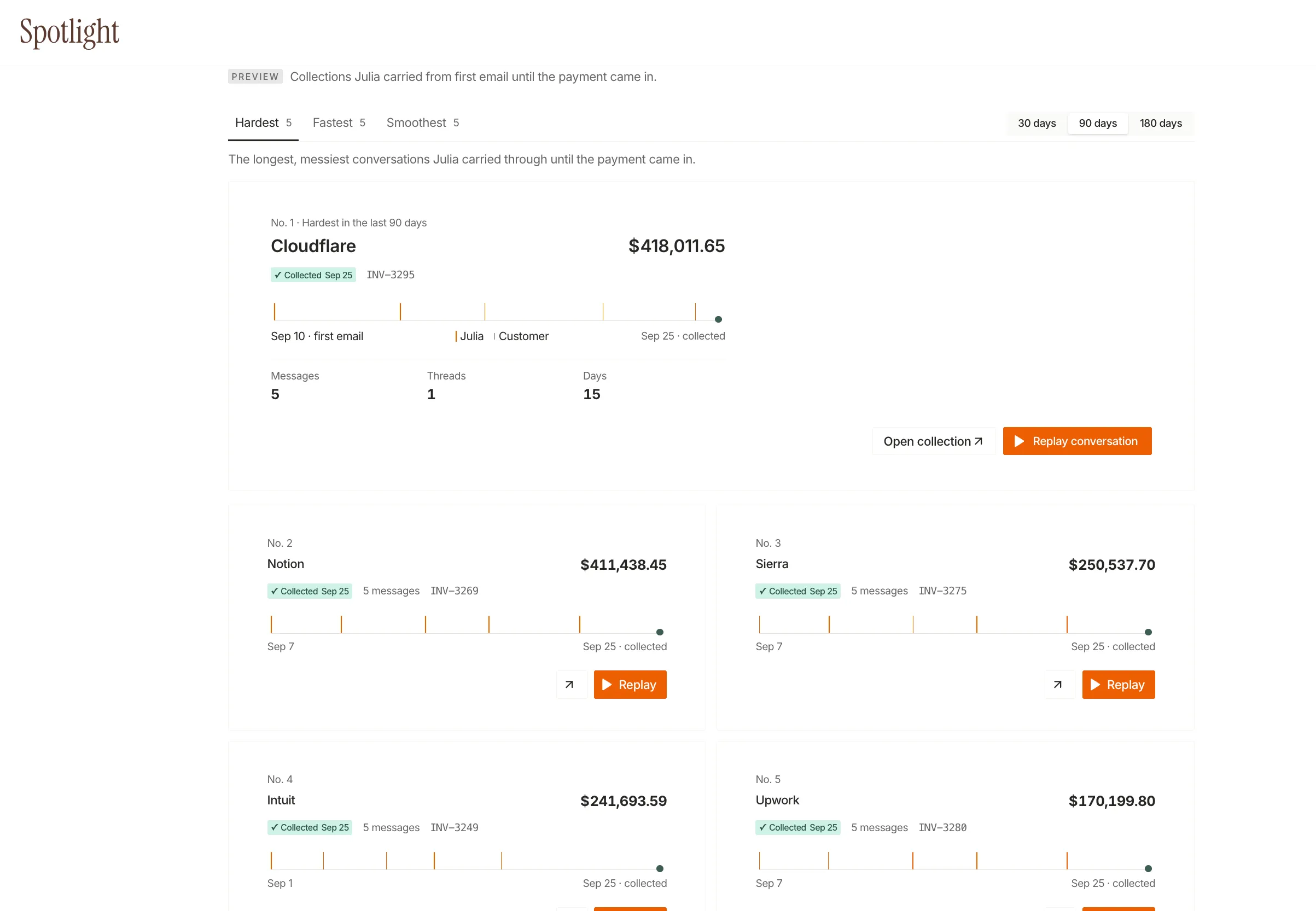
Spotlight is where that work becomes reviewable. It shows the collections Julia has verified, with redesigned cards and a replay of each one: the activity, who it went to and the email as it was formatted. It opens with the hardest collections from the last 90 days, so the first thing a reviewer sees is the work that took the most judgment.
For the reasoning behind Julia’s design, see Meet Julia and Can AI Email My Customers Safely?.
Where should you start?
Pick ten collections from last month, weighted toward the hardest ones, and replay each from first message to payment. Write down anything you would have done differently. If the list is short and specific, turn each item into a playbook or Knowledge change. If the list is long, keep drafts in review mode until it shrinks.
Repeat the review after every major playbook change. Over time, the audit becomes a short monthly habit instead of a project.
Frequently Asked Questions
How do you audit an AI collections agent?
Replay individual collections from start to finish: the account activity, who each message went to, the email as it was sent and how the customer responded. Focus on the hardest cases, such as disputes, large balances and changed contacts.
What is a verified collection?
A verified collection is an invoice the agent worked that ended in payment, packaged so a person can review the full path. In Monk, Spotlight shows the collections Julia has verified.
How often should we review AI-sent collections emails?
Weekly in the first weeks after launch, then monthly on a focused sample once the team is confident. Add a review after any customer complaint or playbook change.
Can I review emails before the AI sends them?
Yes. In Monk you can review every draft before it sends or turn on auto-send, and anything uncertain is drafted for review instead of sent.
What is the difference between auditing and measuring an AI agent?
Measuring looks at totals, such as how much the agent collected on its own. Auditing looks at single collections to confirm the messages and decisions were right.
Does Monk log every action the agent takes?
Yes. Every agent action is logged and auditable, so you can see who did what and when.
Which collections does Spotlight show first?
Spotlight opens with the hardest collections from the last 90 days, so reviewers start with the work that took the most judgment.