Which Collections Follow-Up Gets Invoices Paid: Email, Calls or Your Team?
Break collected cash down by the follow-up before payment: emails, calls, your team or none. See what each group tells you and how Monk reports it.
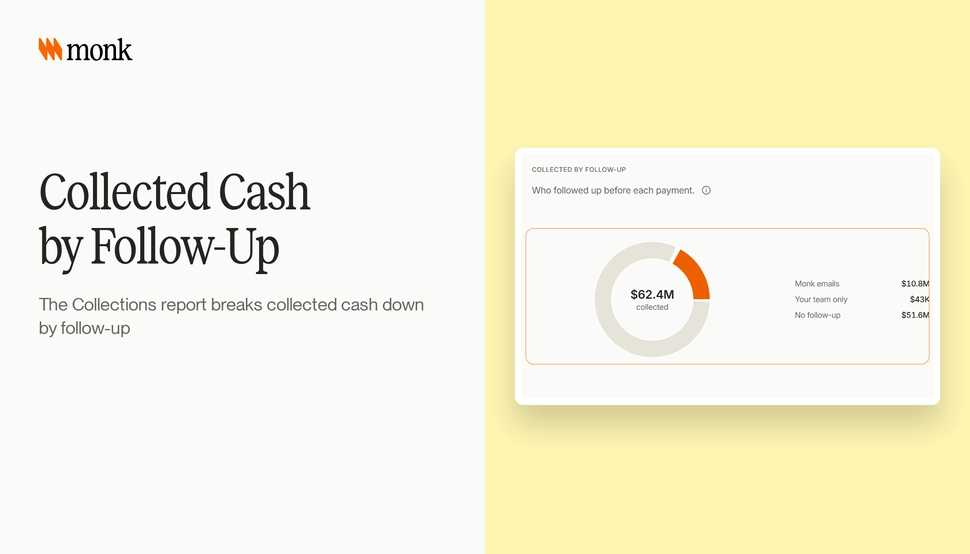
Break your collected cash down by the follow-up that came before each payment. Put every paid dollar in one of five groups: paid after automated emails, paid after automated calls, paid after automation and your team both worked it, paid after only your team worked it, or paid with no follow-up at all. That split tells you which channel is doing the work, where your team’s time goes and how much cash would have come in anyway. In Monk, the Collections report now shows collected cash grouped this way, with a note on the chart that explains what counts.
Explore collected cash by follow-up
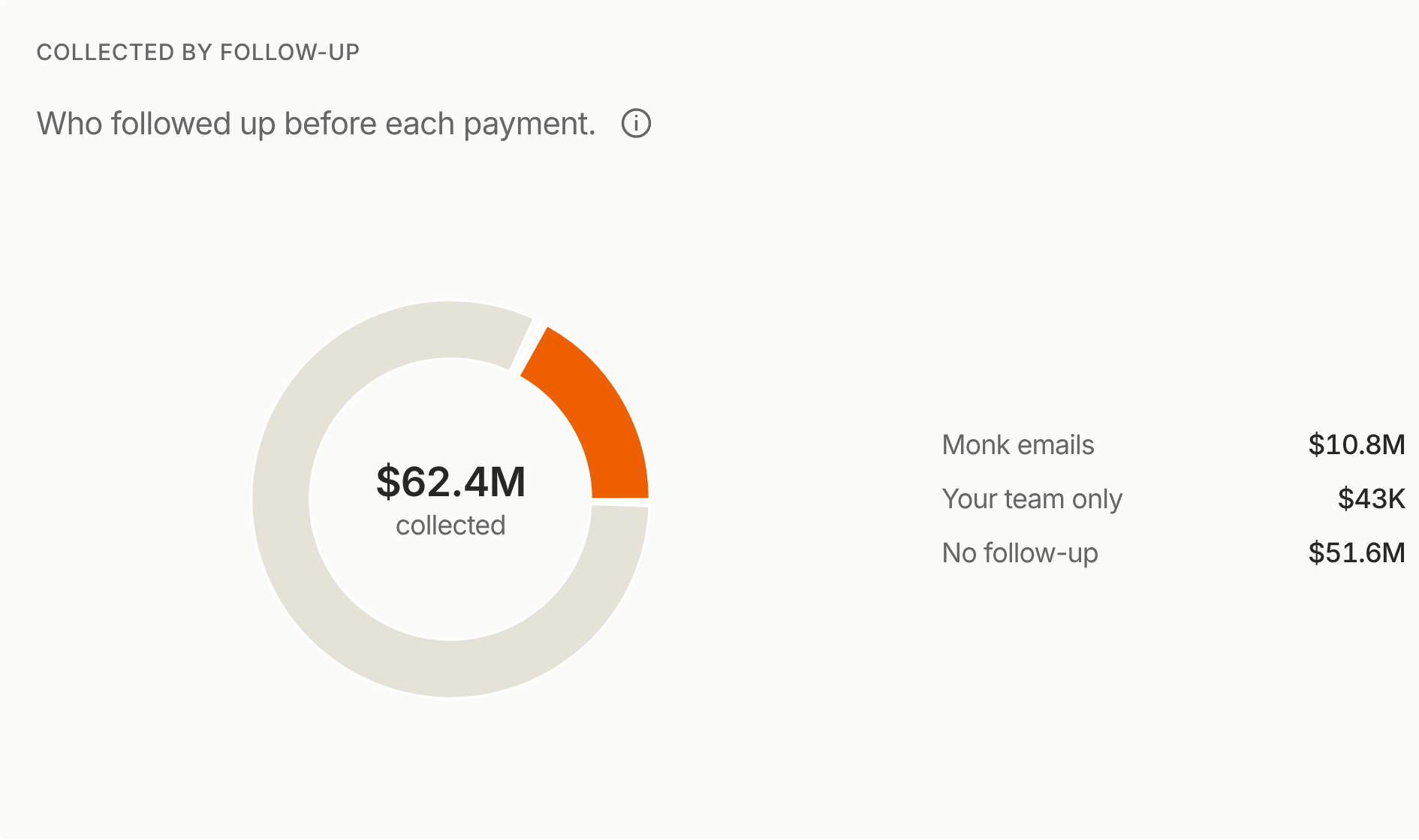
Start with the total collected cash in the Collections report.
The orange segment shows cash collected after Monk emails.
Read the amount beside Monk emails and compare it with the other follow-up groups.
Why isn’t “total collected” enough?
Total collected tells you how much cash came in. It does not tell you why.
Some invoices get paid on time with no reminder. Some get paid after one email. Some need a call, and some need your controller to get on the phone with the customer’s AP lead. If you lump all of that into one number, you can’t answer the questions that matter when you plan next quarter:
- Is automation collecting cash, or just sending messages?
- Are calls worth turning on for more accounts?
- How much of your team’s week goes to invoices that automation could handle?
- How much cash shows up with no follow-up at all?
Activity counts don’t answer these either. Emails sent and calls placed measure effort. Collected cash by follow-up measures results.
What are the five follow-up groups?
| Group | What it means | What it tells you |
|---|---|---|
| Monk emails | Paid after automated email follow-up | How much cash email collects on its own |
| Monk calls | Paid after automated calls | What voice adds beyond email |
| Monk and your team | Paid after both automation and a person worked it | Where your team steps in on harder accounts |
| Your team only | Paid after only your team followed up | Work that may be a candidate for automation |
| No follow-up | Paid with no follow-up | Your baseline of customers who pay on their own |
The “no follow-up” group matters more than it looks. It is your baseline. If a large share of cash shows up there, a good part of your book pays on its own, and your follow-up effort should go to the rest.
How should you read the split?
Look at the trend month over month, not a single snapshot. Here is a hypothetical example for a team collecting $4 million in a month:
| Group | Collected | Share |
|---|---|---|
| Monk emails | $1.6M | 40% |
| Monk calls | $0.4M | 10% |
| Monk and your team | $0.8M | 20% |
| Your team only | $0.4M | 10% |
| No follow-up | $0.8M | 20% |
In this example, automation alone touched half of collected cash. Another 20% needed a person on top of automation, which is where your team’s judgment earns its keep. The 10% your team handled alone is the first place to look: if those accounts follow a pattern, write it down as guidance and let automation take the first pass.
Three patterns are worth acting on:
- “Your team only” is growing. Your team may be taking accounts automation could handle. Check which customers are in that group and why.
- “Monk and your team” is large on a few accounts. Those are your hard accounts. Give them an owner and a clear escalation path.
- “Monk calls” is small but calls are on. Check which accounts get calls. Calls may be going to the wrong part of the book.
Isn’t this the same as agent attribution?
It’s related, but it answers a different question. Agent attribution, covered in How to Know if Your AI Collections Agent Is Working, asks whether the agent or a person collected the money. Collected cash by follow-up adds the channel: email or calls. Use attribution to judge the agent. Use the follow-up split to decide where to spend: which channels to turn on, for which customers, and how to staff your team.
How does this connect to ROI?
Most AR automation ROI models start with hours saved. Hours matter, but the CFO question is cash. When you can show how much collected cash followed automated email, how much followed automated calls and how much needed your team, the ROI conversation moves from “we sent more reminders” to “here is the cash each channel brought in.”
Teams using Monk see DSO drop by more than 40%. The follow-up split shows where in your own book that comes from. For a full ROI model, see AR Automation ROI.
How does Monk report it?
Monk is an AI-native accounts receivable platform. Julia, Monk’s AI collections email agent, and Ryan, Monk’s opt-in AI voice agent, run follow-ups, and your team works alongside them in the same system. Because every email, call and manual touch lives in one place, Monk can tie each payment to the follow-up that came before it.
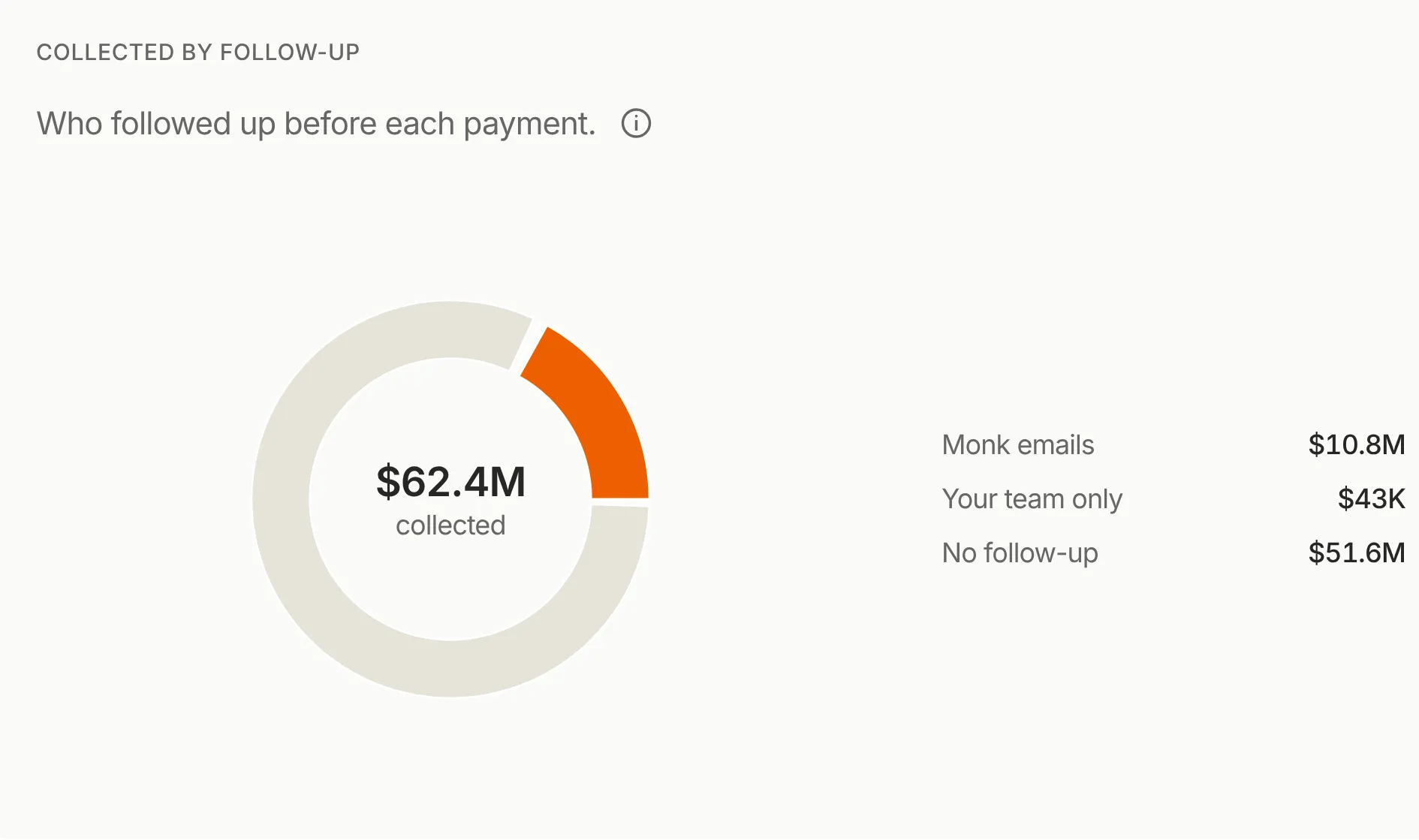
As of the November 1 - 15 release, the Collections report breaks collected cash down by follow-up: Monk emails, Monk calls, Monk and your team, your team only, or no follow-up. The chart explains what counts in each group.
The same release added other reporting views that help you act on the split:
- Save shared, named filter views on All Invoices, including a rolling “due in the next N days” range
- See outstanding balance and oldest open invoice age in the Customers table and CSV export
- See outstanding balances by aging bucket on customer overviews
Where should you start?
Pull last quarter’s collected cash and split it into the five groups. Then do three things:
- Note your “no follow-up” share. That is your baseline.
- List the top 20 customers in “your team only.” Look for a pattern you can turn into guidance for automation.
- Bring the split to your next finance review alongside DSO. It explains the DSO number.
Frequently Asked Questions
What is collected cash by follow-up?
It is your collected cash grouped by the follow-up that came before each payment: automated emails, automated calls, automation and your team together, your team only, or no follow-up.
Why track cash with no follow-up?
It is your baseline. It shows how much of your book pays on its own, so you can focus follow-up effort on the rest.
How is this different from emails sent or calls made?
Emails sent and calls made measure effort. Collected cash by follow-up measures how much cash came in after each kind of follow-up.
Does Monk show collected cash by follow-up?
Yes. As of the November 1 - 15 release, the Collections report breaks collected cash down by Monk emails, Monk calls, Monk and your team, your team only, and no follow-up. The chart explains what counts.
How does this help with AR automation ROI?
It ties collected cash to each channel, so you can show what automation brought in rather than only how many hours it saved.
Should I turn on calls for every account?
Not by default. Look at what calls collect compared with email, then turn calls on for the accounts where email alone isn’t getting paid.
Who are Julia and Ryan?
Julia is Monk’s AI collections email agent. Ryan is Monk’s AI voice agent, which is opt-in.