The Fragmentation Tax: How Tool Sprawl and Siloed Data Drain Cash‑Flow Velocity

What Is the Fragmentation Tax on Cash Flow?
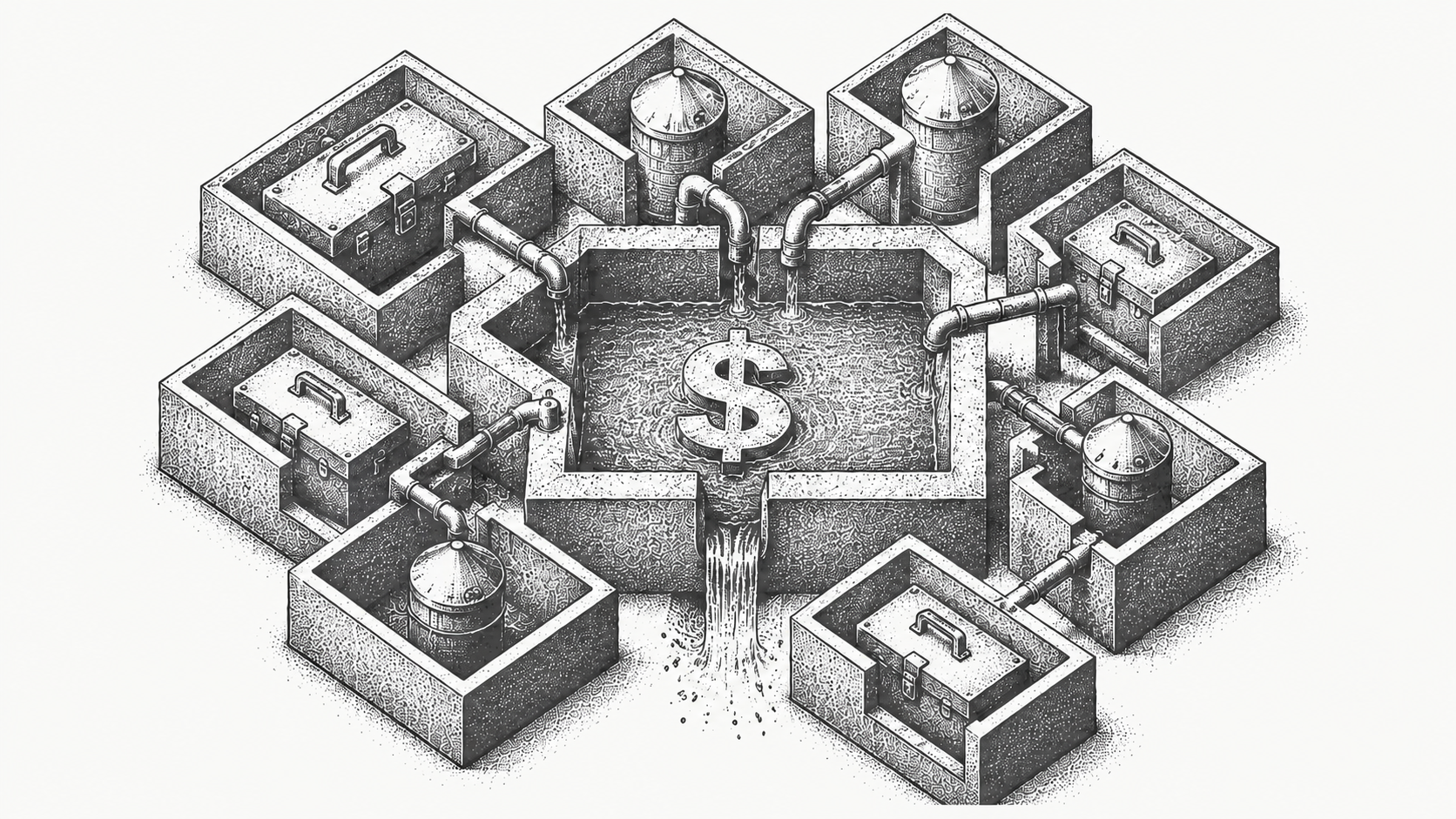
The fragmentation tax is the hidden cost a business pays when its mission-critical accounts receivable workflows live across too many disconnected systems, forcing people to rebuild context and reconcile exceptions by hand. Every time a finance team toggles between a CRM, a billing tool, an inbox, and a spreadsheet to work a single invoice, it loses time and lets cash sit still. That drag never appears on a dashboard, which is exactly why it is so corrosive: it quietly slows cash-flow velocity and inflates DSO. For the foundation behind why this happens, start with Monk's overview of what accounts receivable automation is.
Where Does the Tax Show Up in AR?
The fragmentation tax is not abstract; it accrues at specific, identifiable stages of the invoice-to-cash cycle. Each disconnect adds latency and leakage. The table below maps the most common symptoms of tool sprawl to the cost they impose on cash flow.
| Symptom of tool sprawl | Cost to cash flow |
|---|---|
| Invoice data scattered across CRM, CLM, and billing systems | Rework and delayed invoices stretch DSO |
| Siloed portal credentials force manual re-keying into AP portals like Coupa and Ariba | Time lost per invoice, plus late-payment penalties |
| Collections owners and contact data drift between teams | Duplicate or missed follow-ups lead to write-offs |
| Bank files, ledgers, and contract data fail to sync | Analyst time lost and cash trapped in suspense |
| Edge cases like usage true-ups and credit memos handled by hand | The hardest cases balloon into a disproportionate share of the workload |
Every row describes a place where data has to be moved or matched by a human because two systems do not talk. The cash-trapped-in-suspense row is especially costly, and it is the exact problem solved by one-day cash application. Those handoffs multiply as a company adds more point tools to patch each new gap.
Why Does Fragmentation Compound on Cash-Flow Velocity?
Cash-flow velocity is the number of days from contract signature to funds cleared, and fragmentation makes its delays stack multiplicatively rather than adding up neatly. A few days chasing a missing PO, a day queued for portal entry, back-and-forth on a customer query, and a couple of days to reconcile a mismatch each look small in isolation.
Strung together, those small delays quietly turn a Net 30 invoice into a Net 45 or Net 50 collection, and across thousands of invoices the working-capital drag becomes substantial. A CFO feels this as higher borrowing costs, less reliable cash forecasting, and pressure on vendor terms, none of which trace obviously back to the real culprit. This is the same dynamic Monk argues makes lowering DSO so valuable, covered in its piece on why reducing DSO is the highest-leverage move a finance team can make.
Why Can't Legacy Automation Fix It?
It is tempting to assume that adding automation to each tool solves the problem, but bolting deterministic rules onto individual sub-steps tends to fail in three predictable ways. Schemas change as new usage metrics or tax lines appear, counterparty behavior shifts when a buyer adds a new approver, and data routinely arrives dirty with mismatched identifiers between systems. The same brittleness explains why older bank-side fixes fall short, a tradeoff we unpack in our comparison of lockbox versus automated cash application.
When any of those happen, rule-based automation breaks and dumps the exception back onto a human, the very definition of the fragmentation tax. Partial automation can make the problem worse, because it handles the easy 80% and concentrates the hard, manual work into a smaller, more painful queue. The fix is a fundamentally unified architecture.
How Does an AI-Native, Unified Stack Remove the Tax?
The structural answer is to rebuild accounts receivable as a single, AI-native data layer rather than a chain of disconnected tools. That means hardened, first-class integrations to the systems finance already runs, a unified model that maps contracts to invoices to payments to communication threads, and autonomous agents that work the messy cases as default paths instead of exceptions.
This is exactly how Monk is built. Its intelligent collections ingests the context of each customer conversation and responds more effectively than standard dunning, at a 24% higher response rate, while AI-native cash application matches payments the moment they arrive at an 80% automatic match rate, rising to 95% with suggested rules so cash stops sitting in suspense. Profound is a clear example: by automating its submissions to Coupa, Ariba, and 11 Fortune 500 AP portals on Monk, it grew cash-on-hand 122% in the first month, cut its aging balance 5x, and saved three incremental headcount, as the Profound case study details. Because it connects natively to Salesforce, NetSuite, QuickBooks, HubSpot, Stripe, and Anrok, plus AP portals like Coupa and Ariba, the handoffs that generate the tax simply disappear. You can see the unified design on the Monk automation platform.
How Do You Calculate Your Own Fragmentation Tax?
You can estimate the tax with a simple five-step audit that converts an invisible drag into a number you can act on.
| Step | What to measure |
|---|---|
| Inventory the stack | Count every distinct app that touches invoice-to-cash |
| Measure toggles | Sample analyst screens and record context switches per workflow |
| Track exception rate | The share of invoices requiring manual intervention |
| Quantify the delay delta | Actual payment date minus contractual due date |
| Assign cost | Labor hours times loaded rate, plus cost of capital on delay days, plus write-offs |
Those five steps turn a vague sense that "things are slow" into a defensible figure you can put in front of a board, and a baseline against which you measure any consolidation effort.
What Should CFOs and RevOps Leaders Take Away?
The core lesson is that fragmentation is not a tooling nuisance; it is a cash-flow siphon that hides inside everyday workflows. Partial automation amplifies it, AI-native architecture beats add-on AI, and speed matters because every extra day of DSO carries a real working-capital cost. The teams that win re-platform the whole invoice-to-cash process rather than retrofitting copilots onto a fragmented stack.
Monk is built for exactly that consolidation, and the results are consistent across $2B+ in receivables under management: a 40% average reduction in DSO, 90% of collections resolved with zero human intervention, and 26 hours saved per month, all under SOC 2 controls and without Monk taking a percentage of revenue. Go-live takes less than one week, so the freed cash starts showing up quickly. You can explore the full picture on the Monk platform.
Frequently Asked Questions
What is the fragmentation tax in finance?
It is the hidden economic cost paid when mission-critical workflows live across too many disconnected systems. In accounts receivable, contract, billing, collections, and reconciliation data are scattered, so people rebuild context and reconcile exceptions by hand, slowing every dollar moving from invoice to cash.
How does tool sprawl hurt cash-flow velocity?
Each hop between disconnected apps breaks context and adds hours or days of delay. Those delays compound across thousands of invoices, quietly stretching Net 30 terms toward Net 45 to 50, raising DSO, and tying up working capital.
Why can legacy automation not fix the fragmentation tax?
Traditional tools bolt deterministic rules onto each sub-step, so they break when schemas change, counterparty behavior shifts, or data arrives dirty. The result is brittle automation that dumps exceptions back on humans, which is the very definition of the fragmentation tax.
How does an AI-native invoice-to-cash platform remove the tax?
Monk rebuilds accounts receivable as a single AI-native data model with hardened integrations, automated reconciliation, and autonomous agents that chase, escalate, and close the loop. Humans review only genuine edge escalations, which eliminates the manual context switching that creates the tax.
How can I measure my own fragmentation tax?
Inventory every app touching invoice-to-cash, sample analyst context switches per workflow, track the share of invoices needing manual intervention, and measure the delay between due date and actual payment. Then assign labor, cost-of-capital, and write-off costs to reach a total.
Does consolidating tools mean ripping out my ERP?
No. Monk connects to the systems you already run, including NetSuite, QuickBooks, Salesforce, and Stripe, rather than replacing them. It acts as the unifying invoice-to-cash layer on top, so the freed cash does not require a rip-and-replace project.
How quickly can a team see the tax shrink?
Monk goes live in less than one week, so the manual handoffs start disappearing almost immediately. Many teams see cash-on-hand gains within the first quarter as suspense balances clear and follow-up becomes automatic.
Ready to stop paying the fragmentation tax? Explore the Monk platform or book a demo to size the tax against your own stack.
Worth reading next: From Invoice to Cash in Days: Compressing the Cycle and What Is Cash Flow Velocity? A 2026 Guide.



.avif)