How Do You Check What's Behind a 13-Week Cash Forecast?
A cash forecast is only useful if you can see what's behind it. Learn how to trace each projected receipt to invoices, and why future bills belong in the forecast.
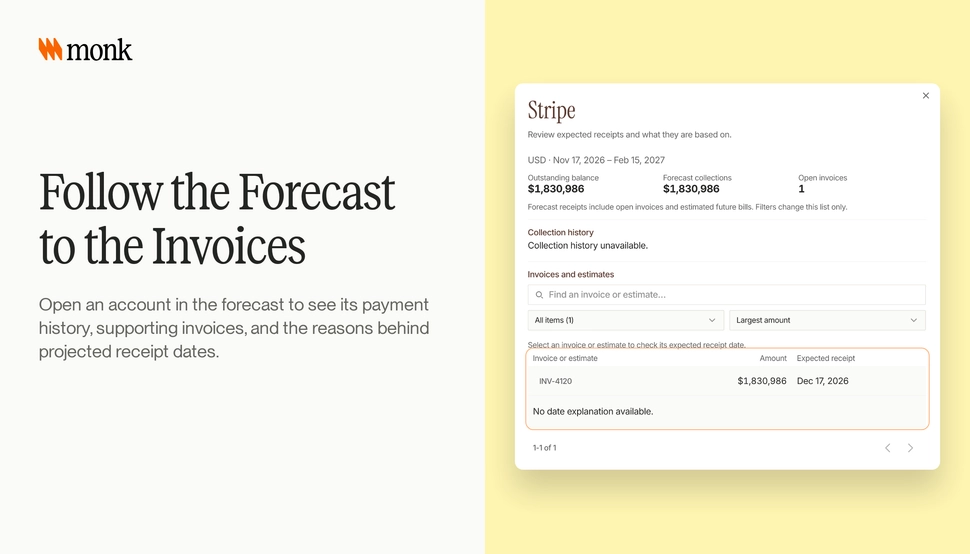
Open the forecast one account at a time and look at three things: the customer’s payment history, the invoices that make up the projected amount and the reason behind each projected receipt date. If you can’t see those, you can’t defend the number in a finance review. A good forecast also includes bills you haven’t sent yet when a customer’s invoice history shows a steady pattern, so weeks six through thirteen aren’t understated. In Monk, the 13-week cash forecast now does both: you can open any account to see its supporting invoices and reasons, and the forecast estimates future bills when recent history supports it.
Explore the forecast invoice detail
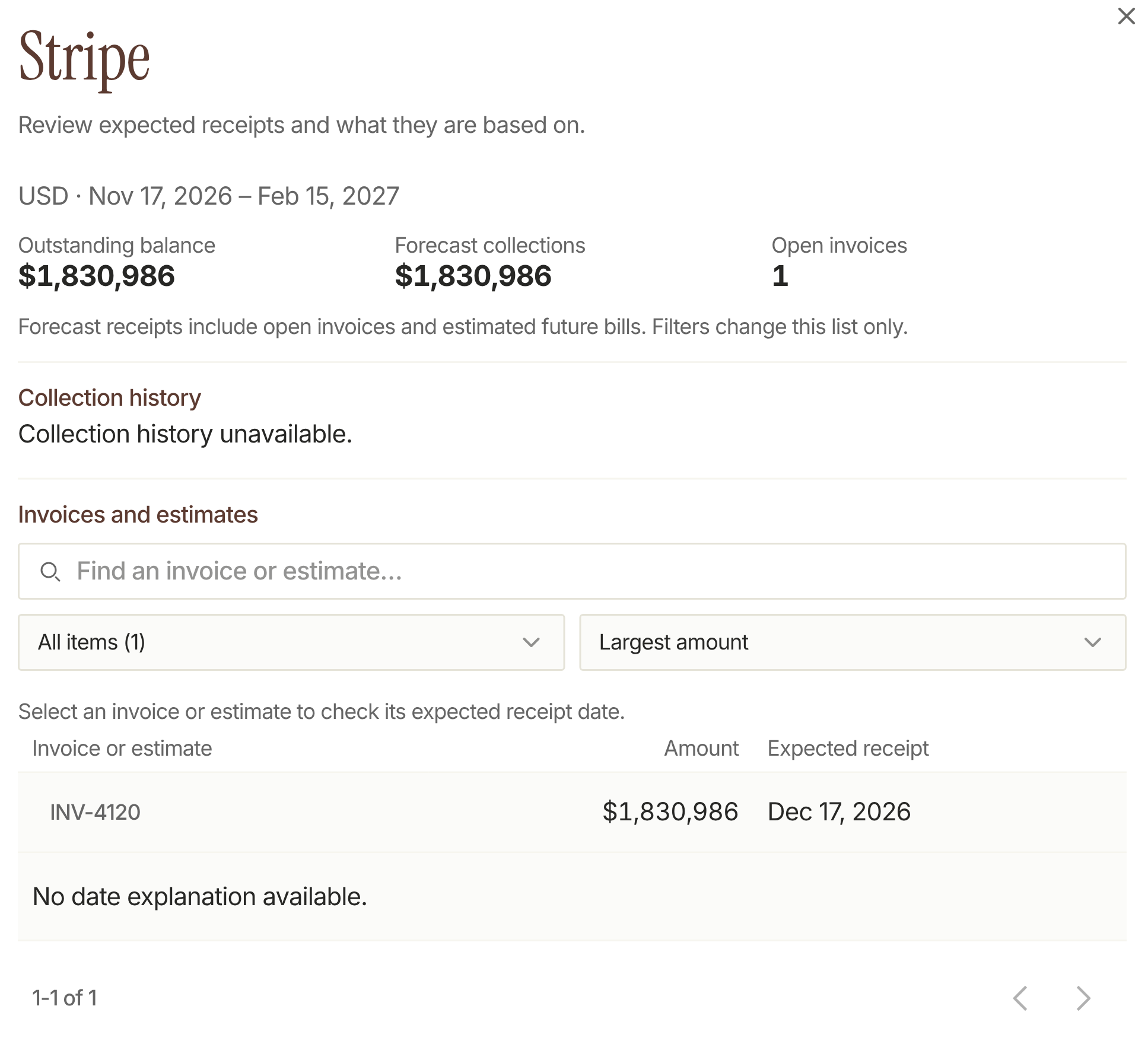
Start with the account's forecast collections and open invoices.
Invoice INV-4120 shows $1,830,986 with an expected receipt date.
The expected receipt date is Dec 17, 2026.
Why do forecasts lose trust?
Most AR forecasts fail in the same two ways.
They’re a black box. The forecast says $2.1 million lands in week four. Your CFO asks which customers that includes. If the answer takes a spreadsheet export and an afternoon, people stop using the forecast.
They only see open invoices. A forecast built only on open AR looks fine for the next few weeks, then falls off a cliff. Week ten looks light, not because cash won’t come in, but because the invoices that will produce it don’t exist yet.
Monk wrote about the first problem in The Real Reason Your AR Forecast Is Always Wrong. This post covers how to check a forecast line by line, and when to include bills you haven’t sent.
What should you be able to see for each account?
| What to check | Why it matters |
|---|---|
| Payment history | Shows how this customer has paid in the past: on time, late, in batches |
| Supporting invoices | Ties the projected amount to real invoices you can open |
| Reason for the projected date | Explains why cash is expected that week and not another |
| Future bills, if included | Shows when part of the projection comes from expected billing, not open invoices |
If any of these is missing, the forecast is a guess you have to take on trust.
When should future bills go into the forecast?
Include future bills when a customer’s recent invoice history shows a steady pattern. A customer billed the same amount on the first of every month for the past year will almost certainly be billed again next month. Leaving that out makes the back half of your forecast too low.
Leave future bills out when the pattern isn’t there: one-off projects, usage that swings month to month or new customers with little history. Guessing at those adds noise.
Here is a hypothetical example. A SaaS customer has been invoiced $30,000 on the first of each month for 14 months and pays in about 35 days. A forecast that only uses open AR shows nothing from this customer after week six. A forecast that includes future bills shows roughly $30,000 landing about five weeks after each expected bill date, which is the cash you’ll actually plan around.
How do you review the forecast each week?
Use a short routine:
- Start with the biggest weeks. Open the accounts that make up most of the projected cash.
- Check the reasons. Does the projected date match how the customer pays? If a customer always pays in batches at month end, the date should reflect that.
- Separate open invoices from future bills. Know how much of each week depends on billing that hasn’t happened yet.
- Search for the outliers. Look for any single invoice large enough to move a week on its own.
- Compare last week’s forecast with actuals. Note which accounts landed early or late.
This takes minutes when the forecast shows its work, and hours when it doesn’t.
Which AR platforms forecast collections at 30, 60 and 90 days?
Several AR platforms offer collections forecasting. When you compare them, ask four questions:
- Does the forecast cover a full 13 weeks, or only the next few?
- Can you open any account and see the invoices behind the number?
- Does it explain why a receipt is expected on a given date?
- Does it account for bills you haven’t sent yet?
A forecast that answers yes to all four is one your finance team can use in a board meeting. For a broader comparison, see Best Cash Flow Forecasting Software.
How does Monk handle this?
Monk is an AI-native accounts receivable platform that runs collections and cash application in one system. Because the forecast sits on the same data as your collections conversations and payments, it can use how each customer actually pays.
As of the November 1 - 15 release:
- Future bills in the cash forecast. The 13-week cash forecast includes estimates of future bills when recent invoice history shows a steady pattern.
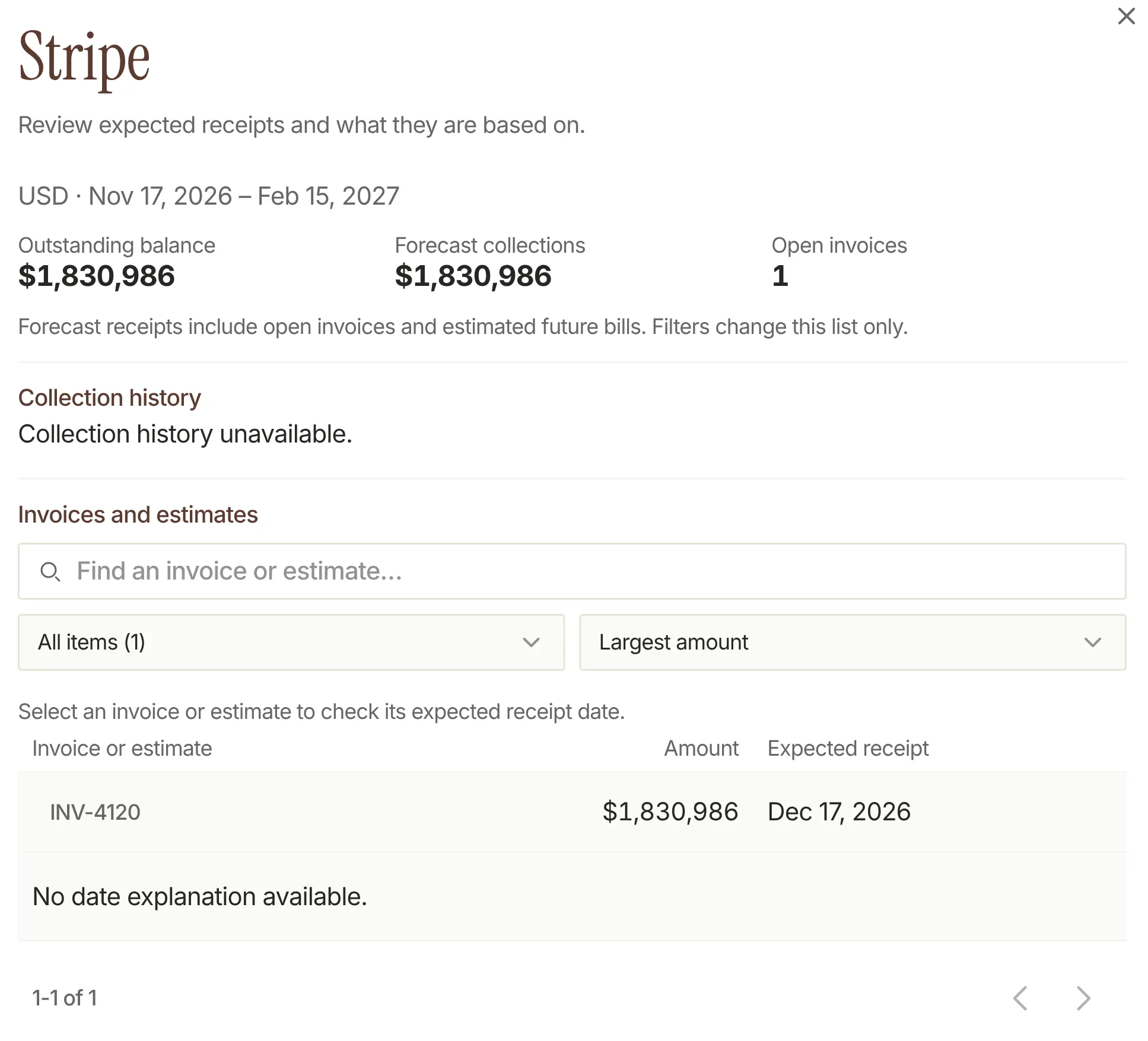
- Follow the forecast to the invoices. Open an account in the forecast to see its payment history, supporting invoices and the reasons behind projected receipt dates.
- Search. Search across eligible accounts and within their invoices to find the amounts you need to review.
The same release added outstanding balance and oldest open invoice age to the Customers table and CSV export, and outstanding balances by aging bucket on customer overviews. For background on how the forecast works, see Cash Forecast 2.0 and the cash forecasting page.
Where should you start?
Take your current 13-week forecast and pick the three largest weeks. For each, open the top five accounts. If you can’t see the invoices and the reason behind each date in under a minute, that is the gap to fix before the next finance review.
Frequently Asked Questions
What is a 13-week cash forecast?
It is a week-by-week projection of cash coming in over the next quarter. Finance teams use it to plan payroll, spending and financing.
How do you check if a cash forecast is accurate?
Open each large account and check its payment history, supporting invoices and the reason for the projected date. Then compare last week’s forecast with what actually arrived.
Should a cash forecast include invoices that haven’t been sent yet?
Yes, when a customer’s recent invoice history shows a steady pattern. Otherwise the later weeks of the forecast will be too low.
Does Monk’s forecast include future bills?
Yes. As of the November 1 - 15 release, Monk’s 13-week cash forecast includes estimates of future bills when recent invoice history shows a steady pattern.
Can I see which invoices make up a forecast in Monk?
Yes. Open an account in the forecast to see its payment history, supporting invoices and the reasons behind projected receipt dates.
Can I search the forecast?
Yes. You can search across eligible accounts and within their invoices.
How often should I review the forecast?
Weekly. Start with the largest weeks and compare the prior week’s forecast with actuals.