From Contract to Cash in Days: Compressing the Cycle

Why Does Invoice-to-Cash Speed Matter So Much?
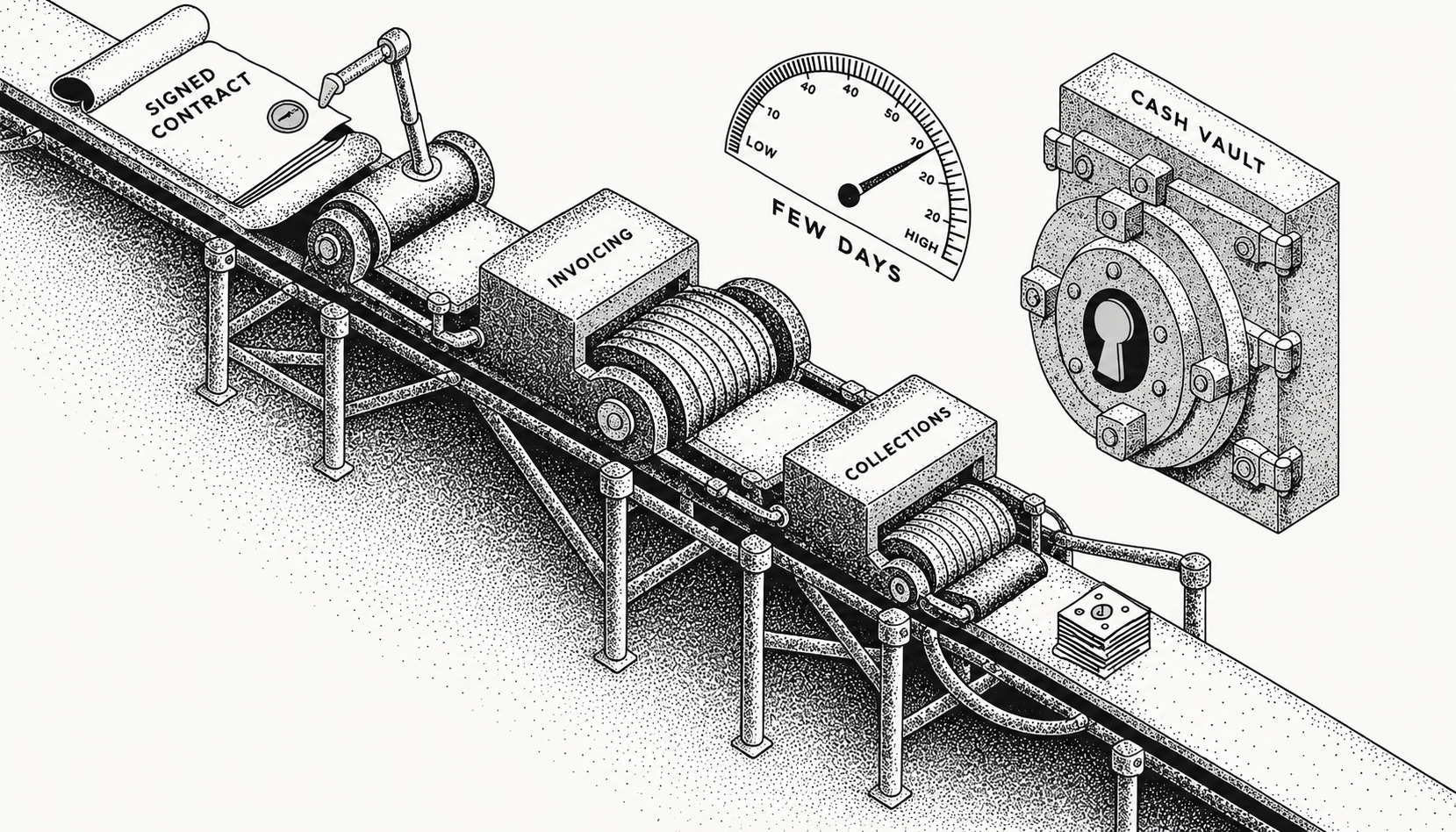
Speed is a competitive weapon. The faster revenue moves from a signed contract to cleared funds, the more working capital a company has for growth, hiring, and runway without dilution. Traditional invoice-to-cash cycles drag for 40 to 60 days, while AI-native, agentic finance stacks compress that window to under 20. The metric that captures it is cash flow velocity, the number of days from contract signature to cleared cash, and it is a sharper measure than DSO because it includes everything that happens before an invoice even goes out.
Most of what gets sold as AR automation never touches the places where the cycle actually leaks, which is the core argument behind Monk's approach to accounts receivable automation. This post covers where the days leak across the pipeline, the working-capital economics of compressing them, why rules-based tooling stalls on the hard cases, and how an AI-native invoice-to-cash platform attacks the full cycle rather than one slice of it.
Where Does the Invoice-to-Cash Cycle Leak Days?
The delay is spread across the whole pipeline, not just collections, which is exactly why DSO alone understates the problem. Each stage adds latency, and because the stages hand off between different systems and teams, the gaps compound rather than simply add up.
| Stage | Typical delay | Root cause |
|---|---|---|
| Contract ops | 3-10 days | Red-line cycles, manual approval routing |
| Billing prep | 1-14 days | Reconciling CRM, CPQ, and ERP data |
| Invoice dispatch / portals | 0-7 days | Portal schema mismatches, missing PO lines |
| Collections | 10-30+ days | Fixed dunning, stale contacts, partial payments |
| Cash application | 1-5 days | Blank remittances, unmatched payments |
Fragmentation adds latency at every hop. The more systems a deal touches between signature and cash, the more handoffs there are to stall it, and the more places an exception can hide. A single missing PO line can park an otherwise healthy invoice in an AP portal for a week before anyone notices it never posted. Collections gets the blame because it is the most visible stage, but the days lost upstream in contract ops and billing are often just as costly and far easier to recover.
What Are the Economics of Compressing the Cycle?
Every day removed from the cycle returns capital you have already earned. Freeing working capital trapped in receivables is the heart of a liquidity-efficient finance stack: it funds headcount before dilution, reduces revolver draws, and sends a valuation signal, because investors reward fast cash conversion. The math is straightforward: a company billing $50M a year frees roughly $137K of cash for every single day it shaves off the average cycle, and most teams have ten or more days to recover.
There is a second-order benefit that rarely shows up in a spreadsheet. When cash arrives predictably, finance can forecast with confidence, which means fewer surprise revolver draws and less cash held idle as a buffer against uncertainty. Predictability, not just speed, is what lets a growing company commit to hiring and spend plans without flinching.
Monk customers see this play out directly. Across the roughly $2B+ in receivables Monk manages, customers report a 40% average reduction in DSO and a 2.4x average increase in cash on hand in the first quarter, while saving an average of 26 hours per month. For the full model behind those numbers, the team's guide to automating accounts receivable for finance leaders walks through the assumptions step by step.
Why Does Legacy Automation Hit a Wall?
Rules-based workflows handle sunny-day scenarios but break on edge cases: usage-based overage caps, multi-currency true-ups, portal rejections for split tax lines, and credit-rebill sequences after a mid-term upsell. Each exception loops back to an analyst, draining time and hiding inside DSO averages where it is hard to spot.
This is the gap that keeps the cycle long no matter how many reminders you send. Monk's own analysis found that roughly 39% of cash-flow slowdowns trace back to predictable, recurring exceptions rather than to customers who will not pay. If your tooling cannot reason through those exceptions, it cannot meaningfully compress the cycle, it can only nag faster.
The deeper issue is that legacy automation treats the cycle as a set of disconnected steps. A billing tool optimizes billing, a dunning tool optimizes reminders, and a reconciliation tool optimizes matching, but none of them sees the whole journey from signature to cash. When an upsell changes the contract mid-term, that change has to ripple through every system by hand, and each manual touch is another place for days to leak back in. Compression comes from collapsing those steps into one connected workflow, not from making each silo individually faster.
How Does AI-Native AR Compress the Cycle?
AI-native AR attacks both halves of the cycle instead of bolting reminders onto the end. Upstream, it ingests contracts and generates invoices straight from the negotiated terms, so billing does not wait on manual data entry or a reconciliation between CRM, CPQ, and ERP.
Downstream, Monk's intelligent collections replaces fixed dunning with context-aware outreach that ingests the history of each conversation and adapts tone per customer, which monk.com reports is 24% more effective than standard dunning. It submits cleanly into AP portals like Coupa and Ariba, applies incoming cash automatically at an 80% automatic match rate, rising to 95% with suggested rules, and resolves 90% of collections with zero human intervention, surfacing only the genuine exceptions to a person. Because the platform layers onto existing systems, most teams go live in one to three days. To see how the pieces connect end to end, explore the Monk platform.
As Lucas Czajka at Pump put it: "At Pump, we manage $25M in volume across 1,500+ customers, and before Monk, a huge part of collections was still manual. The product is extremely customizable and has already helped us collect over $10M in just the last couple of months."
How Should You Sequence an Invoice-to-Cash Overhaul?
Start by mapping where your own cycle actually leaks rather than assuming it is all in collections. Pull a sample of recent deals and timestamp each stage, from signature to billing to dispatch to cash applied, and the bottleneck usually reveals itself within a dozen examples. This diagnostic mirrors the audit step in Monk's CFO playbook for the AI-native era.
From there, connect your source systems so the platform can see contracts, invoices, and payments in one place, then let automation handle the clean cases while routing exceptions to your team. Monk connects to the tools finance already runs, including Salesforce, NetSuite, QuickBooks, HubSpot, Stripe, and Anrok, which is why this tends to feel like an upgrade rather than a migration. The compounding effect, faster billing plus smarter collections plus automatic cash application, is what takes a 40-to-60-day cycle under 20.
Frequently Asked Questions
What is the invoice-to-cash cycle?
It is the full path from a signed contract to cleared cash: contract ops, billing, invoice dispatch, collections, and cash application. Its speed is measured by cash flow velocity, the days from signature to cleared funds.
How long should it take?
Traditional cycles run 40 to 60 days. AI-native stacks compress that to under 20 by removing manual handoffs across the whole cycle rather than just speeding up reminders.
Why isn't DSO enough to measure it?
DSO starts at invoice issue, so it ignores pre-invoice delays in contract ops and billing. Cash flow velocity captures the entire cycle from signature to cleared cash.
How does Monk compress the cycle?
It generates invoices from contract terms, runs context-aware collections that submit into AP portals like Coupa and Ariba, and applies cash automatically at an 80% automatic match rate, rising to 95% with suggested rules, resolving 90% of collections with zero human intervention.
What results do Monk customers see?
A 40% average reduction in DSO, a 2.4x average increase in cash on hand in the first quarter, and 26 hours saved per month, across roughly $2B+ in receivables under management.
What usually causes the longest delays?
Predictable, recurring exceptions account for about 39% of cash-flow slowdowns, according to Monk's analysis. Surfacing and resolving those exceptions early is where the biggest time savings come from.
How quickly can a team get started?
Monk's typical go-live is one to three days because it layers onto existing systems with SOC 2 controls in place, rather than requiring a full migration.
Ready to compress your cycle? Book a demo.
Related reading: What Is Cash Flow Velocity? A 2026 Guide and The Fragmentation Tax: How Tool Sprawl and Siloed Data Drain Cash‑Flow Velocity.





.avif)