Introducing Cash Application 2.0

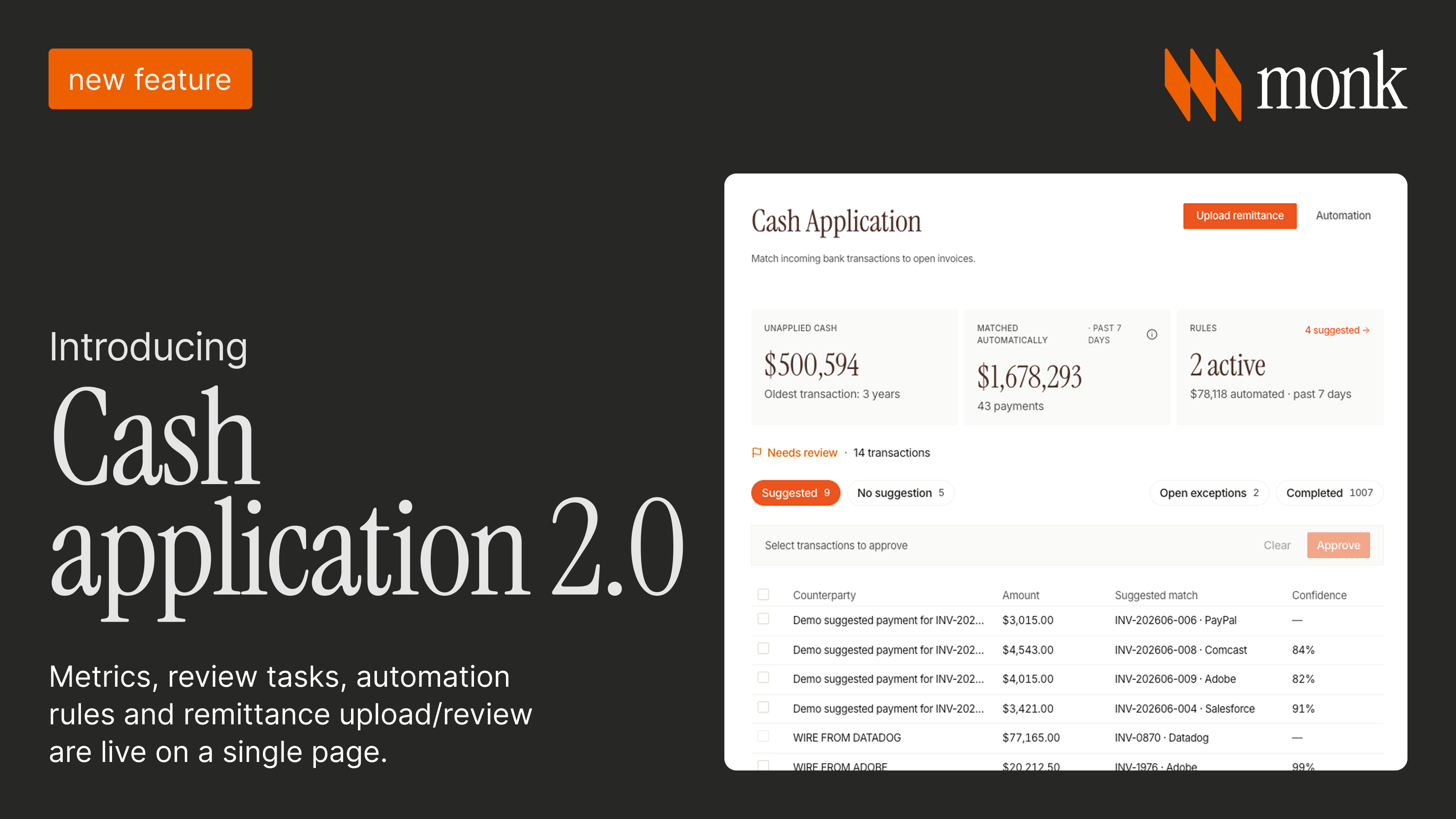
Cash application is one of the least glamorous jobs in finance, and one of the harder engineering problems behind it. Picture thousands of data points a day, checks, wires, ACH, and lumped lockbox deposits, set against hundreds of open invoices, and someone on a finance team trying to match one to the other before the aging report goes stale. It is messy by default. That is also exactly why it is a good fit for AI.
This week we shipped two things: a single home for cash application in Monk, and lockbox and check capture that recovers the matching detail your bank feed throws away. Here is what changed and the thinking underneath it.
The detail you need is gone before the money lands
Most cash application setups pull transactions from a bank feed like Plaid or Mercury. The problem is that by the time a payment reaches your bank, the detail you need to match it to an invoice has already been stripped out.
A lockbox deposit is the clearest example. It shows up as one aggregated transaction when it was really six separate customer payments. Nothing in the feed tells you that, and it is the kind of discrepancy a finance team will not catch on an aging report. So the payment sits unmatched, the invoices stay open, and the cash looks later than it is.
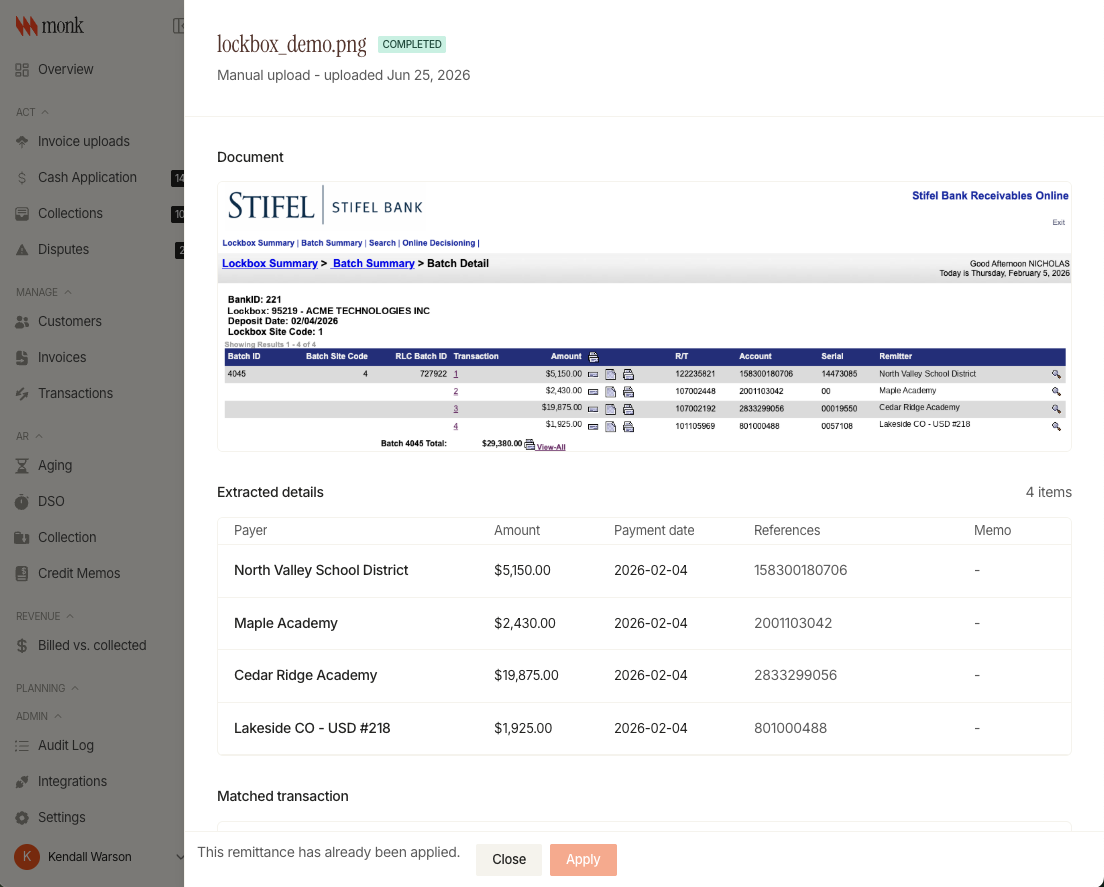
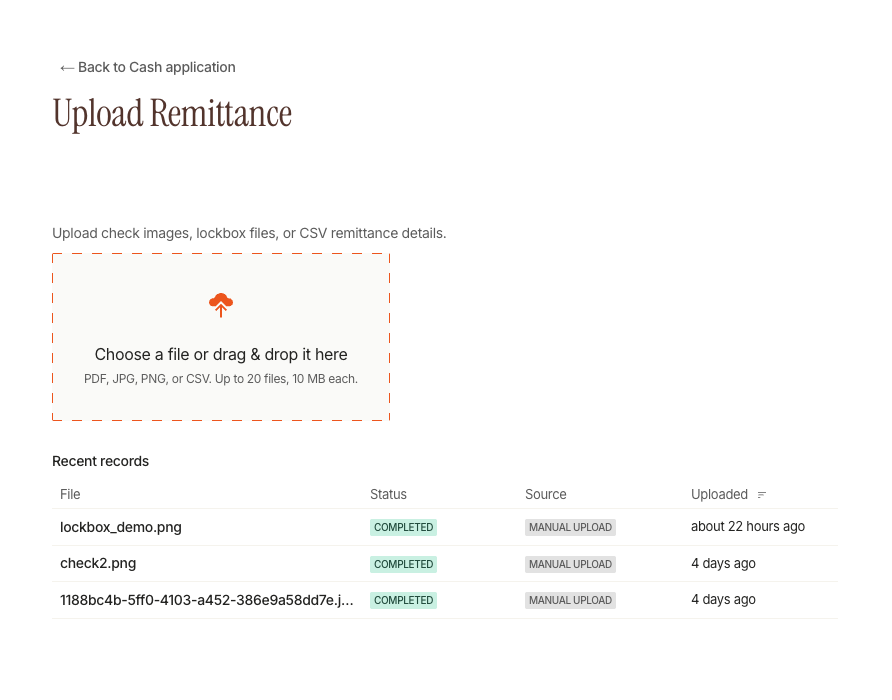
Customers can now upload lockbox files and images of checks. Monk extracts the data, enriches the existing transaction with what the bank feed dropped, and the match rate climbs substantially as a result.
How do Monk's three matching tiers work?
Financial data has to be accurate every time, so we did not put it behind a single model. We built three tiers, each with a different tolerance for risk.
Tier one, deterministic matches. When there is 100% confidence, the payment is matched automatically, no LLM involved.
Tier two, custom rules. Customers set their own deterministic, non-LLM rules for the patterns specific to their business, and Monk now suggests the rules to turn on based on the patterns it observes.
Tier three, the agent. A background agent runs daily over transaction and invoice data and makes predictions from patterns, handling the messy cases the first two tiers cannot encode.
The agent learns from every manual match a human makes, stores that context per customer, and gets better over time. Match rate today is around 80% and trending up. And because this is finance, every match shows its reasoning and keeps a full audit trail you can review. We want to show our work and show customers how each decision was made.
The result is that instead of hours of manual reconciling, the agent handles most of it and surfaces the edge cases for a person to review. Finance gets to spend its time on forecasting and the health of the business instead of tying out deposits.
One page for cash application
Cash application used to live across a few different surfaces in Monk. Metrics in one place, review tasks in another, automation rules somewhere else. We pulled all of it onto a single page: metrics, review tasks, automation rules, and remittance upload and review, together.
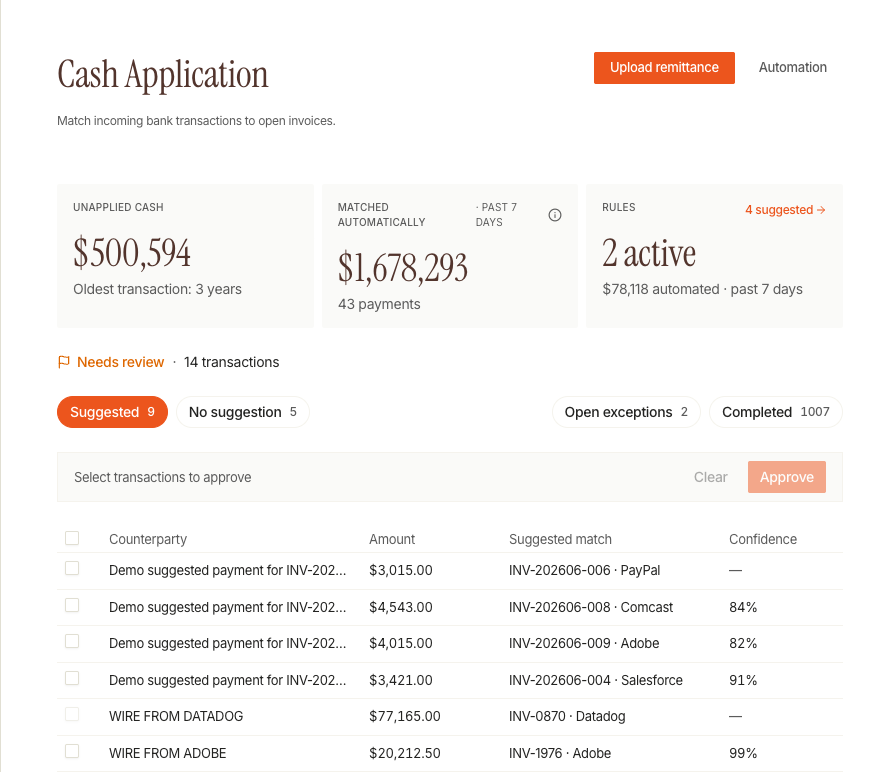
A few things worth calling out on the new page:
- Metric cards that make automation rules visible and give a clear read on the ROI Monk's cash application is generating.
- Bulk approve for AI-suggested matches. Select the clean matches and approve them in one click. To stay on the safe side, bulk approve only applies when the amount matches 100%. Anything with an over or short delta has to be opened and approved individually, on purpose.
- Faster loading. Transactions now page in server-side, so the done tab loads quickly even across thousands of tasks.
Individual detail review uses the same components as before, so nothing changes about a flow your team already knows.
Available now
The new cash application page, plus lockbox and check upload, are live this week for Monk customers. If you are still matching payments by hand, this is the one to try.
And if you build agentic workflows yourself, we think about this stuff constantly: where deterministic rules end, where the agent should take over, and how much autonomy is the right amount when the data is financial.
Frequently Asked Questions
What is cash application?
Cash application is the process of matching incoming payments, such as checks, wires, ACH, and lockbox deposits, to the open invoices they pay off, so a business knows exactly what has been collected and what is still outstanding.
How does Monk automate cash application?
Monk uses three tiers. Deterministic matches handle anything it can confirm at 100% confidence with no LLM. Customers can add their own non-LLM rules, and Monk suggests new ones from the patterns it sees. A background agent then runs daily, learns from every manual match a person makes, and predicts matches for the messier cases.
Can Monk process lockbox files and check images?
Yes. Customers can upload lockbox files and images of checks directly in Monk. Monk extracts the data, enriches the bank transaction with the detail the feed dropped, and uses it to improve the match rate.
Why is a bank feed not enough on its own?
By the time a payment reaches your bank feed, the detail needed to match it to an invoice is often stripped out. A lockbox that was really six separate customer payments can post as one lumped transaction, which finance teams rarely catch on an aging report.
How accurate is Monk's matching?
Monk's match rate is around 80% today and trending up as the agent learns from each customer's data. Every match shows its reasoning and keeps a full audit trail you can review.
What is bulk approve?
Bulk approve lets you select clean AI-suggested matches and approve them in one click. As a safeguard, it only applies when the amount matches 100%. Anything with an over or short delta must be opened and approved individually.
Book a demo to see cash application in action, or see how Monk handles exceptions.
Related reading: Upload Remittances: Recover the Payment Detail Your Bank Feed Throws Away, Lockbox vs Automated Cash Application, Multi-File Remittance Uploads Are Now Live in Monk and Cash Application Rules That Build Themselves.





.avif)