What Is Remittance Matching?

What Is Remittance Matching?
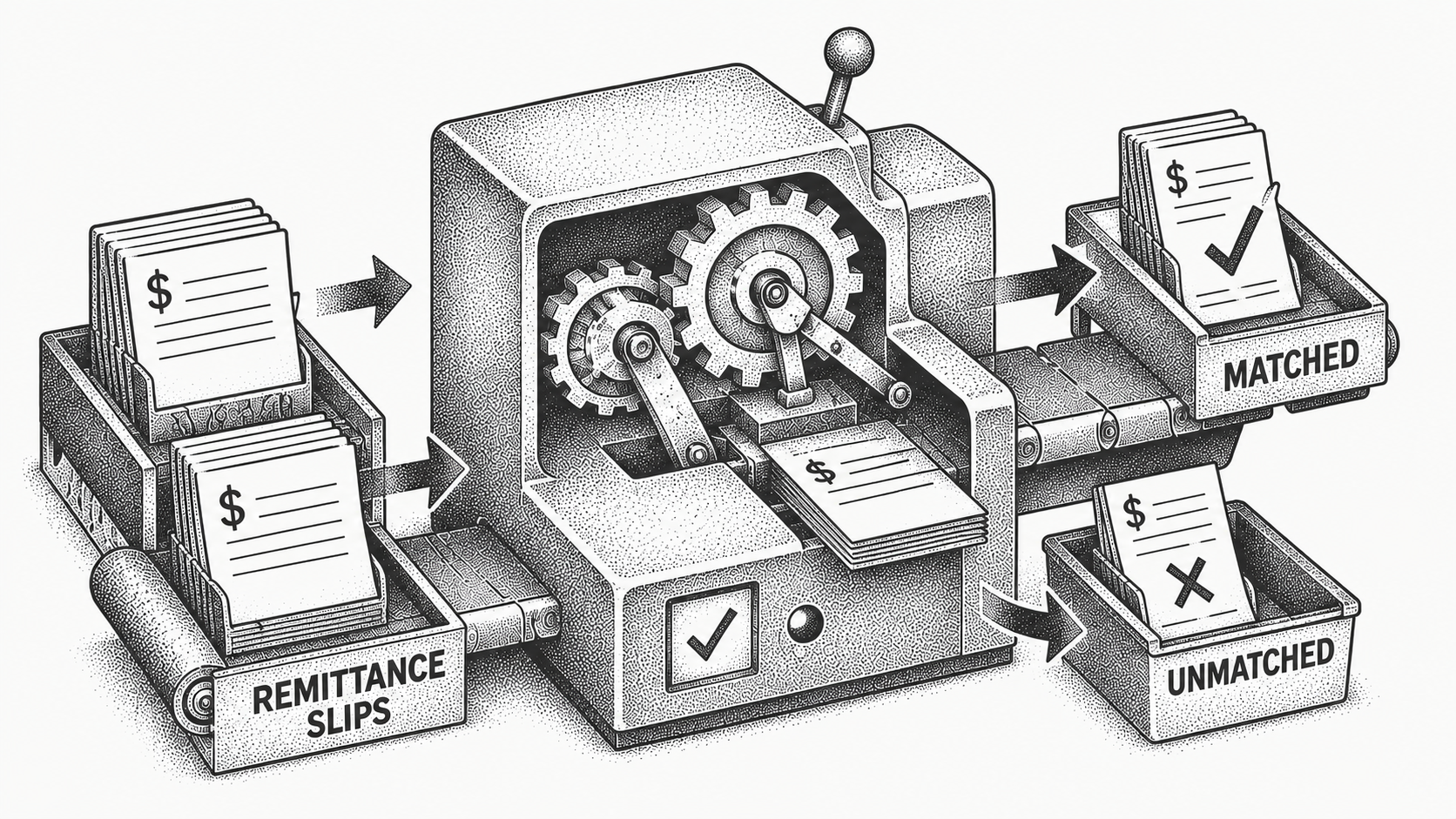
Remittance matching is the process of linking an incoming customer payment to the specific open invoices it is intended to settle. It answers a deceptively simple question: which invoices did this payment actually pay? Customers often pay several invoices in one lump sum, take deductions, or send the payment and the remittance advice through different channels, so matching the money to the right invoices is rarely automatic. Getting it right is the heart of accurate cash application and a clean accounts receivable ledger.
When that question is answered quickly and correctly, cash is applied, accounts are reconciled, and finance teams see an accurate picture of what is still outstanding. When it is answered slowly or wrongly, the aging report drifts from reality and the whole receivables function works off bad data. Monk automates this step as part of its AI-native cash application, reaching an 80% automatic match rate, up to 95% with suggested rules, and for the broader context, our overview of what accounts receivable automation covers is a useful companion.
What Is Remittance Advice and How Does It Relate to Matching?
Remittance advice is the document or message a customer sends to explain what a payment covers. It is the key that unlocks the match.
It typically lists invoice numbers, amounts paid against each, and any deductions or adjustments. Remittance matching is the act of taking that advice and reconciling it against the open invoices in your AR ledger so each invoice is marked paid for the correct amount. The challenge is that remittance advice arrives in many forms: an email attachment, a PDF, a line in a bank file, a note inside an AP portal, or sometimes nothing at all. Each format has to be read and interpreted differently, and customers rarely standardize on one. When the advice is missing entirely, teams have to infer the match from the payment amount and the customer's open balances, which is slow, error-prone, and only gets harder as the customer's invoice history grows.
What Are the Most Common Remittance Advice Formats?
A single customer might send remittance advice as an email body one month, a scanned PDF the next, and a line item inside a bank file the month after that. Larger customers frequently route payment through an AP automation portal, such as Coupa or Ariba, which adds another format to track. A finance team supporting a broad customer base can realistically expect to see five or six different remittance formats in a single week, and each one requires a slightly different process to extract the invoice numbers and amounts it contains.
How Does the Remittance Matching Process Work?
At a high level, remittance matching follows a consistent sequence regardless of how the payment arrives. The table below shows the typical flow from receipt to applied cash, along with where each step tends to break down.
- Pull the payment detail out of the bank feed. Record the amount, value date, payer name, and every reference field the bank passes through, including the addenda records on an ACH or wire. Those fields often carry the invoice number outright, which closes the match with no further lookup.
- Find the remittance advice that belongs to that payment. Search the AR inbox, the customer's AP portal, and any lockbox file for advice matching the payer and amount within a few days either side of the value date. Payment and advice travel separately most of the time, so this reunion step is where the bulk of manual matching time goes.
- Reconcile the advice line by line against open invoices. Check every invoice number on the advice against the ledger and confirm the amount paid on each line rather than trusting that the total ties out. A total that agrees can still hide two offsetting errors, such as an overpayment on one invoice and a short pay on another.
- Work payments with no advice from the amount upward. When nothing arrives, test the payment total against combinations of that customer's open invoices, then against invoice totals minus standard discounts or that customer's known deduction amounts. If no combination fits, ask the AP contact for a breakdown before parking the cash in a suspense account.
- Separate the true exceptions and give each one an owner. Short pays, unexplained deductions, overpayments, and references to invoices that were revised or credited each need a named owner and a due date. Everything that matched cleanly should post immediately instead of waiting behind them.
- Post the cash and close the invoices the same day. Apply matched payments in the ERP, mark those invoices paid, and let the aging report refresh before collections runs its next queue. Cash left unapplied overnight shows up as an overdue balance that your team then chases in error.
| Step | What happens | Common challenge |
|---|---|---|
| Capture payment | Record the incoming amount from bank or portal | Payment and remittance arrive separately |
| Locate remittance | Find the advice that explains the payment | Advice is missing or in an unstructured format |
| Match to invoices | Link the payment to specific open invoices | One payment covers many invoices |
| Handle exceptions | Resolve short pays, deductions, overpayments | Requires investigation and approvals |
| Apply cash | Mark invoices paid and update the ledger | Manual posting delays visibility |
Why Does Remittance Matching Matter for Cash Application?
Remittance matching is the step that makes cash application accurate. Cash application is the broader process of recording customer payments against receivables, and matching is what determines exactly which receivables get cleared.
If matching is wrong, invoices stay open when they are actually paid, or get marked paid in the wrong amount, which corrupts your aging report and triggers unnecessary collections calls. The errors also compound: an unmatched payment inflates DSO, the inflated DSO drives collections toward phantom balances, and the wasted effort means genuinely overdue accounts get less attention. Accurate matching also protects customer relationships, because chasing a customer for an invoice they already paid damages trust and wastes your team's time. Clean matching means collections focuses only on genuinely overdue balances, which is why matching and collections work best as one connected workflow rather than two disconnected tools. The downstream cost of getting this wrong is laid out in our look at the hidden costs of poor cash application.
What Makes Remittance Matching Difficult?
Several recurring problems make manual matching slow. None of them is exotic; they are the everyday reality of how customers pay.
Payments and remittance advice often travel separately, so the two have to be reunited before any matching can happen. Customers pay in bulk, take partial deductions, reference old or incorrect invoice numbers, and send advice in dozens of inconsistent formats, and each of these forces an analyst to stop and investigate. Volume compounds the difficulty: a growing business can receive hundreds of payments a day across checks, ACH, wires, and card, each potentially covering many invoices. Manual lookups across email inboxes, bank portals, and spreadsheets do not scale, which is why matching is one of the most time-consuming tasks in AR.
Consider a typical scenario: a customer sends one wire covering four separate invoices, applies a small deduction for a damaged shipment on one of them, and references an old invoice number that was since revised. Untangling that single payment can take an analyst twenty minutes or more, and a mid-sized AR team can see dozens of similarly tangled payments in a single week. Multiplied across a growing customer base, matching alone can consume a meaningful share of a team's total capacity.
How Does Automation Improve Remittance Matching?
AI-native automation improves remittance matching by reading remittance advice from any source, including emails, PDFs, bank files, and AP portals like Coupa and Ariba, then matching the captured detail to open invoices automatically. Instead of an analyst hunting for the advice and keying in matches, the system reconnects payments with their advice, proposes matches, and flags only the true exceptions for human review.
The difference from rules-based tools is that an AI-native engine reads the actual context of each remittance rather than depending on a fixed rule set that fails when a format changes. Monk is an AI-native invoice-to-cash platform that automates remittance matching as part of cash application, pulling remittance data from AP portals and applying payments at scale. Teams using Monk save an average of 26 hours per month of manual work and cut DSO by 40%, and matched cash flows into the ERP through native integrations with systems like NetSuite, QuickBooks, and Stripe. The full picture of moving off manual work is covered in our guide to stopping manual payment matching.
How Accurate Is Automated Remittance Matching?
Automated matching is most accurate when the system can read both structured and unstructured remittance data and resolve the common exception patterns automatically. Accuracy is the whole point, because a fast match that is wrong creates more work than no match at all.
High-quality automation matches the large majority of payments straight through, applies cash without human touch, and routes only genuine exceptions, such as unexplained short pays, to an analyst. Monk reaches an 80% automatic cash application match rate, rising to 95% once teams enable suggested rules and resolves 90% of collections with zero human intervention, which keeps the ledger current and frees the team for higher-value work. Accuracy also improves cash visibility: when payments are matched and applied promptly, the cash projection reflects reality, so finance leaders can plan with confidence rather than guessing how much of the receivables balance has already been collected. You can see how matching works at monk.
How Quickly Can a Team Automate Remittance Matching?
Go-live for Monk typically takes less than one week because the platform connects to existing bank, billing, and ERP systems rather than replacing them. Matching begins as soon as those connections are live, and there is no percentage-of-collections fee, so the cost structure does not shift as more cash gets matched automatically.
Monk is also SOC 2 Type II compliant, which helps finance and security teams move through vendor review quickly, often the longest part of any new system rollout. That combination of a fast technical setup and a compliance posture that clears procurement without delay is why teams can move from manual matching to automated matching in about a week from first conversation to live payments.
Frequently Asked Questions
Common questions about remittance matching and how it fits into cash application.
What is remittance matching?
Remittance matching is the process of linking an incoming customer payment to the specific open invoices it is meant to pay, using the remittance advice that accompanies the payment. It is the core accuracy step within cash application.
What is the difference between remittance matching and cash application?
Cash application is the full process of recording customer payments against receivables. Remittance matching is the specific step that determines which invoices a payment clears, so it sits inside cash application.
Why is remittance matching difficult?
Payments and remittance advice often arrive separately and in inconsistent formats, customers pay many invoices at once or take deductions, and high volumes make manual lookups across emails, portals, and bank files hard to scale. Each unmatched payment becomes a small manual investigation.
Can remittance matching be automated?
Yes. AI-native automation reads remittance advice from emails, PDFs, bank files, and AP portals, then matches it to open invoices and flags only true exceptions. Monk automates this at an 80% automatic match rate, rising to 95% with suggested rules.
How does remittance matching affect cash flow visibility?
Accurate, timely matching keeps the AR ledger current so the cash projection reflects what has actually been collected. That gives finance leaders a reliable view of outstanding balances and incoming cash rather than a backlog of unapplied payments.
How quickly can a team automate remittance matching?
With Monk, go-live typically takes less than one week because it connects to existing bank, billing, and ERP systems rather than replacing them. Matching begins as soon as those connections are live, and Monk does not take a percentage of revenue.
Want to see automated remittance matching in action? Explore how Monk applies cash automatically or book a demo to map it to your systems.
Related reading: What Is Cash Application? [2026 Guide], How to Stop Manually Matching Payments: A Cash Application Automation Guide, Automated Payment Reconciliation: How It Works, Payment Reconciliation Software: A 2026 Guide and Payment Reconciliation Nightmares: 7 Scenarios That Break Manual Processes.


.avif)