The hidden cash problem: Post 10 of 10
1.10 Should You Build or Buy AR Automation?
Short answer: Buy, unless your billing is so unusual that no vendor can support it and you have engineers dedicated to maintaining an AR system. Most of the cost of building is the upkeep after launch, not the first version. The Buyer Guide lists the questions to ask vendors.
If you've read this far, you probably agree the problem is real, which leaves the question of whether to solve it yourself. The answer depends mostly on what you're optimizing for and how honest you are about your engineering team's bandwidth.
The build temptation
Building promises a perfect fit. Your contracts are complex and your ERP has custom fields, so off-the-shelf tools look too generic. The finance team asks for a custom integration and engineering scopes it. Six months later there's a half-working internal tool that one engineer understands and nobody has time to maintain.
The hidden costs of building
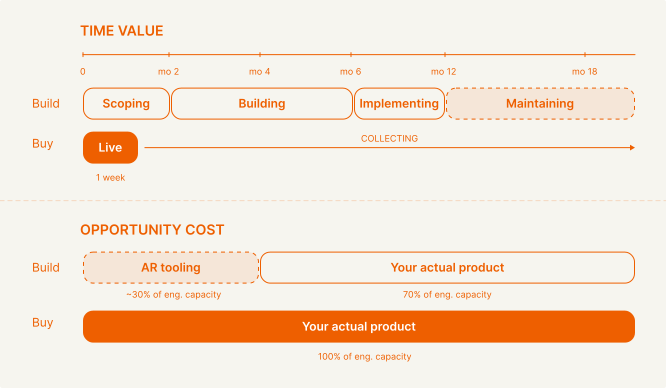
Most of the cost comes after the first version ships. Take a basic AR workflow built by two to four engineers over three to six months (an illustrative scenario, not an industry benchmark; the timeline and capacity split in the diagram are illustrative too, and real effort depends on scope, integrations and maintenance). Those engineers aren't working on your core product for that stretch.
After launch, integrations break when APIs change and data schemas drift, and a tool built around last year's edge cases starts failing on this year's. It also won't have the cross-customer pattern recognition a purpose-built platform develops over thousands of billing cycles.
When building makes sense
Build if no vendor can support your billing model, you have dedicated fintech infrastructure engineers, and AR automation is a real competitive advantage for your business, which is rare. Even then, it usually makes more sense to build on top of an existing platform than to start from scratch.
When buying makes sense
Buy if your customer base is growing and you run on standard systems like Stripe, NetSuite, QuickBooks or HubSpot. The same goes if you want to cut manual AR work without hiring an ML team to do it.
For most teams the harder work is the vendor evaluation itself: checking that a vendor can handle your actual billing complexity, works with the systems you already run, and will keep up as your customer base grows.
Part of a 10-post series on where B2B AR loses cash, stage by stage.