The hidden cash problem: Post 2 of 10
1.2 The Contract-to-Invoice Gap
Short answer: The contract-to-invoice gap is the distance between what a contract says and what gets billed. It opens when terms, usage data, PO numbers and billing entities have to be pulled together by hand from different systems, so invoices go out late or wrong.
An invoice needs the right commercial terms from a contract that might run thirty pages, plus usage data that probably lives in two or three different systems. Someone also has to know which entity to bill and which PO number to reference. Then it has to reach the right contact, accurately and on time, every billing cycle and often for hundreds of customers.
Most of the errors are small on their own, like a missing line item or a usage figure pulled from the wrong period. They add up fast, and they almost always surface after the invoice has gone out and the customer has flagged it.
Where the gap comes from
The failure points show up in the same few places:
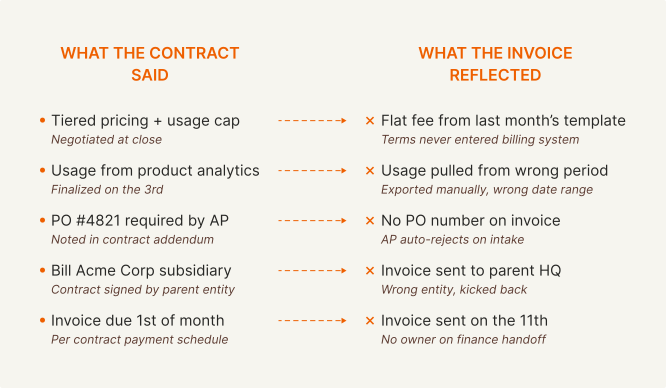
Why most tools don't solve it
Most AR software assumes the invoice already exists and only gets involved after it's sent. Creation happens somewhere else, usually in the ERP or by hand. Getting from the contract to the invoice ends up as a copy-paste job someone does at the end of the month with a deadline coming.
Tools that do attempt invoice automation handle the simple cases well enough: a flat monthly fee on net-30 terms, billed to one entity. They break on contracts with usage components or custom payment schedules, and especially on contracts amended mid-year. Handling those means reading the contract and working out what it actually obligates the customer to pay, which is a much harder problem than scheduling a recurring charge.
Up next: Post 3 covers the hardest version of this problem, usage-based billing, where the invoice depends on late, messy data from systems that were never built to talk to each other.
Part of a 10-post series on where B2B AR loses cash, stage by stage.