The hidden cash problem: Post 8 of 10
1.8 Cash Application = Closing the Loop
Most finance teams don't think much about the last stage of contract-to-cash until month-end, when someone spends two days matching payments to invoices by hand.
Cash application means linking each incoming payment to the invoice it pays. Done by hand, someone opens the bank statement and finds a wire with half a memo or none, then searches open invoices for a match before updating the ledger. At high invoice volume that's days of work, and it always lands right before close.
Why manual matching fails predictably
Most AR tools handle one payment matched exactly to one invoice, and stop there. A partial payment has no workflow, and neither does a single transfer covering several invoices or a payment sent under a subsidiary's name. Those sit unmatched, with the invoice still open, until someone resolves them by hand. For companies with enterprise customers, these cases make up a big share of each month's incoming payments, and most payment reconciliation software isn't built for them.
While they pile up, invoices paid days ago still show as outstanding on the aging report. Collections may keep chasing customers who already paid, and the reported cash position is wrong by whatever is sitting unmatched. Automating the match shortens the time from payment to closed invoice.
What automated cash application looks like
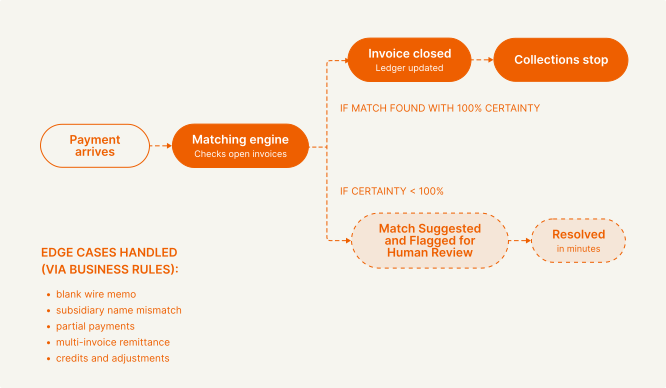
When a payment matches with confidence, automated cash application closes the invoice and updates the ledger, and collections on that invoice stop. Anything less certain goes to a person before the invoice is closed. That takes most of the work out of month-end reconciliation, though how fast the ambiguous payments get resolved still depends on what information came with them.
Up next: Post 9 pulls the series together into a one-page map of the AR lifecycle.
Part of a 10-post series on where B2B AR loses cash, stage by stage.