The hidden cash problem: Post 6 of 10
1.6 The Unreachable Contact Problem: Invoices That Never Reach AP
Short answer: An unreachable contact means the invoice went to a billing contact who left or an inbox that no longer works, so the customer may not know it is due. The fix is usually to find the current AP contact and resend the invoice.
Most overdue invoices get treated as a collections problem, on the assumption that the customer received the invoice and just needs a nudge to pay it. That assumption is wrong more often than most finance teams realize.
A common version has nothing to do with whether the customer wants to pay. The billing contact left the company and their inbox was deactivated. The sending system logged the invoice as delivered, nothing visibly bounced, and reminders kept going to the same dead address for weeks.
Why this stays hidden
Even when delivery signals exist, they rarely reach the AR workflow. A bounce might be logged in the sending system while the aging report shows nothing unusual. An invoice that was received looks exactly like one that could never have been delivered, so finance sends both the same reminders and escalations, and none of it works on an invoice nobody at the customer has seen.
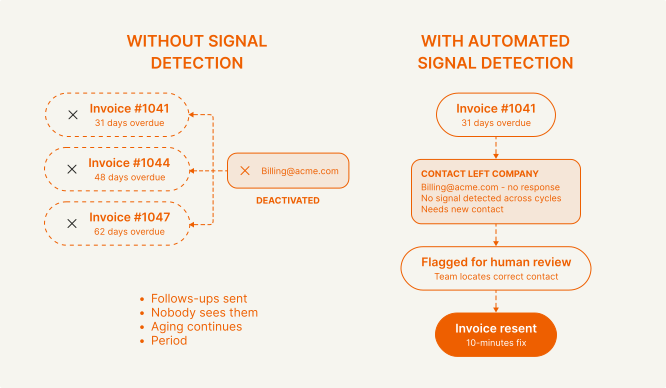
The fix is almost always a quick lookup
Finding the current AP contact and resending the invoice fixes the delivery failure, though payment still has to go through the customer's approval process. The lookup itself is quick. What it costs is the thirty or sixty days the invoice aged while reminders went to a dead inbox.
Across a large enough customer base, contact failures account for a material share of invoices sixty or more days past due, and the pattern is consistent enough to track on purpose. A bounced email or a deactivated domain is a signal, and so is a contact who has gone completely silent. A system can catch those without anyone reviewing them, as long as it's watching for them instead of queuing the next reminder.
Up next: Post 7 covers what intelligent collections looks like in practice, and why most automated collections is closer to a scheduled email than a real system.
Part of a 10-post series on where B2B AR loses cash, stage by stage.